Council on Foreign Relations
The Council on Foreign Relations (CFR) is a New York-based membership organization and think tank founded in 1921, known for convening influential political, business, and intellectual elites to discuss U.S. foreign policy. The Council on Foreign Relations appears in Archive investigations into elite institutional influence, particularly its role as a revolving door between private sector leadership and government foreign policy roles.
The Council on Foreign Relations (CFR) is a New York-based membership organization and think tank founded in 1921, known for convening influential political, business, and intellectual elites to discuss U.S. foreign policy. It publishes Foreign Affairs, one of the most prestigious international affairs journals, and hosts private meetings that include off-the-record discussions among government officials, corporate leaders, and academics. Its membership has consistently included a substantial proportion of U.S. cabinet officials, presidential advisers, and ambassadors across Democratic and Republican administrations.
- Source
- Wikimedia Commons
- Type
- Official Seal / Insignia
- License
- Public domain
- Photographer
- Council on Foreign Relations
Photo Information ▾
- Full name
- Council on Foreign Relations, Inc.
- Founded
- July 29, 1921, New York City
- Founding figures
- Elihu Root, John W. Davis, Paul Warburg, Isaiah Bowman, Allen Dulles, among others
- Type
- Non-profit membership organization, think tank, publisher
- Headquarters
- Harold Pratt House, 58 East 68th Street, Manhattan, New York
- Membership
- Approximately 5,000+ members (by invitation or nomination)
- Key publication
- Foreign Affairs (quarterly journal, founded 1922)
- Major early funders
- Rockefeller Foundation, Carnegie Corporation
- Tax status
- 501(c)(3) tax-exempt organization
- Notable presidents
- David Rockefeller (1970–1985), Richard N. Haass (2003–2023)
- Annual budget (recent)
- Approximately $80–90 million (as of 2020s)
- Washington office
- Opened 1990s
The Council on Foreign Relations appears in Archive investigations into elite institutional influence, particularly its role as a revolving door between private sector leadership and government foreign policy roles. Historical records document that the organization was founded with Rockefeller family financial backing and has maintained close institutional ties to Rockefeller philanthropic and business networks throughout its existence. The CFR's membership rosters overlap significantly with executive branch appointees, raising documented questions about the organization's influence on U.S. foreign policy formation. Its inclusion in Archive dossiers reflects its documented role in facilitating private discussion networks among political, financial, and academic elites, and the organization's treatment in historical scholarship examining post-World War I internationalist institutions and their relationship to American power structures.
Identity
The Council on Foreign Relations (CFR) is a membership-based organization and think tank established in 1921 and headquartered at the Harold Pratt House in Manhattan, New York. It describes itself as "an independent, nonpartisan membership organization, think tank, and publisher dedicated to being a resource for its members, government officials, business executives, journalists, educators and students, civic and religious leaders, and other interested citizens in order to help them better understand the world and the foreign policy choices facing the United States and other countries."
The CFR publishes Foreign Affairs, widely regarded as among the most influential journals on international relations and U.S. foreign policy. Membership is by invitation or nomination and includes senior government officials, corporate executives, academic scholars, journalists, and attorneys. Membership rosters have historically been confidential but have been leaked or published at various times; analyses of these rosters document that CFR members have occupied a disproportionate share of senior U.S. foreign policy positions across multiple administrations.
The organization hosts regular meetings in New York and Washington, D.C., many of which follow "Chatham House Rule" protocols—participants may use information received but may not reveal the identity or affiliation of speakers or other participants. This format is designed to encourage candid discussion but has generated ongoing debate about transparency and accountability in foreign policy formation.
Origins & Charter
The Council on Foreign Relations traces its origins to post-World War I planning efforts. According to CFR's own published histories and contemporaneous records, the organization emerged from discussions among American participants in the 1919 Paris Peace Conference. A parallel British group, Chatham House (the Royal Institute of International Affairs), was founded simultaneously with comparable objectives.
The formal founding occurred on July 29, 1921, when the existing Council on Foreign Relations (a New York dinner club) merged with a group called "The Inquiry"—scholars and diplomats who had advised President Woodrow Wilson on postwar planning. Founding figures included Elihu Root (former Secretary of State and Secretary of War), international lawyer John W. Davis, banker Paul Warburg, geographer Isaiah Bowman, and young diplomat Allen Dulles (who later directed the CIA).
Historical records held at the Council on Foreign Relations archives and examined by academic researchers document that early and sustained financial backing came from Rockefeller and Carnegie philanthropies. The Rockefeller Foundation provided substantial funding to the CFR during the 1920s and 1930s; David Rockefeller later served as CFR chairman and director, and his brother John D. Rockefeller 3rd was also a member and supporter. Carnegie Corporation grants similarly supported CFR operations and research projects.
The organization's charter defined its purpose as studying the international aspects of American political, economic, and strategic problems and promoting informed discussion. The CFR was incorporated as a non-profit educational organization under New York law and later received federal tax-exempt status under Section 501(c)(3) of the Internal Revenue Code.
Structure & Leadership
The Council on Foreign Relations is governed by a Board of Directors, historically drawn from senior ranks of finance, law, academia, media, and former government service. The president serves as chief executive officer; notable past presidents include David Rockefeller (1970–1985), who also chaired the board, and Richard N. Haass (2003–2023), a former State Department official.
Membership is tiered: full members, life members, and term members (younger professionals selected for five-year renewable terms). Corporate membership programs allow firms to sponsor access to CFR programs. The organization does not disclose complete current membership lists publicly, but partial rosters have appeared in journalists' reports and academic studies over the decades.
CFR operates several research programs and fellowships. The David Rockefeller Studies Program supports resident scholars and produces policy reports. The organization awards international affairs fellowships, some of which place recipients in government agencies—a practice that critics argue institutionalizes a revolving door between the CFR and the executive branch.
The CFR convenes numerous private meetings each year, classified as on-the-record, off-the-record, or not-for-attribution. Speakers have included sitting presidents, secretaries of state, foreign heads of government, central bank governors, and CEOs of major corporations. Transcripts of some meetings are archived; others remain confidential.
Major Activities & Operations
Publishing *Foreign Affairs*: Since 1922, the CFR has published Foreign Affairs, a quarterly journal that has printed seminal articles shaping U.S. foreign policy debate, including George F. Kennan's "X Article" (1947) outlining containment strategy and Samuel Huntington's "Clash of Civilizations?" (1993). The journal's editorial independence from the CFR's corporate body is formally maintained, but its editors are selected by CFR leadership.
Study Groups and Task Forces: The CFR organizes confidential study groups bringing together experts and officials to examine specific policy questions. Reports from these groups are often published and circulated to policymakers. During World War II, the CFR's War and Peace Studies project, funded by the Rockefeller Foundation, produced memoranda for the State Department on postwar planning—documents now available in the National Archives demonstrate significant CFR influence on the architecture of postwar international institutions.
Educational Programs: The organization runs outreach to educators and students, sponsors academic fellowships, and produces educational materials. CFR.org has become a widely used resource in university international relations courses.
Corporate Programs: CFR offers corporate membership tiers, allowing firms to sponsor events and gain access to briefings. Corporate members have included major financial institutions, energy companies, defense contractors, and technology firms. Critics contend this creates conflicts of interest; CFR representatives maintain that corporate support does not dictate institutional positions.
Independent Task Forces: These are convened to examine urgent policy questions; reports are published and often receive media coverage and congressional attention. Task forces have addressed issues ranging from nuclear proliferation to climate policy to immigration reform.
Historical Importance
Scholarship in diplomatic history and the sociology of elites identifies the Council on Foreign Relations as a significant institution in the development of U.S. internationalist foreign policy during the 20th century. Historian Laurence Shoup's research, drawing on CFR archives, documents the organization's role in shaping post-World War II international economic institutions, including contributing to planning for the United Nations, the International Monetary Fund, and the World Bank. CFR study groups during the war years produced memoranda advocating for an American-led international order premised on free trade, dollar centrality, and multilateral institutions—a vision largely realized in the Bretton Woods system.
Political scientist G. William Domhoff, in works such as Who Rules America?, classifies the CFR as a key "policy-planning network" through which corporate and financial elites coordinate perspectives on foreign policy and cultivate future leaders. Sociologist C. Wright Mills, in The Power Elite (1956), identified CFR membership as a marker of belonging to America's governing class.
Presidential administrations have drawn heavily on CFR membership for senior appointments. Studies analyzing membership lists against executive branch rosters show that in multiple administrations—Kennedy, Nixon, Carter, Reagan, Clinton, Bush, Obama—substantial percentages of cabinet officials, national security advisers, undersecretaries, and ambassadors held CFR membership at the time of appointment or shortly thereafter. This pattern persists across party lines, suggesting the CFR serves as a bipartisan talent pool and credentialing institution.
Documented Controversies
Historical Consensus The Council on Foreign Relations' role as a nexus between private financial power and government foreign policy has generated sustained scholarly and popular criticism. Political scientist Laurence Shoup and historian William Minter argued in Imperial Brain Trust: The Council on Foreign Relations and United States Foreign Policy (1977) that the CFR functioned as a vehicle for corporate elite influence over foreign policy, particularly in securing U.S. economic interests abroad during the Cold War. Their research, based on CFR archival records and membership analysis, documented close coordination between CFR study groups and State Department planning offices.
Credible Allegation The organization has been accused of fostering a policy consensus that prioritizes internationalism, free trade, and military interventionism, marginalizing dissenting perspectives. Journalist Richard H. Rovere wrote in 1956 that the CFR had become "a sort of Presidium for that part of the Establishment that guides our destiny as a nation." While Rovere's claim was partly satirical, subsequent analysts have used membership data and policy outputs to argue that CFR discussions establish boundaries of "respectable" foreign policy debate, excluding anti-interventionist, anti-globalization, or economic nationalist positions.
Unsupported Claim The CFR has been a longstanding focus of conspiracy theories alleging it is part of a secret world government or "shadow government" controlling U.S. policy in coordination with other elite groups such as the Trilateral Commission and the Bilderberg Group. These claims—prominent in John Birch Society literature since the 1960s and revived in various internet-era conspiracy narratives—lack evidence of formal hierarchical control mechanisms or secret governing authority. The CFR's actual influence operates through its role as a networking and credentialing institution, not through clandestine command structures.
Documented Association The CFR's funding base and leadership overlap with major financial institutions has prompted scrutiny. David Rockefeller's long tenure as chairman (1970–1985) and the continued presence of banking and investment firm executives on the board have been documented in CFR annual reports. During Rockefeller's chairmanship, CFR expanded its influence and budget substantially. Rockefeller himself acknowledged in his memoirs the importance of the CFR to his vision of internationally oriented capitalism.
Official Record The CFR is registered as a tax-exempt educational organization, and its finances are disclosed in annual IRS Form 990 filings, which are public records. These filings show income from membership dues, corporate contributions, foundation grants, investment income, and publication sales. Critics have pointed to large donations from corporations with significant interests in foreign policy outcomes—defense contractors, oil companies, financial firms—as evidence of structural conflicts of interest, though no legal violations of tax-exempt status have been established.
Reported Association Overlapping membership between the CFR and other elite institutions—such as the Bilderberg Group, the Trilateral Commission, and corporate boards—has been documented by researchers. David Rockefeller was a founder of the Trilateral Commission (1973) and a participant in Bilderberg meetings; many CFR members also attended these gatherings. While these overlaps are factual, the extent to which they represent coordinated policy planning versus informal elite social networks remains a matter of scholarly debate.
Investigations & Official Findings
The Council on Foreign Relations has not been the subject of formal criminal or legislative investigation. Its tax-exempt status has been maintained, and no government body has found evidence of illegal activity.
Congressional hearings have occasionally featured testimony by CFR members or references to CFR reports, and some lawmakers have cited CFR policy proposals in legislative debate. However, no congressional inquiry has specifically targeted the CFR for investigation.
Journalistic investigations, notably by The New York Times, The Washington Post, and investigative reporters such as Seymour Hersh, have periodically examined CFR influence. A 1971 Washington Post article on the CFR's membership noted the concentration of corporate and government power but did not allege illegality. Academic access to CFR archives, held at the organization's headquarters and in some cases at Princeton University's Mudd Library, has permitted historians to document its internal deliberations, funding sources, and policy recommendations.
The organization's own records, including published annual reports and archived correspondence, show awareness of public criticism. CFR leadership has periodically responded by emphasizing the organization's educational mission, diversity of viewpoints among members, and lack of institutional policy positions (the CFR as a body does not advocate specific policies, though individual members and task forces do).
Legacy & Historical Debate
The Council on Foreign Relations remains among the most influential think tanks in American foreign policy, with Foreign Affairs retaining its status as a leading journal. Membership continues to confer prestige, and CFR fellowships remain competitive.
Scholarly debate about the CFR's role centers on whether it represents a relatively benign forum for elite deliberation or a mechanism for concentrated economic power to shape government policy in its own interest. Pluralist scholars argue the CFR is one voice among many in a competitive policy marketplace, while elite theorists contend it plays a gatekeeping role, defining mainstream foreign policy discourse and excluding perspectives threatening to corporate-financial interests.
The organization's demographic composition has evolved. Historically male-dominated, the CFR has increased gender and racial diversity in recent decades, though analysis of membership rosters shows senior ranks remain predominantly white and male, reflecting broader patterns in U.S. foreign policy and corporate leadership.
The CFR's relevance in the internet age is debated. Some analysts argue that decentralized information networks and the rise of ideologically driven think tanks have diluted the CFR's monopoly on expertise; others note that CFR membership and fellowships remain career accelerants for ambitious foreign policy professionals, ensuring continued influence.
The organization's funding model, reliant on corporate and philanthropic contributions, raises enduring questions about intellectual independence. The CFR maintains formal editorial and programmatic autonomy, but critics observe that dependence on elite donors may subtly constrain the boundaries of inquiry.
Continue Investigating
The Council on Foreign Relations' documented role in shaping U.S. foreign policy networks connects directly to Archive dossiers on the-rockefeller-familys-hidden-influence, which traces the financial and institutional linkages between Rockefeller philanthropy and policy institutions including the CFR. The relationship between david-rockefeller and the CFR is extensively documented, with Rockefeller serving as chairman during a period of significant organizational expansion and influence.
The CFR's overlapping membership with the trilateral-commission and bilderberg-group reflects broader patterns of elite networking examined in those dossiers; many individuals appear in multiple organizational contexts, raising questions about coordination or insularity of international policy elites. The Archive's dossier on the-new-world-order explores conspiratorial interpretations of institutions like the CFR, distinguishing documented influence from unsupported claims of secret governance.
Leadership figures such as henry-kissinger (longtime CFR member and director), madeleine-albright (CFR director), richard-n-haass (CFR president 2003–2023), and robert-rubin (CFR member and director) illustrate the revolving door between the organization and senior government roles. The CFR's connections to financial institutions, notably chase-manhattan-bank-jpmorgan-chase under Rockefeller leadership, are addressed in dossiers examining finance-policy nexuses.
Investigators examining institutional influence on U.S. foreign policy should consult CFR annual reports (available on CFR.org), archived correspondence and meeting minutes (accessible to researchers at CFR headquarters and select university libraries), and academic studies analyzing membership rosters and policy outputs. The organization's historical papers are partially accessible; some records remain restricted. Congressional testimony by CFR members, State Department documents referencing CFR study groups, and journalistic profiles provide additional primary sources.
Further investigation should consider the CFR's influence relative to other foreign policy institutions—the Brookings Institution, RAND Corporation, Center for Strategic and International Studies, and university-based research centers—and assess whether CFR influence has waned, persisted, or adapted in the 21st century geopolitical environment.
- 1919American participants in Paris Peace Conference discuss forming a U.S. institute for international affairs; parallel British effort leads to Chatham House.
- 1921Council on Foreign Relations formally incorporated on July 29 in New York City, merging an existing New York discussion group with scholars from 'The Inquiry.'
- 1922CFR begins publishing Foreign Affairs quarterly journal, which becomes leading venue for foreign policy scholarship and debate.
- 1927CFR moves into Harold Pratt House at 58 East 68th Street, Manhattan, donated by Pratt family; remains headquarters to present.
- 1939–1945CFR War and Peace Studies project, funded by Rockefeller Foundation, produces confidential memoranda for State Department on postwar planning.
- 1947George F. Kennan's 'X Article' published in Foreign Affairs, outlining containment strategy that shapes U.S. Cold War policy.
- 1956Sociologist C. Wright Mills identifies CFR in The Power Elite as key institution of American governing class.
- 1970David Rockefeller becomes chairman of CFR, serving until 1985 while also leading Chase Manhattan Bank.
- 1977Laurence Shoup and William Minter publish Imperial Brain Trust, documenting CFR influence on U.S. foreign policy from archival research.
- 1993Samuel P. Huntington's 'Clash of Civilizations?' published in Foreign Affairs, sparking major debate on post-Cold War international relations.
- 2003Richard N. Haass, former State Department official, becomes CFR president, serving two decades and expanding organization's public profile.
- 2023Haass steps down as CFR president; Michael Froman, former U.S. Trade Representative, succeeds him, continuing pattern of government-CFR interchange.
- S1Council on Foreign Relations – History and MissionCouncil on Foreign Relations · primary
- S2Carnegie Corporation Grants DatabaseCarnegie Corporation of New York · primary
- S3Council on Foreign Relations Annual ReportsCouncil on Foreign Relations · primary
- S4Imperial Brain Trust: The Council on Foreign Relations and United States Foreign PolicyJSTOR (Monthly Review Press) · academic
- S5Council on Foreign Relations War and Peace Studies Records, National ArchivesNational Archives and Records Administration · primary
- S6The Council on Foreign Relations and the Grand Area: Case Studies of Policy Planning, 1940-1948JSTOR (Diplomatic History) · academic
- S7Council on Foreign RelationsWikipedia · reference
- S8The New World Order (Robertson book) – Conspiracy theories about CFRWikipedia · reference
- S9The Sources of Soviet Conduct (X Article by George F. Kennan)Foreign Affairs · primary
- S10Chatham House RuleChatham House (Royal Institute of International Affairs) · primary
- S11The Power EliteOxford University Press (C. Wright Mills) · book
- S12Foreign Affairs Journal – AboutForeign Affairs / Council on Foreign Relations · primary
- S13Think Tanks and Civil Societies Program – CFR ProfileUniversity of Pennsylvania · academic
If you're learning about this topic for the first time, these are the best places to continue — documented evidence and historical relationships are the guide.
Council on Foreign Relations is documented in the evidence record of this published dossier.
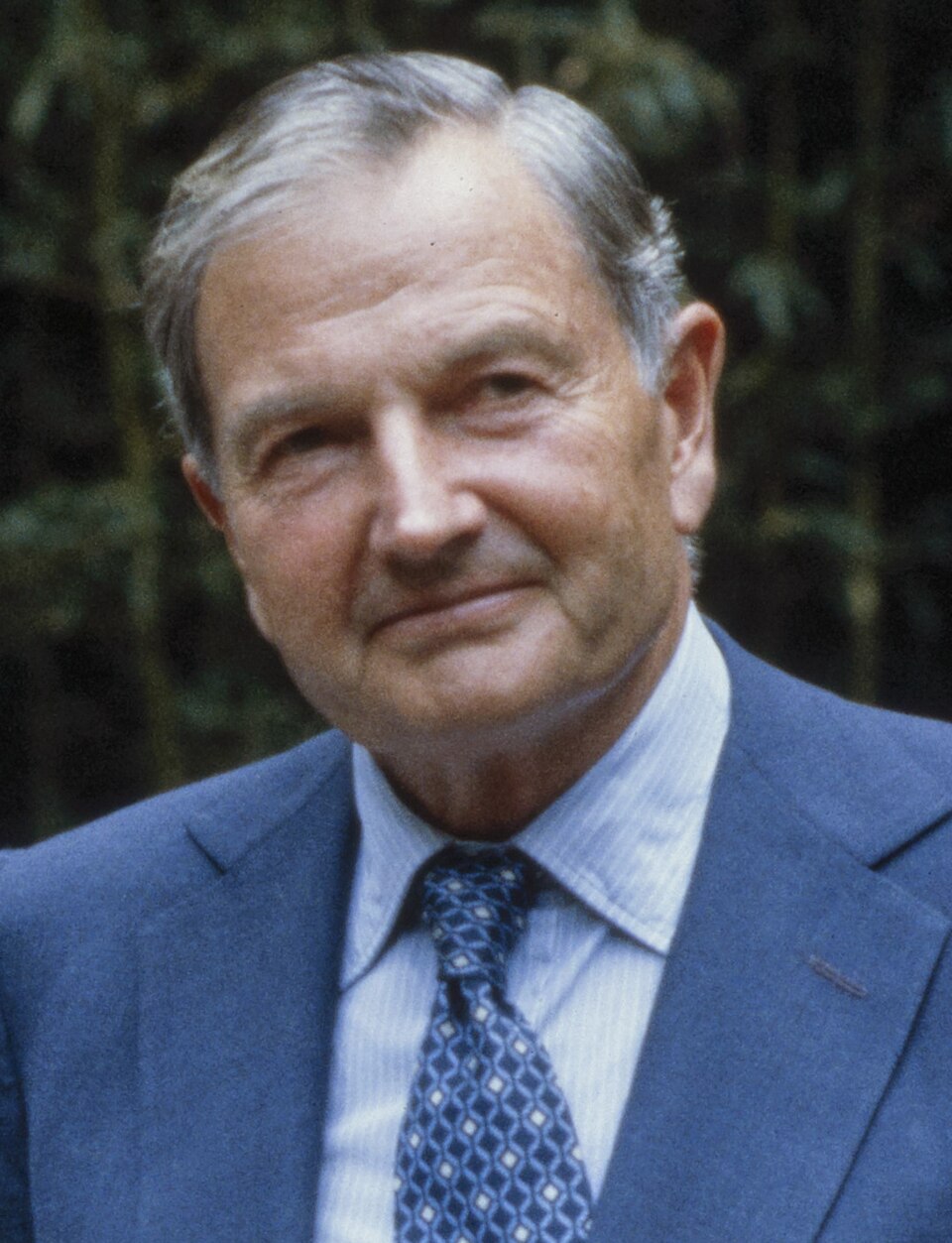
Chairman and dominant figure in CFR during its peak influence, 1970–1985.
David Rockefeller led both CFR and Chase Manhattan simultaneously, illustrating finance-policy linkage.