Vladimir Putin
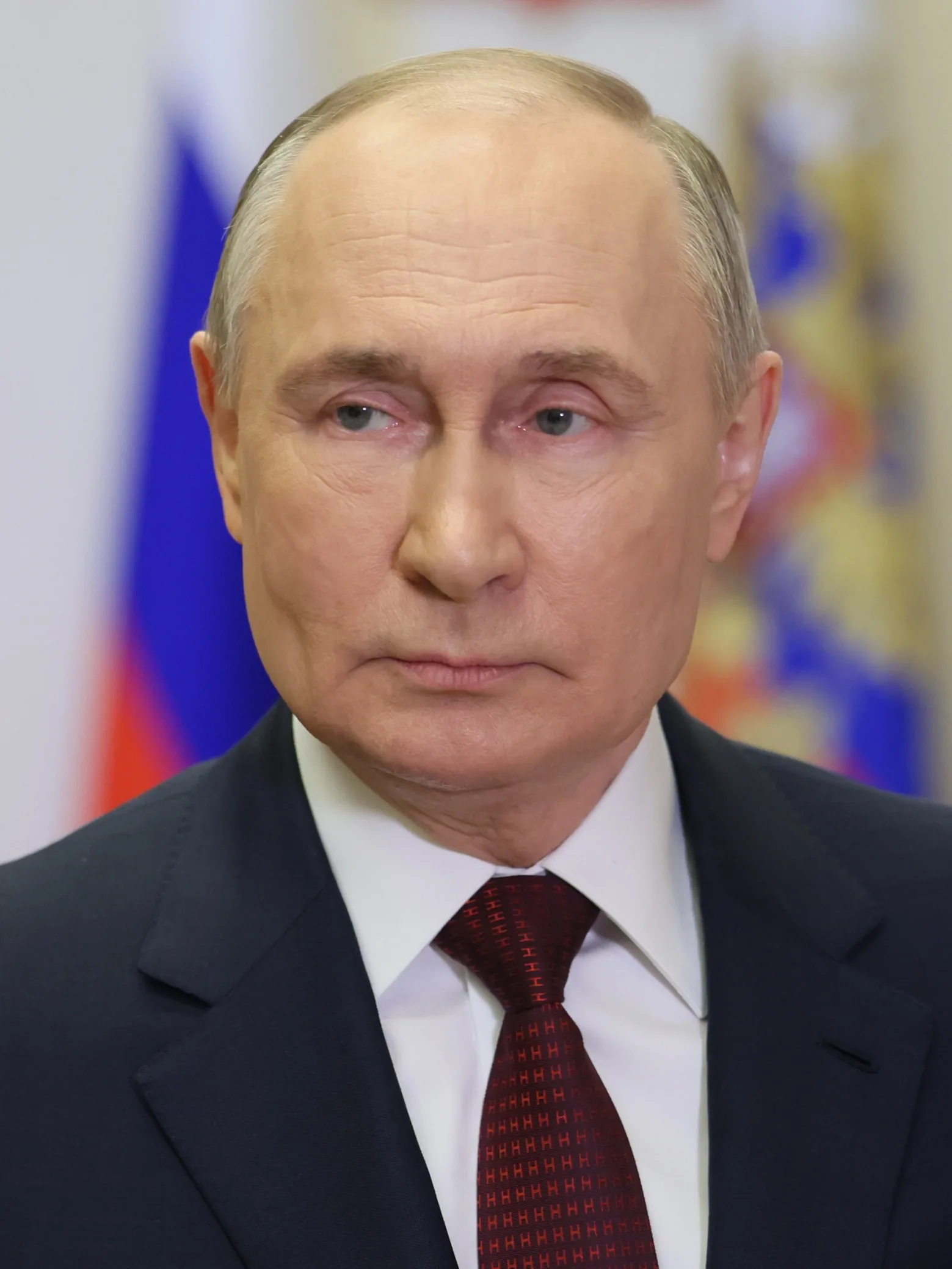
Vladimir Vladimirovich Putin has served as President of the Russian Federation since 2012, previously holding the office from 2000 to 2008, and as Prime Minister from 1999–2000 and 2008–2012. His tenure has been marked by centralization of power, suppression of opposition, and military interventions in Ukraine, Georgia, and Syria. Putin appears in The Archive because independent investigations and judicial inquiries have documented his government's alleged involvement in high-profile extrajudicial killings and covert military operations.
Vladimir Vladimirovich Putin has served as President of the Russian Federation since 2012, previously holding the office from 2000 to 2008, and as Prime Minister from 1999–2000 and 2008–2012. His tenure has been marked by centralization of power, suppression of opposition, and military interventions in Ukraine, Georgia, and Syria. Multiple international investigations have linked Russian state agencies under his leadership to targeted killings, election interference, and other covert operations.
- Source
- Wikimedia Commons
- Type
- Photograph
- License
- CC BY 4.0
- Photographer
- Пресс-служба Президента РФ
- Year
- 2024
Photo Information ▾
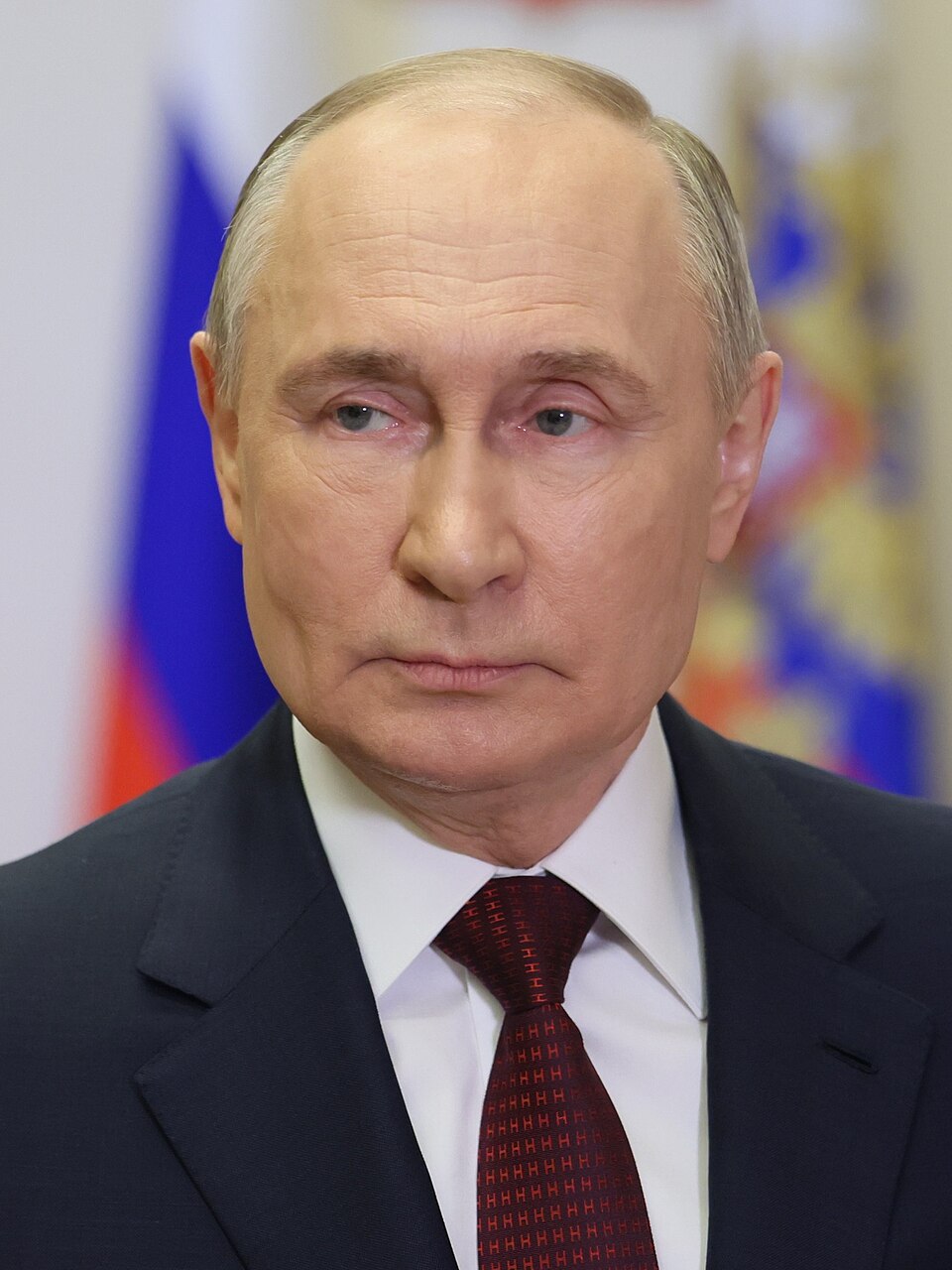
Russian President Vladimir Putin makes a video address to congratulate Russia's women on International Women's Day in Moscow, Russia.
(indirectly, this is identical in framing, slightly different color, higher res)
View original ↗- Full name
- Vladimir Vladimirovich Putin
- Birth
- October 7, 1952, Leningrad, Russian SFSR, Soviet Union
- Nationality
- Russian
- Education
- Leningrad State University (law degree, 1975)
- KGB service
- 1975–1991, posted in Leningrad and East Germany
- Political career commenced
- 1990, advisor to Leningrad Mayor Anatoly Sobchak
- FSB Director
- July 1998–August 1999
- Prime Minister
- August 1999–May 2000; May 2008–May 2012
- President
- May 2000–May 2008; May 2012–present
- Constitutional amendments
- 2020 amendments allow Putin to remain in office until 2036
- Marital status
- Divorced from Lyudmila Putina (m. 1983, div. 2014); two daughters confirmed
- Net worth claims
- Official salary modest; allegations of concealed wealth estimated in billions of dollars, unconfirmed
Putin appears in The Archive because independent investigations and judicial inquiries have documented his government's alleged involvement in high-profile extrajudicial killings and covert military operations. The 2016 public inquiry led by Sir Robert Owen concluded that the 2006 polonium poisoning of Alexander Litvinenko was "probably approved" by Putin. Putin's relationship with Yevgeny Prigozhin and the Wagner Group, which operated in Syria, Africa, and Ukraine as a de facto arm of Russian foreign policy, ended in Prigozhin's death following a failed mutiny in June 2023. These cases exemplify the documented pattern of state-directed violence, plausible deniability, and suppression of dissent that characterizes Putin's rule, making him central to understanding modern Russian covert operations and the erosion of post-Cold War norms.
# Vladimir Putin
Identity
Vladimir Vladimirovich Putin was born on October 7, 1952, in Leningrad (now Saint Petersburg), in the Soviet Union. He graduated from Leningrad State University in 1975 with a degree in law and was recruited by the KGB, the Soviet security and intelligence service, where he served from 1975 until the dissolution of the Soviet Union in 1991. His KGB career included postings in Leningrad and East Germany; he reached the rank of lieutenant colonel. After the collapse of the Soviet Union, Putin entered politics in Saint Petersburg, working as an advisor to Mayor Anatoly Sobchak from 1990 to 1996. He moved to Moscow in 1996, serving in President Boris Yeltsin's administration. In July 1998, Yeltsin appointed him Director of the Federal Security Service (FSB), the KGB's successor agency. On August 9, 1999, Yeltsin named Putin Prime Minister, and on December 31, 1999, Yeltsin unexpectedly resigned, making Putin Acting President. Putin won the presidential election in March 2000 and has dominated Russian politics ever since, either as President (2000–2008, 2012–present) or Prime Minister (2008–2012). Constitutional amendments approved in 2020 reset his term limits, potentially allowing him to remain in office until 2036.
Putin's personal life has been closely guarded. He was married to Lyudmila Putina from 1983 until their divorce was finalized in 2014; they have two daughters, Maria and Katerina. Allegations of relationships with other women, including Olympic gymnast Alina Kabaeva, have circulated in Russian media but have not been officially confirmed. Putin's public image emphasizes physical fitness, traditional masculinity, and Russian nationalist pride. His official income is modest by Western standards, but numerous investigations by journalists and governments have alleged that Putin controls vast hidden wealth through proxies, oligarchs, and offshore holdings, with estimates ranging into the tens of billions of dollars. These allegations remain unproven due to the opacity of Russian financial systems and the risks faced by investigators.
Career & Roles
Putin's rise to power was rapid and unexpected. As FSB Director in 1998–1999, he oversaw domestic security during a period of political and economic turmoil. His appointment as Prime Minister came as a surprise; Yeltsin had cycled through several prime ministers in preceding years. Putin's decisive rhetoric during the Second Chechen War, which began in August 1999, and his promises to restore order resonated with a Russian public exhausted by the chaos of the 1990s. Yeltsin's resignation on the last day of 1999 positioned Putin as Acting President and the frontrunner in the March 2000 election, which he won with 53% of the vote.
As President, Putin moved quickly to consolidate power. He brought Russia's semi-autonomous regions under federal control, subdued independent media, and restructured the political system to marginalize opposition. Oligarchs who challenged him, such as Mikhail Khodorkovsky, were prosecuted and imprisoned; those who acquiesced retained their wealth in exchange for loyalty. Putin's approval ratings soared during his first two terms, driven by rising oil prices, economic recovery, and a restoration of national pride. He stepped down in 2008 due to constitutional term limits, but his handpicked successor, Dmitry Medvedev, appointed him Prime Minister. During this period, Putin remained the dominant political figure. In 2012, he returned to the presidency amid widespread protests alleging electoral fraud. Constitutional amendments in 2020, approved in a controversial nationwide vote, reset his term count, effectively allowing him to serve until 2036.
Putin's governance style has been characterized by political scientists as authoritarian or "managed democracy." Independent media outlets have been shut down or brought under state control; opposition leaders have been jailed, exiled, or killed. Alexei Navalny, Putin's most prominent critic, was poisoned with a Novichok nerve agent in 2020, survived, returned to Russia in 2021, and was imprisoned on charges widely regarded as politically motivated; he died in prison in February 2024 under disputed circumstances. International observers and human rights organizations have documented systemic repression, unfair elections, and the use of state resources to maintain Putin's grip on power.
Organizations & Networks
Putin's power rests on a network of security service veterans, loyalist oligarchs, and state institutions. The siloviki—officials drawn from the security and military services—form the backbone of his regime. Key figures include Nikolai Patrushev, Secretary of the Security Council and former FSB Director; Sergei Shoigu, Defense Minister from 2012 to 2024; and Valery Gerasimov, Chief of the General Staff. These men oversee Russia's military, intelligence, and internal security apparatus.
The FSB, the Federal Protective Service (FSO), the Foreign Intelligence Service (SVR), and the Main Intelligence Directorate (GRU) operate under Putin's direct or indirect authority. Credible investigative reporting has linked these agencies to assassinations, cyberattacks, election interference, and other covert operations. The 2016 U.S. intelligence community assessment concluded that Putin personally ordered a campaign to influence the U.S. presidential election. The British public inquiry into Alexander Litvinenko's death found that his 2006 polonium poisoning was "probably approved" by Putin and Patrushev.
Putin has also relied on informal, deniable networks. The Wagner Group, a private military company founded by Yevgeny Prigozhin and commanded by Dmitry Utkin, operated in Syria, Ukraine, and Africa, advancing Russian interests while providing Moscow with plausible deniability. Prigozhin, often called "Putin's chef" due to his catering contracts with the Kremlin, also ran the Internet Research Agency, which was indicted by the U.S. Department of Justice in 2018 for interfering in the 2016 election. Prigozhin's relationship with Putin soured after Wagner's mutiny in June 2023; two months later, Prigozhin died in a suspicious plane crash.
Oligarchs such as Roman Abramovich, Gennady Timchenko, and Arkady Rotenberg have amassed fortunes through state contracts and privileged access to resources. Investigative journalists have alleged that some oligarchs hold assets on Putin's behalf, though definitive proof remains elusive. International sanctions targeting these individuals aim to pressure Putin indirectly by freezing the wealth of his inner circle.
Major Operations & Activities
Putin's presidency has been marked by military interventions, annexations, and covert operations. The Second Chechen War, which began in 1999, was prosecuted with extreme brutality; human rights groups documented widespread atrocities by Russian forces. In 2008, Russia fought a brief war with Georgia, occupying the breakaway regions of South Ossetia and Abkhazia. In 2014, following Ukraine's Euromaidan revolution, Russian forces seized and annexed Crimea; Russia also supported separatist militants in eastern Ukraine's Donbas region, leading to a protracted conflict. On February 24, 2022, Russia launched a full-scale invasion of Ukraine, the largest military conflict in Europe since World War II. The invasion has resulted in tens of thousands of deaths, mass displacement, and widespread destruction. International Criminal Court prosecutors issued an arrest warrant for Putin in March 2023, charging him with war crimes related to the forced deportation of Ukrainian children.
Russian forces intervened in Syria in 2015, propping up the Assad regime through airstrikes and ground support provided in part by Wagner Group fighters. This intervention secured Russia's naval base at Tartus and reasserted Moscow's role as a global power. In Africa, Wagner mercenaries operated in the Central African Republic, Libya, Mali, and Sudan, securing mining concessions and supporting friendly governments in exchange for resources and influence.
Russian intelligence services have been implicated in numerous assassination attempts and cyberattacks. Beyond Litvinenko, targets have included Sergei Skripal, a former GRU officer poisoned with Novichok in Salisbury, England, in 2018; Alexei Navalny; and numerous exiled dissidents and journalists. Cyberattacks attributed to Russian actors include the 2016 hacking of the Democratic National Committee, the 2017 NotPetya ransomware attack, and the 2020 SolarWinds supply chain breach. Western governments have imposed sanctions in response, though their effectiveness in changing Russian behavior remains debated.
Historical Importance
Putin's tenure represents a reversal of the post-Cold War trajectory toward democracy and integration with the West that briefly characterized Russia in the 1990s. He rebuilt the Russian state, restored its military power, and reasserted its sphere of influence in the former Soviet space. Domestically, he ended the oligarchic chaos of the Yeltsin years, but at the cost of political freedoms, press independence, and the rule of law. His model of governance—authoritarian stability, state capitalism, nationalist rhetoric, and the selective use of repression—has influenced other leaders in Eurasia and beyond.
Putin's geopolitical impact is equally significant. He challenged the U.S.-led liberal international order through military interventions, support for autocratic regimes, cyber operations, and disinformation campaigns. The annexation of Crimea violated the post-1945 norm against territorial conquest; the 2022 invasion of Ukraine further destabilized Europe and raised fears of broader conflict. Putin's reliance on energy exports as a tool of coercion, his cultivation of relationships with China, Iran, and other U.S. adversaries, and his use of hybrid warfare have reshaped global security dynamics. Historians are likely to view Putin as a central figure in the decline of the post-Cold War order and the return of great-power competition.
Documented Controversies
Credible Allegation Multiple investigative reports have alleged that Putin controls vast hidden wealth. The International Consortium of Investigative Journalists' Panama Papers (2016) and Paradise Papers (2017) revealed offshore holdings linked to individuals in Putin's inner circle, including cellist Sergei Roldugin, a close friend. Russian opposition leader Alexei Navalny released investigations alleging that Putin owns palatial residences on the Black Sea and elsewhere, funded through corrupt schemes. The U.S. Treasury has stated that Putin may be "the richest man in Europe," though exact figures are impossible to verify. Putin has denied these allegations, calling them politically motivated fabrications.
Government Finding The 2016 U.S. intelligence community assessment concluded with "high confidence" that Putin personally ordered an influence campaign to interfere in the 2016 presidential election, intending to harm Hillary Clinton's candidacy and help Donald Trump. The campaign included hacking, strategic leaks through WikiLeaks and DCLeaks, and a social media disinformation effort run by the Internet Research Agency. The Mueller Report (2019) detailed these activities but did not establish criminal conspiracy between the Trump campaign and Russia. Russian officials have consistently denied interference.
Government Finding The British public inquiry led by Sir Robert Owen concluded in January 2016 that the 2006 murder of Alexander Litvinenko by polonium-210 poisoning was "probably approved" by Putin and FSB Director Nikolai Patrushev. The inquiry found that Litvinenko was killed in retaliation for his criticism of Putin and the FSB, and that the operation bore the hallmarks of state sponsorship. Russia refused to extradite the suspects, Andrei Lugovoi and Dmitri Kovtun, and denied involvement.
Credible Allegation Investigative journalists, including those at Bellingcat, have linked Russian military intelligence (GRU) to the 2018 Novichok poisoning of Sergei Skripal and his daughter Yulia in Salisbury, England. Open-source evidence identified GRU officers who traveled to the U.K. under false identities around the time of the attack. The British government formally accused Russia; Moscow denied responsibility. The same Novichok variant was used in the 2020 poisoning of Alexei Navalny in Siberia; Bellingcat and partners identified an FSB team that trailed Navalny for years. Navalny survived, returned to Russia, and was imprisoned; he died in prison in February 2024 under circumstances his supporters call suspicious.
Confirmed by Court The International Criminal Court issued an arrest warrant for Putin in March 2023, charging him with the war crime of unlawful deportation of Ukrainian children to Russia. The ICC's warrant is based on documented evidence of systematic forced transfers and adoptions. Russia does not recognize the ICC's jurisdiction, and Putin has dismissed the charges as politically motivated.
Credible Allegation The downing of Malaysia Airlines Flight MH17 over eastern Ukraine in July 2014, killing 298 people, has been attributed to a Russian-supplied Buk missile system operated by Russian-backed separatists or Russian military personnel. A Dutch-led international investigation concluded that the missile launcher came from Russia's 53rd Anti-Aircraft Missile Brigade. In 2022, a Dutch court convicted three men (two Russians, one Ukrainian) in absentia for their roles in the shoot-down. Russia has denied involvement and offered alternative theories, none of which have been substantiated by independent evidence.
Credible Allegation Reports from former associates and defectors have alleged that Putin employs body doubles for security purposes. Former Putin advisor Gleb Pavlovsky and others have claimed that lookalikes are used during public events or in dangerous situations. No definitive photographic or documentary evidence has been made public, and the Kremlin has not commented on these claims.
Unsupported Claim Conspiracy theories have circulated alleging that Putin orchestrated the 1999 apartment bombings in Moscow and other Russian cities to justify the Second Chechen War and consolidate his power. Former FSB officer Alexander Litvinenko and exiled oligarch Boris Berezovsky promoted this theory. Investigative journalists, including those involved in the film "Disbelief" (unreleased after the murder of producer Yuri Shchekochikhin), explored suspicious circumstances, including an apparent FSB training exercise in Ryazan involving materials resembling explosives. Official investigations blamed Chechen militants. Independent inquiries have been obstructed, and key witnesses have died under suspicious circumstances. The allegations remain unproven and highly disputed.
Investigations & Legal Proceedings
Putin has never faced criminal prosecution, and Russian law grants sitting presidents immunity. However, international bodies have investigated actions attributed to his government. The International Criminal Court's 2023 arrest warrant for war crimes related to Ukraine is the most significant legal action. The warrant is enforceable in ICC member states, restricting Putin's international travel, though Russia does not recognize the court.
The Mueller investigation (2017–2019) examined Russian interference in the 2016 U.S. election and potential coordination with the Trump campaign. While the investigation detailed extensive Russian operations, it did not establish criminal conspiracy. The report described multiple contacts between Russian officials and Trump associates and documented efforts by Trump to impede the investigation, but Special Counsel Robert Mueller declined to conclude whether these constituted obstruction of justice, citing Justice Department policy against indicting a sitting president.
The U.K. government's public inquiry into Litvinenko's death was a quasi-judicial proceeding, not a criminal trial, but its findings implicated Putin directly. Sir Robert Owen's 2016 report stated that Litvinenko was killed by Lugovoi and Kovtun, acting on behalf of the FSB, and that the operation was "probably approved" by Putin. Russia rejected the findings and refused to cooperate.
Numerous human rights organizations, including Amnesty International and Human Rights Watch, have documented abuses under Putin's rule, including torture, arbitrary detention, suppression of speech, and extrajudicial killings. These reports provide the evidentiary basis for sanctions imposed by the United States, European Union, Canada, and other democracies. Sanctioned individuals include Putin himself, whose foreign assets (if any can be located) are frozen, and who is banned from entering sanctioning countries.
Denials & Disputes
Putin and Russian government spokespersons have consistently denied responsibility for assassinations, cyberattacks, and election interference. In response to the Litvinenko inquiry, the Kremlin called the findings "absurd" and politically motivated. After the Skripal poisoning, Russia offered multiple conflicting explanations and accused the U.K. of fabricating evidence. Putin personally denied involvement in the 2016 U.S. election interference during his 2018 summit with President Trump in Helsinki, a denial Trump initially accepted before walking it back under domestic pressure.
Regarding the downing of MH17, Russia has promoted alternative theories, including claims that Ukraine shot down the plane, that the missile came from Ukrainian-held territory, or that the investigation was biased. None of these theories withstands scrutiny against the evidence presented by the Dutch Safety Board and the Joint Investigation Team, which included detailed satellite imagery, witness testimony, and forensic analysis.
Putin has dismissed allegations of hidden wealth as fabrications by foreign intelligence services and opposition figures. He has portrayed himself as a modest public servant and framed investigations like the Panama Papers as Western propaganda designed to undermine Russia. State-controlled media amplify these denials, and independent Russian journalists who investigate Putin's finances face harassment, prosecution, or violence.
On Ukraine, Putin has described the 2022 invasion as a "special military operation" necessitated by NATO expansion, alleged persecution of Russian speakers in Ukraine, and the need to "denazify" the Ukrainian government. These justifications have been rejected by international law scholars, who characterize the invasion as a war of aggression prohibited by the United Nations Charter. The ICC's arrest warrant reflects this legal consensus.
Legacy & Historical Debate
Putin's legacy is contested and will remain so for decades. Within Russia, state propaganda portrays him as the leader who restored national pride, rebuilt the military, and defended Russia against Western encroachment. Polls conducted under authoritarian conditions show high approval ratings, though the reliability of such data is debated. Opposition figures and exiled dissidents view him as a dictator who destroyed Russia's democratic potential, looted the state, and led the country into disastrous wars.
Internationally, Putin is seen by Western governments and their allies as a revisionist autocrat who undermines international law, sponsors terrorism, and threatens European security. His actions have reinvigorated NATO, prompted Finland and Sweden to abandon neutrality and join the alliance, and galvanized democratic coalitions. Some realist scholars argue that NATO expansion and Western policies provoked Russia, and that Putin's actions, while condemnable, were predictable responses to perceived security threats. This view is rejected by most historians and international relations experts, who emphasize that Russia's neighbors have the sovereign right to choose their alliances and that Putin's aggression, not NATO policy, is the primary cause of conflict.
Putin's reliance on covert operations, deniable proxies like Wagner, and hybrid warfare tactics has set precedents that other states may follow. His model of governance—centralized authority, state control of media, selective repression, and nationalist legitimation—has been emulated by leaders in Belarus, Central Asia, and beyond. Whether his regime can survive his eventual departure, and whether Russia can transition to a more democratic system, are open questions that will shape the region's future.
Historians will likely debate the extent of Putin's personal responsibility for specific operations. The British inquiry's conclusion that he "probably approved" Litvinenko's murder reflects the difficulty of obtaining definitive proof in a system characterized by secrecy and plausible deniability. The same challenge applies to other alleged assassinations, cyberattacks, and Wagner operations. Nonetheless, the pattern of evidence—multiple independent investigations reaching similar conclusions, consistent with the logic of authoritarian governance—supports the assessment that Putin bears ultimate responsibility for actions taken by the Russian state and its proxies.
Continue Investigating
Putin's role in The Archive centers on documented allegations of state-sponsored violence, covert operations, and the centralization of authoritarian power. The Litvinenko poisoning inquiry provides a rare judicial finding implicating him directly in extrajudicial killing. His relationship with Yevgeny Prigozhin and the Wagner Group illustrates the use of deniable proxies to advance Russian interests in conflict zones, a relationship that ended in Prigozhin's death under suspicious circumstances. Understanding Putin requires examining the broader network of security officials, oligarchs, and informal actors who sustain his regime, as well as the international investigations that have sought to hold him accountable. The Archive's related dossiers on the-wagner-group-and-prigozhins-death and the-litvinenko-poisoning provide detailed case studies of operations attributed to Putin's government. Additional context can be found in dossiers on operation-gladio, which explores Cold War-era covert networks that prefigure some Russian tactics, and the-cambridge-five, which examines Soviet intelligence tradecraft. Readers interested in authoritarian governance and covert influence should consult snowden-and-nsa-mass-surveillance for comparative perspectives on state power and secrecy. Key associates include yevgeny-prigozhin, alexander-litvinenko, sergei-shoigu, nikolai-patrushev, and alexander-lukashenko. Independent investigations by journalists, human rights organizations, and judicial bodies continue to document actions taken under Putin's leadership, even as access to information within Russia becomes increasingly restricted.
- 1952Vladimir Putin born in Leningrad, Soviet Union
- 1975Graduated from Leningrad State University; recruited by KGB
- 1985-1990Served in KGB posting in Dresden, East Germany
- 1991Resigned from KGB following the collapse of the Soviet Union
- 1996Moved to Moscow to work in Yeltsin administration
- 1998Appointed Director of the Federal Security Service (FSB)
- 1999Appointed Prime Minister in August; became Acting President on December 31 after Yeltsin's resignation
- 2000Elected President of Russia in March
- 2008Stepped down as President; became Prime Minister under Dmitry Medvedev
- 2012Returned to presidency amid widespread protests alleging electoral fraud
- 2014Russia annexed Crimea; conflict began in eastern Ukraine
- 2016British public inquiry concluded Putin probably approved Litvinenko's murder; U.S. intelligence concluded Putin ordered 2016 election interference
- 2020Constitutional amendments reset term limits; Alexei Navalny poisoned with Novichok
- 2022Russia launched full-scale invasion of Ukraine on February 24
- 2023ICC issued arrest warrant for Putin; Wagner Group mutiny and Prigozhin's death
- 2024Alexei Navalny died in prison under disputed circumstances
- S1The Litvinenko Inquiry: Report into the death of Alexander LitvinenkoUK Government · primary
- S2Background to 'Assessing Russian Activities and Intentions in Recent US Elections': The Analytic Process and Cyber Incident AttributionOffice of the Director of National Intelligence · primary
- S3Report On The Investigation Into Russian Interference In The 2016 Presidential Election (Mueller Report)U.S. Department of Justice · primary
- S4ICC issues arrest warrants for Vladimir Putin and Maria Lvova-BelovaInternational Criminal Court · primary
- S5
- S6The Panama Papers: Exposing the Rogue Offshore Finance IndustryInternational Consortium of Investigative Journalists · investigative
- S7Putin's Palace: History of World's Largest BribeAlexei Navalny (via YouTube) · investigative
- S8U.S. Sanctions on RussiaU.S. Department of State · primary
- S9Navalny: Tracking Down The Alexei Navalny Poisoning SuspectsBellingcat · investigative
- S10Alexei Navalny, Russian Opposition Leader, Dies in PrisonThe New York Times · mainstream
- S11MH17 - Russian missile downed plane in Ukraine, investigators sayBBC News · mainstream
- S12Blowing Up Russia: The Secret Plot to Bring Back KGB TerrorYale University Press · book
- S13Russia's War in Ukraine: Timeline of Major EventsBBC News · mainstream
- S14Ukraine: Civilian Casualties as of 31 December 2024UN Office of the High Commissioner for Human Rights · primary
- S15Vladimir PutinWikipedia · reference
If you're learning about this topic for the first time, these are the best places to continue — documented evidence and historical relationships are the guide.
Vladimir Putin is documented in the evidence record of this published dossier.
Co-documented with Vladimir Putin in 1 published dossier, including “Panama Papers”.
Belarusian President; close Putin ally; mediated end to Wagner mutiny.