The Iran-Contra Affair
Selling arms to Iran to fund a war Congress had outlawed. The Reagan-era scandal that broke open how executive branches run covert action without consent — and how accountability ends.
Sign in to bookmark, follow, and message the contributor.
Executive Summary
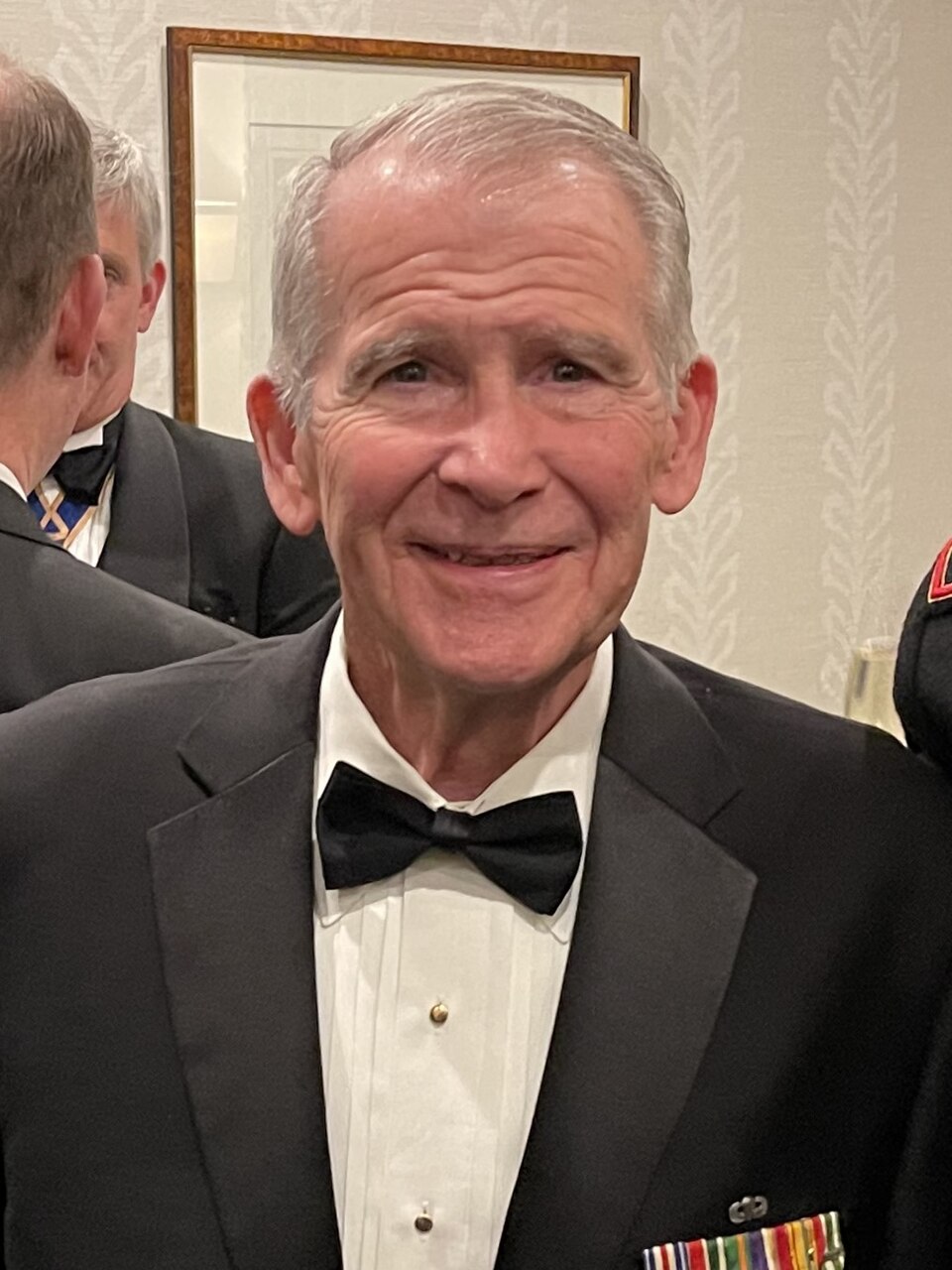
Between 1985 and 1986, senior officials in the Reagan administration secretly sold arms to Iran — at the time under a U.S. embargo and designated a state sponsor of terrorism — and diverted some of the proceeds to fund the Contras, a guerrilla force fighting the Sandinista government in Nicaragua. Congress had explicitly prohibited that funding through the Boland Amendments. The operation ran out of the National Security Council, primarily through Lt. Col. Oliver North under National Security Advisor John Poindexter. When it broke open in late 1986, the resulting investigations produced fourteen criminal indictments — and a presidential pardon wave that ended most of them without verdict.
- 01."There is no honor in this. We were operating an off-the-books U.S. foreign policy." — Oliver North, 1987 congressional testimony
- 02."The Iran-Contra affair was the product of two foreign policy directives... that ran counter to declared U.S. policy." — Tower Commission Report, 1987
- 03."The pardons of Caspar Weinberger and other Iran-Contra defendants undermined principles of accountability and constituted the last act of the Iran-Contra coverup." — Lawrence Walsh, *Final Report* of the Independent Counsel, 1993
The Hidden Truth
What the headlines won't tell you
The Mainstream Narrative
The standard account treats Iran-Contra as two overlapping covert operations that converged into one constitutional crisis. The arms-for-hostages track sold TOW and HAWK missiles to Iran via Israeli intermediaries in the hope that Tehran would press Hezbollah to release U.S. hostages in Lebanon. The Contra-funding track diverted profits from those arms sales — about $18 million by official estimates — to support the Nicaraguan Contras after Congress had cut off military aid through a series of amendments authored by Rep. Edward Boland.
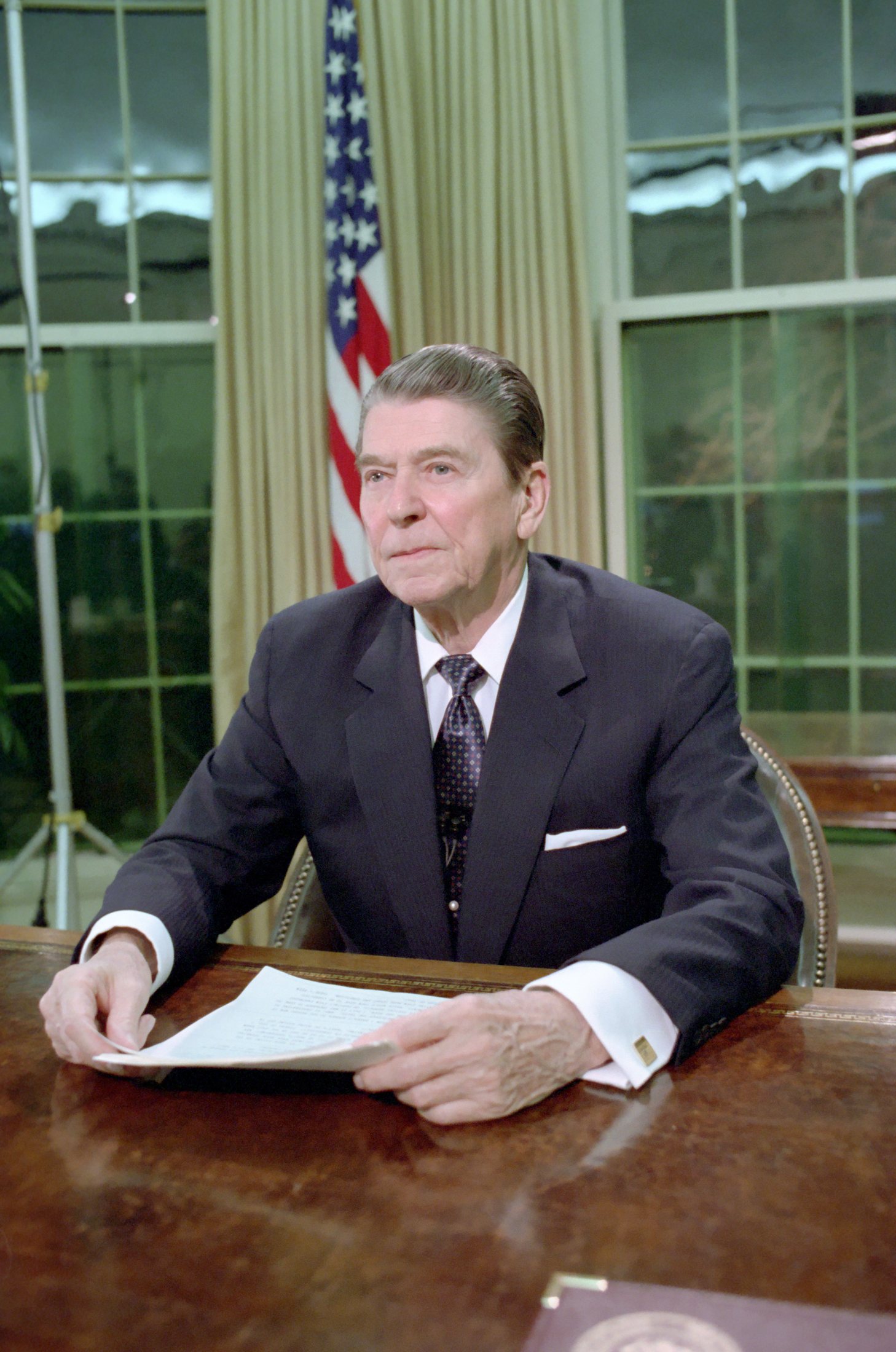
In November 1986, after a Lebanese magazine reported the arms-for-hostages dealings, the Reagan administration's story collapsed in weeks. Attorney General Edwin Meese announced the Contra diversion at a press conference. President Reagan addressed the nation, eventually saying that "what began as a strategic opening to Iran deteriorated, in its implementation, into trading arms for hostages." A presidentially appointed review board (the Tower Commission), a joint congressional investigation, and a seven-year Independent Counsel inquiry under Lawrence Walsh produced detailed findings, indictments, and the broad shape of accountability we have today.
Established Record vs Disputed Layers
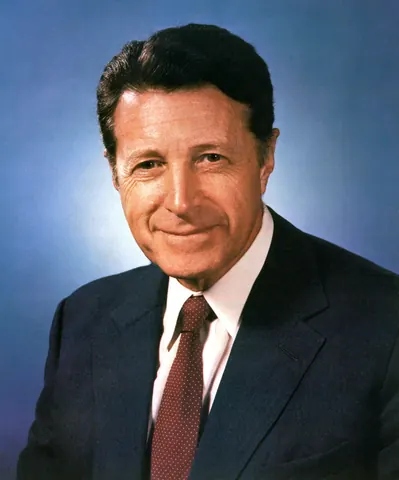
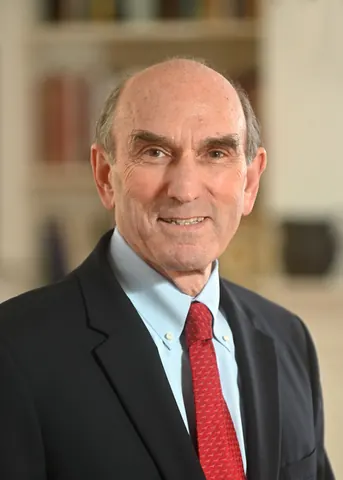
The settled facts are extensive: the arms shipments happened; the Contra diversion happened; National Security Council staff led by Oliver North orchestrated both tracks with John Poindexter's approval; the Boland Amendments were violated in spirit and arguably in letter; documents were shredded as the scandal broke; senior officials including Caspar Weinberger (Defense), Robert McFarlane (NSA), Elliott Abrams (State), Alan Fiers (CIA), and Clair George (CIA) faced indictment or guilty pleas.
What remains genuinely contested is the upper-floor question: how much did President Reagan know, when did he know it, and what was the chain of authorization above Poindexter? Reagan's own diaries and the Tower Commission report show a president deeply engaged with the hostage track but vague on operational details of the diversion. Walsh's Final Report (1993) concluded the diversion was authorized by Reagan-administration officials acting in concert but stopped short of finding direct presidential knowledge of the funding-diversion specifically — partly because key witnesses had been pardoned before testifying.
Follow the Money
What Iran-Contra exposed was less the misdeeds of a few NSC staffers than the existence of an off-the-books foreign-policy apparatus: private fundraising networks (run by retired Gen. Richard Secord and Albert Hakim through the "Enterprise"), foreign-government contributions (Saudi Arabia, Brunei, Taiwan), arms dealers (Manucher Ghorbanifar), and laundering channels designed to operate beyond congressional oversight. The Boland Amendments had cut off official CIA funding of the Contras; the Enterprise was constructed precisely to replace that funding through deniable channels.
The institutional pattern matters. The structures Iran-Contra revealed — private intermediaries, foreign-state cash flows, presidential findings used to shield operations from congressional notification — were not unique to the Reagan NSC. They were a refinement of patterns that ran back through the Phoenix Program, MK-Ultra, and the Church Committee findings of the 1970s. The accountability mechanisms put in place after Iran-Contra — the inspector-general regime, the reporting requirements of the National Security Act amendments — have been repeatedly tested, and arguably bypassed, in every subsequent administration that ran significant covert action.
How Accountability Ended
On December 24, 1992, outgoing President George H. W. Bush pardoned six Iran-Contra figures: Caspar Weinberger (then under indictment), Robert McFarlane, Elliott Abrams, Alan Fiers, Clair George, and Duane Clarridge. Walsh, the Independent Counsel, called the pardons "the last act of the Iran-Contra coverup." Weinberger's trial — which Walsh said would have placed Bush himself near the operational chain as Vice President — never happened.
Oliver North's and John Poindexter's criminal convictions were overturned on appeal in 1990 and 1991, respectively, because their congressional immunized testimony had tainted the prosecution's witness pool. Neither was retried.
Open Questions
Three questions remain live, and historians divide on each:
First, the precise scope of presidential knowledge. The Walsh report establishes that Reagan was informed of the broad arms-for-hostages structure and approved several finding documents; whether he was specifically briefed on the diversion of profits to the Contras is supported by some witness accounts (notably Poindexter's testimony) and undermined by others.
Second, the role of George H. W. Bush. Bush, as Vice President, claimed to be "out of the loop" during the relevant period. Walsh's later access to Weinberger's contemporaneous notes — which Bush had personally requested be kept secret — contradicted that account in significant respects. The notes were released only after Bush left office.
Third, what the Enterprise reveals about ongoing covert-funding architecture. The Iran-Contra investigations exposed the mechanism — private intermediaries, foreign-state donations, deniable accounts — but did not foreclose its reuse. Subsequent reporting on Afghanistan, Iraq, and post-2001 covert programs suggests the architecture has been adapted rather than dismantled. That is a question of contemporary institutional behavior, not 1980s history.
Under-Reported Dimensions
Editorial pass pending.
Credible Dissenting Voices
Editorial pass pending.
Case Timeline
- 1982GOVERNMENT RECORDFirst Boland Amendment passed, restricting CIA and DoD use of funds to overthrow the Sandinista government.This first Boland Amendment left loopholes—it applied only to CIA and Defense Department funds intended to overthrow the government, allowing the NSC to later argue it was not covered.
- 1984GOVERNMENT RECORDBoland II passed, broadly prohibiting U.S. support for Contra military operations.Boland II expanded the prohibition to 'any agency or entity of the United States involved in intelligence activities,' closing earlier loopholes but creating debate over NSC staff applicability.
- 1985PRIMARY SOURCEFirst U.S.-approved Israeli arms shipments to Iran begin; NSC staff led by McFarlane and North run the channel.The Israeli intermediaries Michael Ledeen and Yaacov Nimrodi acted as cutouts for TOW and HAWK missile shipments that the Reagan administration retroactively tried to legitimize with a finding.
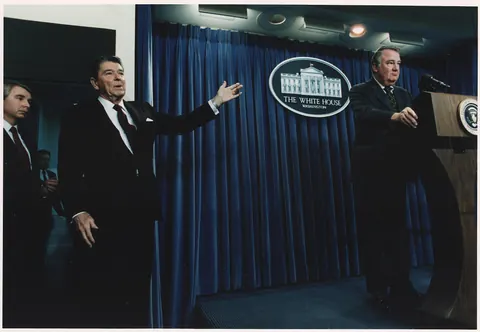
Photograph of President Reagan motioning to Ed Meese during a White House Press Briefing on Iran-Contra - NARA - 198579 - Jan 1986PRIMARY SOURCEReagan signs a presidential finding authorizing direct U.S. arms sales to Iran; CIA participates.The finding was signed retroactively to cover earlier Israeli shipments and explicitly directed the CIA to assist, formally implicating the Agency despite Director Casey's denials.
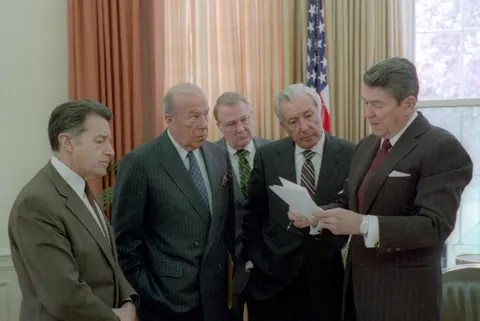
President with Caspar Weinberger George Shultz Ed Meese and Don Regan in The Oval Office Discussing The President's Remarks on The Iran-Contra Affair, 11/25/1986 - 1985–86CORROBORATEDProfits from the arms sales (~$18M) are diverted to fund the Contras via 'the Enterprise.'The 'Enterprise' was Richard Secord and Albert Hakim's private network of Swiss accounts, aircraft companies, and operatives that functioned as a parallel covert action capability outside normal channels.
Photograph of President Reagan motioning to Ed Meese during a White House Press Briefing on Iran-Contra - NARA - 198579 - Oct 5, 1986CREDIBLE REPORTINGA Contra resupply plane is shot down over Nicaragua; surviving crewman Eugene Hasenfus exposes the supply operation.Hasenfus carried business cards linking him to Southern Air Transport, a known CIA proprietary, and told Nicaraguan authorities the operation was CIA-directed, forcing a White House denial.
President with Caspar Weinberger George Shultz Ed Meese and Don Regan in The Oval Office Discussing The President's Remarks on The Iran-Contra Affair, 11/25/1986 - Nov 3, 1986CREDIBLE REPORTINGLebanese magazine *Ash-Shiraa* reveals the arms-for-hostages dealings with Iran.The *Ash-Shiraa* article quoted Iranian parliamentary speaker Rafsanjani and came days after McFarlane's secret mission to Tehran, immediately unraveling administration cover stories about the Iran channel.
President with Caspar Weinberger George Shultz Ed Meese and Don Regan in The Oval Office Discussing The President's Remarks on The Iran-Contra Affair, 11/25/1986 - Nov 25, 1986GOVERNMENT RECORDAttorney General Edwin Meese announces the Contra diversion at a White House press conference; Poindexter resigns; North is fired.Meese had conducted a weekend internal inquiry during which North and his secretary Fawn Hall shredded documents; the 'diversion memo' he announced finding was one North had inexplicably failed to destroy.
President with Caspar Weinberger George Shultz Ed Meese and Don Regan in The Oval Office Discussing The President's Remarks on The Iran-Contra Affair, 11/25/1986 - Feb 1987GOVERNMENT RECORDTower Commission Report released — finds Reagan's management style enabled the operation.The Tower Board concluded that Reagan's passive management style and reliance on subordinates created an environment where NSC staff ran operations the President either did not understand or chose not to know about.
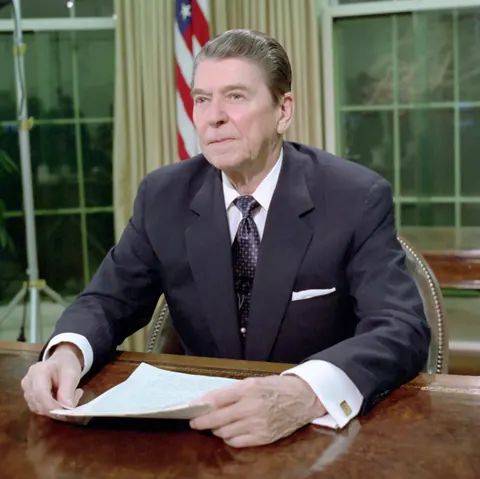
President Ronald Reagan Making An Address to The Nation on The Iran-Contra Controversy in Oval Office, 3/4/1987 - May–Aug 1987PRIMARY SOURCEIran-Contra joint congressional hearings; Oliver North testifies under immunity grant.North's testimony, broadcast live over six days, presented him as a patriotic scapegoat and complicated later prosecutions because his immunized statements could not be used against him.
President Ronald Reagan Making An Address to The Nation on The Iran-Contra Controversy in Oval Office, 3/4/1987 - Nov 1987GOVERNMENT RECORDJoint congressional committee issues final report; minority report (signed by future VP Dick Cheney) argues executive prerogative.The minority report, co-authored by Rep. Dick Cheney and signed by eight Republicans, argued that congressional restrictions on covert action unconstitutionally infringed upon executive war powers.
President Ronald Reagan Making An Address to The Nation on The Iran-Contra Controversy in Oval Office, 3/4/1987 - 1989–91COURT RECORDNorth and Poindexter convicted; both convictions overturned on appeal due to immunized testimony issues.Both convictions were vacated by appellate courts that ruled prosecutors had not adequately demonstrated that trial evidence was untainted by the witnesses' prior immunized congressional testimony.
- Dec 24, 1992GOVERNMENT RECORDOutgoing President George H. W. Bush pardons Weinberger, McFarlane, Abrams, Fiers, George, and Clarridge.Bush issued the pardons on Christmas Eve just weeks before Weinberger's trial was to begin, preempting testimony that Walsh believed would have implicated Bush more directly in the arms sales.
- Aug 1993GOVERNMENT RECORDIndependent Counsel Lawrence Walsh releases his *Final Report* — concludes Reagan and Bush knew more than they admitted; no charges follow.Walsh's final report documented Bush's and Reagan's diary entries and meeting notes showing awareness of the arms-for-hostages nature of the trades, contradicting their public claims of ignorance.
Key People
Evidence Library
- documentpartial redactionDOC-IC1Final Report of the Independent Counsel for Iran/Contra Matters (Walsh Report)
Seven-year investigation concluded in August 1993 documenting the arms sales, Contra diversion, and cover-up. Walsh concluded that Reagan and Bush knew far more than they admitted, but immunized testimony and presidential pardons blocked accountability. Definitive prosecutorial record.
- documentDOC-TC1Report of the President's Special Review Board (Tower Commission Report, February 1987)
Blue-ribbon panel appointed by Reagan found that the NSC staff had become operational rather than advisory, that Reagan's detached management style enabled the operation, and that no one exercised adequate oversight. First authoritative account released during the crisis.
- documentDOC-CR1Joint Congressional Report on the Iran-Contra Affair (November 1987)
Majority report of House and Senate select committees concluded laws were broken and constitutional processes subverted. The co-signed minority report arguing executive prerogative became influential in later expansive views of presidential power.
- testimonyTEST-ON1Lt. Col. Oliver North Testimony to Joint Congressional Committee (July 1987)
Six days of nationally televised testimony under immunity grant in which North defended the operations as patriotic, admitted shredding documents, and portrayed himself as following orders. Immunization later voided his conviction and complicated other prosecutions.
- documentpartial redactionDOC-PF1Presidential Finding on Iran Arms Sales (January 17, 1986)
Reagan's retroactive authorization directing the CIA to support arms sales to Iran in hopes of securing hostage releases and opening a strategic channel. The finding's secrecy and retrospective nature became central legal issues.
- documentDOC-BA1The Boland Amendments (1982, 1984)
Series of legislative restrictions prohibiting U.S. agencies from supporting military operations to overthrow the Nicaraguan government. Boland II (1984) broadly covered intelligence agencies but left debate over whether NSC staff fell under the prohibition.
- documentpartial redactionDOC-NSA1National Security Archive Iran-Contra Document Collection
Declassified cables, memos, and meeting notes obtained through FOIA showing the day-to-day mechanics of the arms sales and Contra support. Includes communications between North, Poindexter, McFarlane, and CIA officials documenting operational details.
- documentDOC-PP1Presidential Pardon Proclamations (December 24, 1992)
President George H.W. Bush's grants of executive clemency to six Iran-Contra figures including Weinberger, issued weeks before trial. Walsh characterized the pardons as completing a cover-up by foreclosing testimony that would have implicated Bush.
Evidence Gallery




Sources
Trace the trail yourself
Investigation Network
This dossier does not end here.
- The Death of Gary Webb and Dark AllianceInvestigative reporter Gary Webb's CIA-crack cocaine exposé, professional destruction, and 2004 death by two gunshot wounds.Shared person: Oliver NorthShared subject: Iran-Contra, Nicaragua
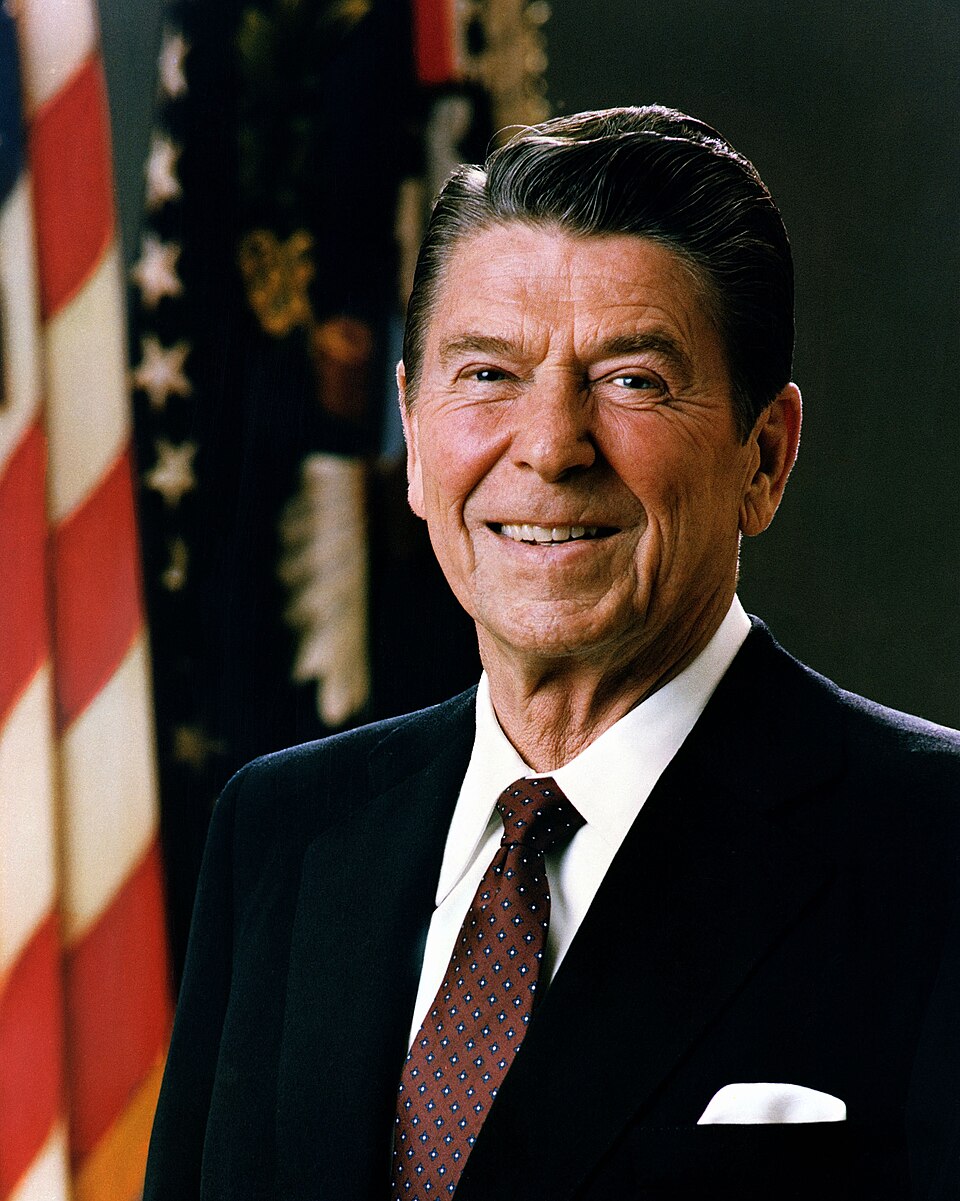
- The Bohemian Grove GatheringsElite men's retreat in California redwoods sparks decades of speculation about power and secrecy.Shared person: Ronald Reagan
- The New World OrderGlobal governance conspiracy theory meets real international cooperation — where does fear end and policy begin?Shared person: George H.W. Bush
- Skull and Bones Society at YaleYale's secretive elite society accused of grooming power brokers and manufacturing American leadershipShared person: George H.W. Bush
- 1986Historian Antony Sutton publishes 'America's Secret Establishment' exposing society's networksSkull and Bones Society at Yale
- 1989Spy Magazine publishes rare exposé based on leaked internal documents and interviews.The Bohemian Grove Gatherings
- 1989Kerry Subcommittee report documents Contra drug trafficking and U.S. officials' knowledge.The Death of Gary Webb and Dark Alliance
- 1985Robert Parry and Brian Barger publish AP stories linking Contras to cocaine trafficking.The Death of Gary Webb and Dark Alliance
- 1990George H.W. Bush uses phrase 'New World Order' in speech to Congress regarding Gulf WarThe New World Order
- 1991Pat Robertson publishes 'The New World Order,' popularizing conspiracy theory in religious circlesThe New World Order
Live Discussion
1 Perspective
Add to the record. Be specific. Cite where you can.
- TTest Reader· 6/20/2026This is a posted perspective from the smoke test.
- [[removed]· 6/20/2026[comment removed]
If you're learning about this topic for the first time, these are the best places to continue — documented evidence and historical relationships are the guide.
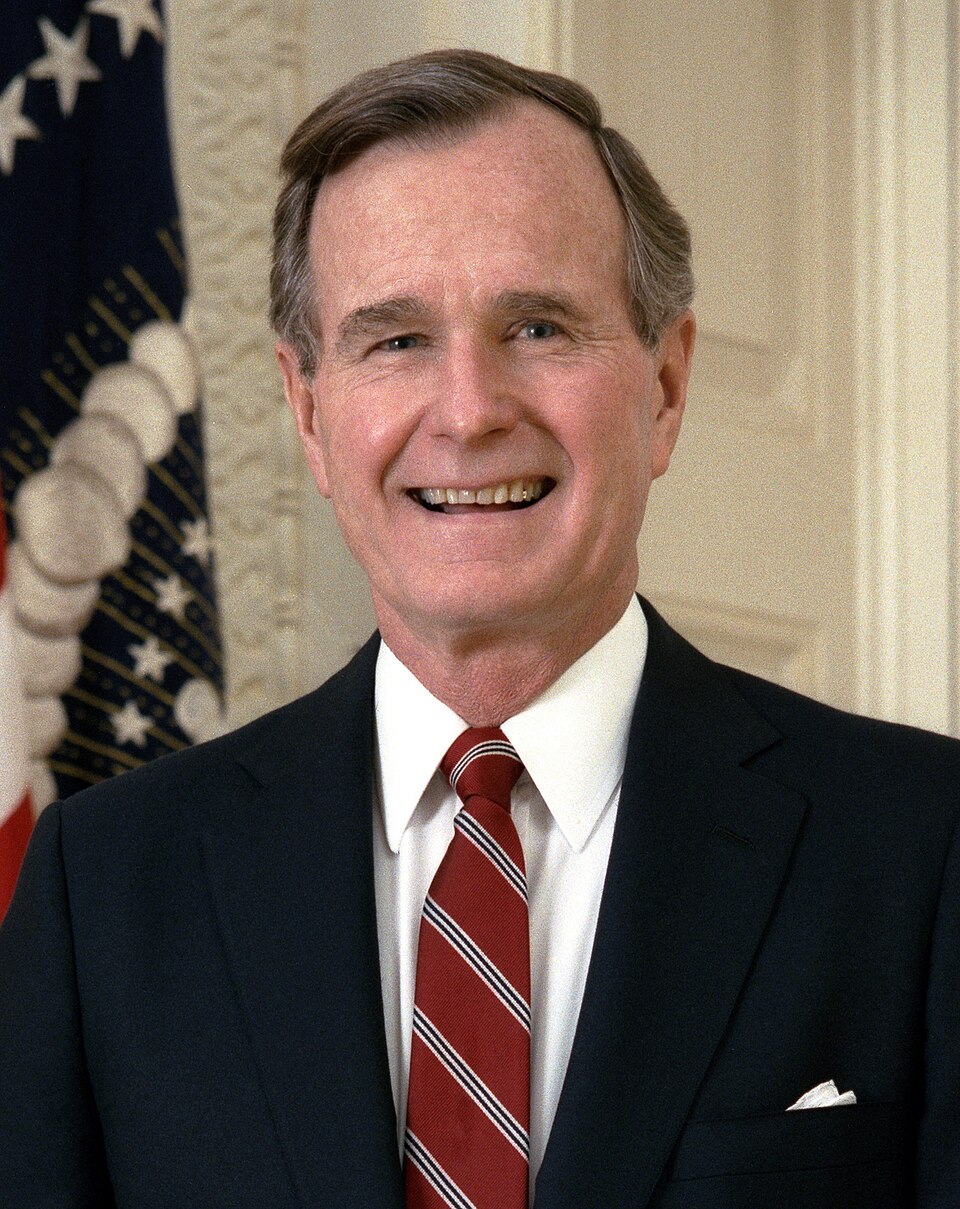
Named in “The Iran-Contra Affair” and 2 other published dossiers.
Shares 1 documented key player with “The Iran-Contra Affair”, including George H.W. Bush.
Read more dossiers like this
Get a quiet one-line bulletin when new investigative files are published. Bound to this dossier — useful for tracking follow-ups.