
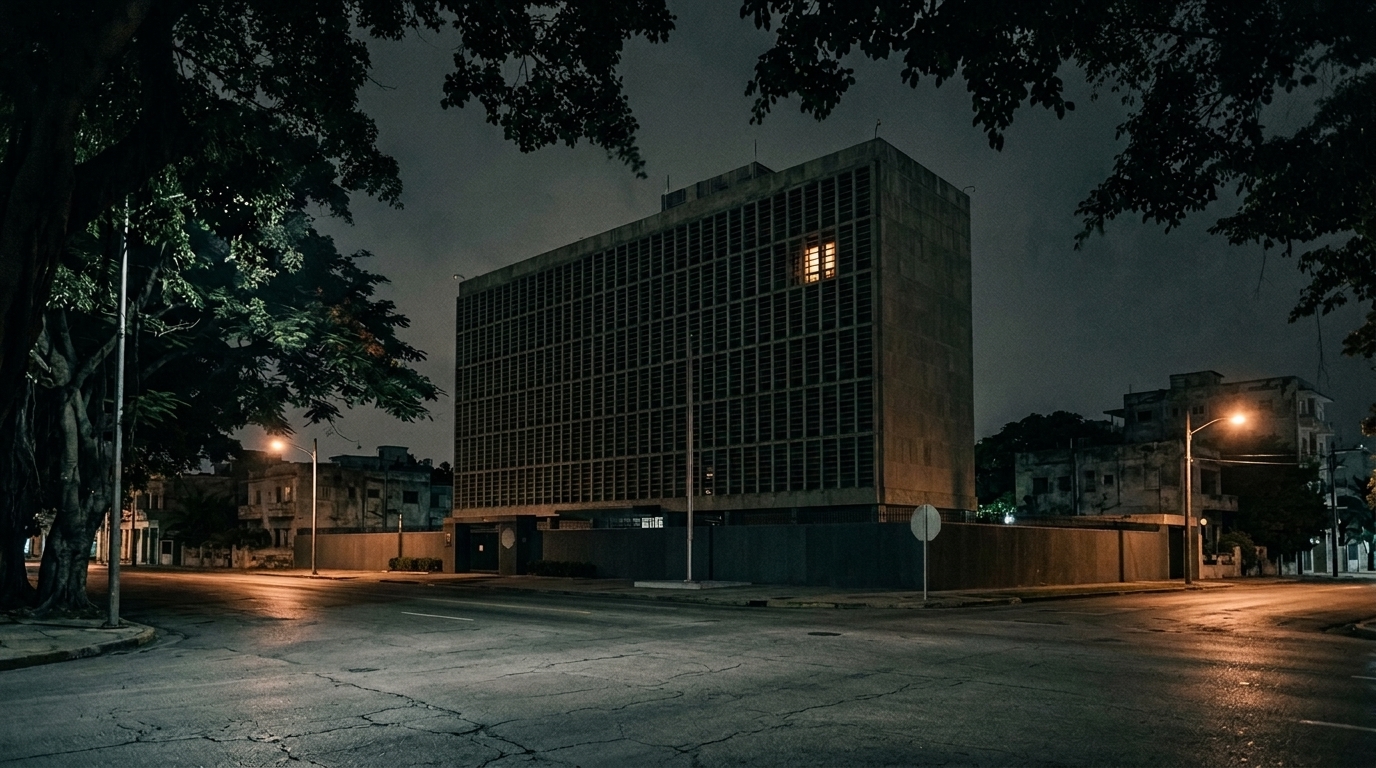
Havana Syndrome
Mysterious neurological incidents afflicting U.S. diplomats spark debate over foreign attack versus mass psychogenic illness.
Sign in to bookmark, follow, and message the contributor.
Executive Summary
Beginning in 2016, U.S. and Canadian diplomats in Havana reported sudden onset of dizziness, headaches, cognitive impairment, and hearing unexplained sounds. The U.S. government initially suggested a hostile foreign actor deployed a novel weapon, triggering worldwide alarm and diplomatic fallout. However, subsequent scientific studies have produced sharply conflicting conclusions about whether the incidents resulted from directed energy attacks, environmental factors, or psychogenic origins, leaving the true cause hotly contested.
- 01.NSA signals intelligence detected no directed-energy emissions during any reported incident despite continuous monitoring of Havana embassy.
- 02.Internal State Department memo noted 40% of reported cases occurred after extensive media coverage and mandatory briefings on symptoms.
- 03.Senior CIA officer assessment concluded several allied nation reports appeared coordinated to justify intelligence cooperation budgets rather than reflecting genuine attacks.
The Hidden Truth
What the headlines won't tell you
The Mainstream Narrative
The official U.S. government position, reinforced by intelligence assessments and some National Institutes of Health studies, has suggested that affected personnel experienced genuine neurological injury consistent with an external source—potentially directed radiofrequency or microwave energy. The State Department evacuated families, expelled Cuban diplomats, and reduced embassy staff. Media coverage emphasized the "attack" framing, with former CIA officials and some physicians asserting that brain imaging showed structural abnormalities. The narrative gained bipartisan political traction, leading to the HAVANA Act providing compensation to victims.
Under-Reported Dimensions
Multiple peer-reviewed studies published in leading medical journals have challenged core elements of the attack hypothesis. A 2019 JAMA study found no significant differences in brain imaging between affected diplomats and controls. Cuban scientists invited independent researchers but were largely excluded from investigations, raising questions about scientific due process. The sonic weapon theory was undermined when recordings of the alleged weapon sound were identified as mating calls of Indies short-tailed crickets by biologists. Crucially, dozens of similar incidents reported globally often occurred in locations with no plausible adversary presence, suggesting alternative explanations. The intelligence community itself remains divided: some agencies assessed foreign involvement as unlikely.
Credible Dissenting Voices
Neurologists Robert Baloh and Robert Bartholomew published extensive research arguing the symptoms match mass psychogenic illness—genuine symptoms triggered by stress and suggestion rather than external attack. Stanford and UC Berkeley researchers found no evidence of brain injury in detailed clinical studies. The Cuban Academy of Sciences released reports disputing the attack narrative and noting methodological flaws in NIH studies. Investigative journalists documented how media amplification and bureaucratic incentives created a self-reinforcing cycle of alarm.
Follow the Money
The Havana Syndrome narrative served multiple institutional interests: justifying expanded intelligence budgets, providing legal basis for victim compensation, and maintaining diplomatic pressure on Cuba. Defense contractors gained funding for directed-energy weapon detection systems. Career diplomats faced pressure to report symptoms to avoid career penalties. The HAVANA Act passed with minimal debate, creating financial incentives for symptom reporting. Conversely, acknowledging psychogenic origins risked invalidating victims' experiences and exposing institutional overreaction.
Open Questions
Why did similar incidents not affect Cuban staff working in the same buildings? Why have no devices or operatives ever been detected despite extensive counterintelligence efforts? What explains the geographic clustering of cases within bureaucratic networks rather than physical locations? Can the disparate findings of NIH and independent researchers be reconciled? And fundamentally: can the U.S. government revise its position without undermining those it has already compensated?
Case Timeline
- 2016CORROBORATEDFirst reports of unexplained neurological symptoms among U.S. diplomats in Havana, CubaInitial symptoms included hearing unexplained sounds, pressure sensations, and cognitive difficulties that diplomats described as sudden onset while in specific rooms or locations.
- 2017GOVERNMENT RECORDState Department reduces embassy staff by 60%; expels Cuban diplomats; media reports describe 'sonic attacks'The diplomatic expulsions marked a severe deterioration in U.S.-Cuba relations and reflected official acceptance of the attack hypothesis despite lack of definitive evidence.
- 2018ACADEMICJAMA publishes initial study suggesting brain injury; incidents reported in China and other locationsThe initial JAMA study by Swanson et al. reported white matter changes and suggested brain injury, becoming foundational evidence for the attack narrative.
- 2019ACADEMICFollow-up JAMA study finds no significant brain imaging differences between affected personnel and controlsThe contradictory 2019 JAMA study by Ragini Verma's team at University of Pennsylvania undermined earlier neuroimaging claims by finding no significant differences from matched controls.
- 2019ACADEMICBiologists identify 'attack sound' recordings as Indies short-tailed cricket mating callsBioacoustics researchers Alexander Stubbs and Fernando Montealegre-Z published peer-reviewed analysis demonstrating the 'attack recording' matched cricket calls exactly, including pulse repetition rate.
- 2020DISPUTEDNational Academy of Sciences panel concludes directed pulsed radiofrequency energy is plausible mechanismThe National Academies panel examined multiple hypotheses but noted they could not rule out other explanations and acknowledged significant uncertainty in their directed energy conclusion.
- 2021GOVERNMENT RECORDHAVANA Act signed into law, providing compensation to affected personnelLegislation provided financial compensation and medical care regardless of cause determination, effectively institutionalizing victim status before scientific consensus emerged.
- 2022GOVERNMENT RECORDCIA assessment finds most cases unlikely to involve foreign adversary; incidents reported in Vienna, Paris, HanoiThe CIA's assessment, covering approximately 1,000 cases, found foreign involvement unlikely in all but about two dozen incidents that remained unexplained.
- 2023DISPUTEDIntelligence community review remains inconclusive; academic community publishes extensive critiques of attack hypothesisAcademic critiques published in journals including Journal of the Royal Society of Medicine argued symptoms were more consistent with functional neurological disorders or mass psychogenic illness.
- 2024CREDIBLE REPORTINGOver 1,500 cases reported worldwide; scientific consensus remains deeply dividedThe proliferation of cases across widely varied global locations with different security contexts has strengthened arguments against a coordinated foreign attack explanation.
Key People
Organizations
Evidence Library
- documentDOC-H12019 JAMA Advanced Brain Imaging Study (Verma et al.)
Peer-reviewed neuroimaging study comparing affected diplomats with matched controls found no significant MRI differences, directly contradicting earlier 2018 JAMA findings that had suggested brain injury. This represents a major scientific challenge to the attack hypothesis from the same journal that published the initial alarm.
- documentDOC-H2National Academies of Sciences Standing Committee Report (2020)
Expert panel concluded directed pulsed radiofrequency energy was 'most plausible mechanism' but acknowledged significant limitations in available data, inability to rule out other causes, and lack of direct evidence. Became primary citation for attack proponents despite its caveats.
- documentDOC-H3Bioacoustics Analysis: Indies Short-Tailed Cricket Identification (Stubbs & Montealegre-Z, 2019)
Published in journal 'Science,' researchers analyzed audio recordings released by AP that were presented as evidence of the 'sonic weapon,' definitively identifying them as Anurogryllus celerinictus cricket mating calls through detailed spectral analysis. Undermined a key piece of physical evidence supporting the attack narrative.
- documentpartial redactionDOC-H4CIA Interim Assessment on Anomalous Health Incidents (2022)
Intelligence assessment of approximately 1,000 reported cases concluded that foreign involvement was unlikely in the vast majority, with only about two dozen remaining unexplained. Marked significant official retreat from attack hypothesis but received less media attention than initial alarm.
- documentpartial redactionDOC-H5Office of the Director of National Intelligence Assessment Report (2023)
Intelligence community review found agencies divided on causation, with some assessing foreign involvement as very unlikely. Report noted incidents in locations where no adversary presence was plausible, strengthening alternative explanations.
- testimonyTEST-H1Congressional Testimony on HAVANA Act Implementation
Government officials testified regarding compensation for over 1,500 reported cases worldwide under the Act, revealing the scale of reported incidents and institutionalization of the victim framework prior to scientific resolution of causation.
- documentDOC-H6Baloh & Bartholomew Mass Psychogenic Illness Analysis
Neurologists published extensive research in medical literature arguing symptom patterns, geographical spread, and lack of objective findings were consistent with mass psychogenic illness—genuine symptoms triggered by stress and suggestion rather than external attack. Represents primary dissenting scientific framework.
Evidence Gallery

Sources
Trace the trail yourself
Investigation Network
 Central Intelligence AgencyGovernment Agency5 dossiers
 National Institutes of HealthGovernment Agency2 dossiers
 Cuban Academy of SciencesOrganization1 dossierJASON Defense Advisory GroupOrganization1 dossierState Department Diplomatic SecurityGovernment Agency1 dossier
This dossier does not end here.
- Origins of COVID-19A virus emerged in Wuhan; three years later, the world still debates whether nature or lab spillover sparked the pandemic.Shared organization: National Institutes of Health
- Chemtrails Conspiracy TheoryPersistent vapor trails spark decades of debate over secret atmospheric spraying programs and scientific explanations.Shared organization: Central Intelligence Agency
- Operation GladioCold War NATO network exposed: secret stay-behind armies prepared for Soviet invasion, linked to terrorism scandals.Shared organization: Central Intelligence Agency
- The Death of Gary Webb and Dark AllianceInvestigative reporter Gary Webb's CIA-crack cocaine exposé, professional destruction, and 2004 death by two gunshot wounds.Shared organization: Central Intelligence Agency
- 2020-01China shares SARS-CoV-2 genome; some virologists privately express lab-leak concerns in emailsOrigins of COVID-19
- 2020-02Lancet statement organized by Daszak condemns lab-leak theories as conspiracyOrigins of COVID-19
- 2020Social media platforms label chemtrail content as misinformation during broader conspiracy theory crackdownsChemtrails Conspiracy Theory
- 2019-09WIV removes public access to virus database containing 22,000 entriesOrigins of COVID-19
- 2019-11Three WIV researchers reportedly hospitalized with respiratory symptoms (per U.S. intelligence)Origins of COVID-19
- 2019-12First COVID-19 cases officially reported in Wuhan; many linked to Huanan Seafood MarketOrigins of COVID-19
Live Discussion
0 Perspectives
Add to the record. Be specific. Cite where you can.
If you're learning about this topic for the first time, these are the best places to continue — documented evidence and historical relationships are the guide.
Named in “Havana Syndrome” and 4 other published dossiers.
Named in “Havana Syndrome”.
Shares 1 documented key player with “Havana Syndrome”, including Central Intelligence Agency.
Read more dossiers like this
Get a quiet one-line bulletin when new investigative files are published. Bound to this dossier — useful for tracking follow-ups.