Northrop Grumman
Northrop Grumman Corporation is the fourth-largest U.S. defense contractor by revenue, specializing in aerospace, defense systems, cyber operations, and nuclear weapons infrastructure. Northrop Grumman appears in The Archive as a principal actor in the Military-Industrial Complex, representing the structural integration of private profit motive with national security policy that President Eisenhower warned against in 1961.
Northrop Grumman Corporation is the fourth-largest U.S. defense contractor by revenue, specializing in aerospace, defense systems, cyber operations, and nuclear weapons infrastructure. Formed through the 1994 merger of Northrop and Grumman corporations, it manufactures strategic bombers (B-2, B-21), unmanned systems, missile defense components, and nuclear delivery platforms under contracts worth tens of billions annually from the Department of Defense and intelligence agencies.
- Legal Name
- Northrop Grumman Corporation
- Founded
- 1994 (merger); predecessor Northrop Corporation founded 1939, Grumman Corporation 1929
- Headquarters
- Falls Church, Virginia, United States
- Industry Sector
- Aerospace, defense, electronics, cybersecurity, space systems
- Defense Contracting Rank
- Fourth-largest U.S. defense contractor by revenue (as of 2023)
- Annual Revenue (2023)
- Approximately $39.3 billion
- Employees
- Approximately 95,000 worldwide (as of 2023)
- Primary Government Client
- U.S. Department of Defense, intelligence agencies, NASA, allied governments
- Major Product Lines
- Strategic bombers, unmanned systems, missile defense, cyber operations, space systems, nuclear command infrastructure
- Security Clearance Status
- Extensive classified and Top Secret/SCI contract portfolio
- Stock Exchange
- NYSE: NOC
- CEO (2024)
- Kathy Warden (since 2019)
Northrop Grumman appears in The Archive as a principal actor in the Military-Industrial Complex, representing the structural integration of private profit motive with national security policy that President Eisenhower warned against in 1961. The company's extensive classified programs, revolving-door employment relationships with Pentagon leadership, and lobbying expenditures epitomize the systematic influence defense contractors exert over procurement, policy, and military strategy. It appears in the aerospace and nuclear scientists deaths dossier due to its workforce of thousands of engineers with security clearances working on advanced weapons systems, nuclear modernization, hypersonics, and space programs—domains where the 2024-2026 cluster of unusual deaths has occurred. Understanding Northrop Grumman's operational scope, classified portfolio, and position within defense contracting networks is essential to evaluating structural questions about industry influence, personnel security, and the concentration of strategic capabilities in private hands.
# Northrop Grumman Corporation
Identity
Northrop Grumman Corporation ranks as the fourth-largest defense contractor in the United States measured by annual revenue from Department of Defense contracts. Headquartered in Falls Church, Virginia, the company operates as a publicly traded aerospace and defense technology manufacturer with approximately 95,000 employees worldwide as of 2023. The corporation reported $39.3 billion in revenue for fiscal year 2023, with approximately 85% derived from U.S. government contracts, primarily with the Department of Defense, intelligence community agencies, NASA, and the Department of Energy's nuclear security enterprise.
The company organizes its operations across four segments: Aeronautics Systems (military aircraft including strategic bombers and unmanned platforms), Defense Systems (weapons, munitions, missile components, and ground systems), Mission Systems (sensors, radar, electronic warfare, cyber operations), and Space Systems (satellites, missile defense, launch systems, and strategic missile components). Northrop Grumman holds thousands of active security clearances ranging from Secret to Top Secret/Sensitive Compartmented Information, positioning it as a primary implementer of classified programs across nuclear weapons modernization, signals intelligence, space reconnaissance, and next-generation weapons development.
Origins & Charter
Northrop Grumman formed on April 4, 1994, through the merger of Northrop Corporation and Grumman Corporation, two aerospace firms with distinct military aviation legacies dating to the interwar period. Northrop Corporation, founded by John Knudsen Northrop in 1939 in Hawthorne, California, established its reputation developing the P-61 Black Widow night fighter during World War II and the flying wing designs that evolved into the B-2 stealth bomber. Grumman Corporation, founded by Leroy Grumman on Long Island, New York, in 1929, produced carrier-based naval aircraft including the F-14 Tomcat and the Apollo Lunar Module that landed astronauts on the moon between 1969 and 1972.
The 1994 merger represented one transaction in a wave of defense industry consolidation following the Cold War's end. Pentagon procurement budgets declined sharply after 1989, and Deputy Secretary of Defense William Perry convened defense industry executives in July 1993 for what became known as the "Last Supper"—a meeting explicitly encouraging mergers to reduce excess capacity. The resulting consolidation reduced major U.S. defense prime contractors from approximately 15 in 1990 to five by 2000. Northrop's $2.1 billion acquisition of Grumman created a combined entity capable of competing for larger integrated contracts.
Following the merger, Northrop Grumman continued aggressive expansion, acquiring Westinghouse Electronic Systems (1996), Logicon (1997), Litton Industries (2001), TRW Inc. (2002), and numerous smaller firms specializing in electronics, information technology, and space systems. The TRW acquisition for $7.8 billion particularly expanded the company's position in satellite systems, missile defense, and classified intelligence programs. In 2011, Northrop Grumman spun off its shipbuilding division as Huntington Ingalls Industries, refocusing the parent company on aerospace, electronics, and cyber operations.
Structure & Leadership
Northrop Grumman operates as a Delaware corporation with executive offices in Falls Church, Virginia, and major production facilities in California, Florida, Virginia, Alabama, Utah, and Maryland. The company maintains additional facilities across 50 U.S. states and approximately 25 countries. Organizational structure divides the corporation into four operating sectors, each functioning as a semi-autonomous business unit with dedicated engineering, manufacturing, and program management staff:
Aeronautics Systems (headquartered in Redondo Beach, California) produces manned and unmanned aircraft, including the B-2 Spirit stealth bomber, the B-21 Raider next-generation bomber under development, the RQ-4 Global Hawk high-altitude surveillance drone, and components for the F-35 Joint Strike Fighter. This sector employs advanced composite manufacturing, low-observable (stealth) technologies, and autonomous flight systems.
Defense Systems (headquartered in Reston, Virginia) manufactures weapons, ammunition, armored vehicles, and tactical systems. Products include precision munitions, missile components, gun systems for Army and Marine ground vehicles, and battlefield sensors.
Mission Systems (headquartered in Linthicum, Maryland) develops and integrates sensors, radar systems, electronic warfare platforms, command and control systems, and cyber operations capabilities. This sector supports signals intelligence collection, airborne early warning systems (E-2D Hawkeye), and infrared surveillance.
Space Systems (headquartered in Redondo Beach, California) builds military and intelligence satellites, ground-based missile defense interceptors, solid rocket motors for intercontinental ballistic missiles, and launch systems. This sector maintains the production line for Ground-Based Midcourse Defense interceptors and manufactures strategic missile components under Air Force contracts.
Kathy Warden has served as chief executive officer and board chair since 2019, the first woman to lead a top-five U.S. defense contractor. Warden joined Northrop Grumman in 2008 and previously led the Mission Systems and Information Systems divisions. The board of directors includes former senior military officers, former government officials, and corporate executives—a composition typical of major defense contractors that facilitates relationship networks with procurement decision-makers.
Major Activities & Operations
Northrop Grumman's primary business consists of designing, developing, and manufacturing weapons systems, surveillance platforms, and enabling technologies under cost-plus and fixed-price contracts with the U.S. government. The Department of Defense represented approximately 85% of 2023 revenue, with intelligence agencies, NASA, international military customers, and commercial clients comprising the remainder.
Strategic Bomber Programs: The company manufactures and sustains the B-2 Spirit, a stealth bomber introduced in 1997 with a fleet of 20 aircraft capable of delivering conventional and nuclear weapons. In 2015, Northrop Grumman won the Air Force contract to develop the B-21 Raider, a next-generation stealth bomber intended to replace aging B-1 and B-2 fleets. The B-21 program, with an estimated total cost exceeding $200 billion for development and production of at least 100 aircraft, represents the largest Air Force acquisition program. First flight occurred in November 2023. The program operates under strict classification; even the per-unit cost remains officially undisclosed, with independent estimates ranging from $550 million to $750 million per aircraft in 2023 dollars.
Unmanned Systems: Northrop Grumman produces the RQ-4 Global Hawk, a high-altitude long-endurance drone conducting surveillance missions for the Air Force and Navy. The company also developed the X-47B unmanned combat air vehicle demonstrator, which completed carrier-based operations including autonomous takeoffs, landings, and aerial refueling between 2013 and 2015. These programs position Northrop Grumman as a leader in autonomous systems for intelligence, surveillance, and reconnaissance.
Missile Defense: The company serves as prime contractor for the Ground-Based Midcourse Defense system, the United States' primary defense against intercontinental ballistic missile threats. Northrop Grumman manufactures the Ground-Based Interceptors deployed at Fort Greely, Alaska, and Vandenberg Space Force Base, California. The system, operational since 2004, has demonstrated mixed test results; a 2020 Government Accountability Office report documented a 55% intercept success rate across all flight tests conducted through 2019. The company also produces sensors and components for Aegis ballistic missile defense and Terminal High Altitude Area Defense systems.
Space and Satellite Systems: Northrop Grumman designs and builds classified reconnaissance satellites for the National Reconnaissance Office and communication satellites for military and intelligence use. The company manufactures solid rocket motors used in Minuteman III intercontinental ballistic missiles and produces boosters for NASA's Space Launch System. In 2018, the company acquired Orbital ATK, adding the Antares rocket and Cygnus cargo spacecraft for International Space Station resupply missions.
Nuclear Weapons Infrastructure: Northrop Grumman holds major contracts supporting nuclear weapons modernization, including development of the Ground-Based Strategic Deterrent (GBSD) intercontinental ballistic missile to replace the Minuteman III. The GBSD program, awarded in 2020 with an estimated cost of $95.8 billion over its lifecycle, will produce 400 missiles carrying nuclear warheads. The company also supports the Long Range Stand Off Weapon, a nuclear-armed cruise missile, and modernization of command-and-control systems for strategic forces.
Cyber Operations and Electronic Warfare: Through its Mission Systems division, Northrop Grumman develops cyber capabilities for offensive and defensive operations, signals intelligence collection systems, and electronic warfare platforms. Much of this work remains classified; public disclosures indicate contracts supporting National Security Agency programs, Air Force cyber operations, and military communications security.
Historical Importance
Northrop Grumman's predecessor companies and the merged corporation have occupied central positions in U.S. military aviation and strategic weapons development for eight decades. Grumman's carrier-based fighters dominated naval aviation from the 1940s through the 1990s, while Northrop's flying wing research produced the only operational stealth bomber. The company's current role as prime contractor for the next-generation strategic bomber, ground-based missile defense, and intercontinental ballistic missile replacement places it at the core of strategic weapons systems intended to remain operational into the 2070s.
The corporation exemplifies structural characteristics of the military-industrial complex as articulated by President Dwight D. Eisenhower in his January 1961 farewell address. Eisenhower warned that "the conjunction of an immense military establishment and a large arms industry" created potential for "unwarranted influence" over government policy. Northrop Grumman's scale—$39 billion in largely government-funded revenue, 95,000 employees with economic presence across most congressional districts, extensive classified programs limiting public oversight, and systemic personnel interchange with the Pentagon—demonstrates the integration of private corporate structures with national security decision-making that concerned Eisenhower.
The company's lobbying operations, like those of other major defense contractors, maintain continuous presence in Washington to influence procurement priorities, budget allocations, and export policy. Federal disclosure records show Northrop Grumman spent approximately $12.8 million on federal lobbying in 2023, with lobbyists engaging Congressional Armed Services Committees, appropriations committees, and executive branch agencies on program funding and policy issues.
Documented Controversies
Confirmed by Court In 2009, Northrop Grumman paid $325 million to settle False Claims Act allegations involving defective satellite components. The Department of Justice complaint alleged that between 1997 and 2000, TRW Inc. (acquired by Northrop Grumman in 2002) provided the Air Force with satellite components that did not meet contract specifications and submitted false test data. The settlement resolved civil fraud claims without admission of liability.
Confirmed by Court In 2005, the company paid $62 million to settle charges that it fraudulently billed the government for defective parts on the B-2 bomber program. A whistleblower lawsuit alleged Northrop Grumman knowingly delivered faulty radar warning components between 1995 and 2003 while certifying them as meeting specifications. The settlement included $32.5 million to the federal government and $29.5 million to the State of California under the False Claims Act.
Government Finding The Department of Defense Inspector General issued reports in 1994 and 2008 documenting accounting irregularities and questioned costs on multiple Northrop Grumman contracts. A 2008 audit identified $33 million in unsupported or inadequately documented costs billed to the government. The company disputed some findings but implemented corrective actions under Defense Contract Audit Agency oversight.
Official Record Northrop Grumman has been party to numerous bid protests and contract disputes. In 2008, the company partnered with EADS (Airbus parent company) to win the Air Force KC-45 aerial refueling tanker contract over Boeing. Following Boeing's protest, the Government Accountability Office sustained the complaint, finding the Air Force evaluation contained significant errors. The Air Force reopened the competition; Northrop Grumman subsequently withdrew, and Boeing received the contract for what became the KC-46 program. The episode illustrated intense competition and political pressure surrounding major defense procurements.
Official Record Congressional and Pentagon records document extensive "revolving door" employment between Northrop Grumman and government defense positions. Between 2008 and 2018, the Project on Government Oversight documented that Northrop Grumman employed at least 229 former senior government officials, military officers, and members of Congress. Conversely, numerous Northrop Grumman executives have moved into senior Pentagon acquisition positions. While legal under existing ethics rules with cooling-off periods, this personnel interchange raises structural questions about procurement independence and the alignment of corporate and institutional interests.
Credible Allegation Watchdog organizations including the Project on Government Oversight have documented instances where Northrop Grumman and other major contractors successfully lobbied to continue programs despite poor performance or Pentagon recommendations for termination. The Ground-Based Midcourse Defense program, despite documented technical shortcomings and mixed test performance, has received continuous funding increases—a pattern critics attribute partly to contractor lobbying and the program's economic presence across multiple congressional districts.
Established Fact Northrop Grumman participates in the practice of "political engineering"—deliberately distributing subcontracts and facilities across numerous congressional districts to build political support. The B-21 bomber program, for example, involves suppliers in 40 states. Congressional Research Service analyses have documented how this strategy complicates program cancellation by creating broad coalitions of members with employment stakes in continuation, regardless of strategic necessity or cost-effectiveness.
Investigated Federal prosecutors investigated the company's handling of classified information in 2018 following reports of security violations at a Mission Systems facility. Details remain largely sealed; the matter concluded without public charges but resulted in enhanced security protocols under Defense Counterintelligence and Security Agency oversight.
Investigations & Official Findings
Government oversight of Northrop Grumman occurs through multiple channels: Defense Contract Management Agency surveillance, Defense Contract Audit Agency financial reviews, Inspector General audits, Congressional oversight, and Department of Justice enforcement of the False Claims Act. Given the volume and complexity of the company's contracts—thousands of active agreements with classified components—investigations and audits represent routine features of the contractor-government relationship.
The Government Accountability Office has issued dozens of reports examining programs where Northrop Grumman serves as prime contractor. A 2020 GAO report on the Ground-Based Midcourse Defense system found "the system has not demonstrated through flight testing that it can defend the U.S. homeland against the current missile threat" and recommended program restructuring. A 2019 report on the B-21 program noted the Air Force granted Northrop Grumman extensive classification waivers limiting normal cost oversight, raising concerns about accountability and the potential for cost growth hidden from public scrutiny.
The Project on Government Oversight, a nonprofit watchdog, maintains a database tracking contractor misconduct. Between 1995 and 2024, this database lists Northrop Grumman and its predecessors/subsidiaries in connection with approximately 60 instances of settled claims, fines, or penalties involving False Claims Act violations, export control breaches, environmental violations, employment discrimination, and procurement fraud. Total penalties exceeded $750 million. The company disputes characterizations of this record as indicative of systematic misconduct, noting the database includes settled claims without admission of wrongdoing and represents a small fraction relative to thousands of successfully executed contracts.
Congressional Armed Services Committees conduct annual oversight hearings where Northrop Grumman executives testify on major programs. These proceedings, while providing transparency on schedule and high-level cost data, rarely penetrate classification barriers surrounding technical performance, threat assessments, or strategic rationale—a structural limitation on democratic accountability for weapons development.
Legacy & Historical Debate
Northrop Grumman's legacy intertwines with broader debates over the military-industrial complex's influence on American foreign policy, defense spending priorities, and the balance between security and democratic accountability. Supporters emphasize the company's technological achievements—stealth aircraft that provide strategic advantage, missile defense systems protecting against emerging threats, and space capabilities supporting national security. From this perspective, Northrop Grumman represents the successful mobilization of private sector innovation and engineering expertise in service of defensive needs, producing capabilities adversaries cannot match.
Critics argue the corporation exemplifies structural pathologies Eisenhower warned against: a profit-driven entity with institutional interests in sustained high defense spending, threat inflation, and procurement of expensive systems regardless of strategic necessity. The revolving door between industry and government, extensive lobbying, political engineering of contracts across congressional districts, and classification that prevents public scrutiny create conditions where corporate revenue priorities can shape national security policy. The company's centrality in nuclear weapons modernization—a $1.7 trillion thirty-year effort across all three legs of the strategic triad—places private shareholders in position to profit from investments in civilization-ending weaponry, raising ethical questions distinct from conventional defense.
The concentration of strategic capabilities in five major contractors (Lockheed Martin, Raytheon, Boeing Defense, General Dynamics, and Northrop Grumman) creates dependencies that limit government leverage and complicate competition. Northrop Grumman's position as sole-source provider for strategic bombers and ground-based missile defense components means program cancellation or significant restructuring could threaten unique industrial capacity with no alternative production sources. This dynamic—where national security becomes dependent on specific corporate entities—inverts traditional relationships of government authority over industry.
Defense acquisition scholars debate whether the current contractor model produces optimal outcomes. Studies by the RAND Corporation and Congressional Research Service have documented persistent cost growth and schedule delays across major programs, patterns some analysts attribute to inadequate competition and insufficient government technical expertise to oversee contractors effectively. Others argue that the complexity of modern weapons systems makes some cost uncertainty inevitable and that private contractors deliver capabilities government arsenals could not match.
Continue Investigating
Northrop Grumman's operations intersect with fundamental questions about The Archive's core investigations. Its position within The Military-Industrial Complex dossier illustrates how defense contracting has evolved into a permanent institutional structure shaping national priorities. The company's role manufacturing strategic weapons, developing autonomous systems, and conducting classified cyber operations places it at the intersection of technological capability and policy influence that Eisenhower identified as democracy's challenge.
Its appearance in The 2024-2026 Deaths of American Aerospace and Nuclear Scientists dossier reflects the company's employment of thousands of cleared engineers working on advanced weapons, nuclear systems, hypersonics, directed energy, space warfare, and other classified programs. Whether the unusual cluster of deaths among aerospace professionals includes Northrop Grumman personnel, and whether any such deaths warrant scrutiny beyond natural or accidental causes, requires examination of publicly available records while respecting classification boundaries and avoiding speculation.
Further investigation should examine:
- ·Comparison of Northrop Grumman's contracting patterns, cost performance, and technical delivery against competitors Lockheed Martin Corporation, Boeing Defense, Raytheon Technologies, and General Dynamics—do systematic differences exist, or do all exhibit similar characteristics?
- ·Personnel flows between Northrop Grumman and The Pentagon/Department of Defense, particularly senior acquisition officials, using financial disclosures and ethics filings available through government databases
- ·Advocacy by Northrop Grumman and industry groups before Congressional Armed Services Committees on budget priorities, especially regarding nuclear modernization, missile defense, and space programs where the company holds dominant positions
- ·Analysis from policy institutions like Center for Strategic and International Studies evaluating whether current force structure and weapons programs reflect strategic necessity or industrial-political considerations
- ·Oversight reports from Project on Government Oversight examining specific instances of cost overruns, performance failures, or procurement irregularities, cross-referenced with official audits
- ·Broader patterns documented in dossiers on government transparency (The Pentagon Papers, Snowden and NSA Mass Surveillance, Operation Mockingbird) and institutional capture to contextualize defense contracting within historical frameworks of state-corporate relationships
- ·Technical assessments of missile defense effectiveness, strategic bomber necessity, and nuclear force modernization to evaluate whether programs serve defensive requirements or institutional-economic interests—a question requiring deep engagement with strategic theory and threat assessment beyond corporate advocacy
The documentary record permits fact-based evaluation of Northrop Grumman's performance, influence mechanisms, and role within defense policy structures. What remains difficult to assess—and what motivates enduring debate—is whether the current arrangement serves national security optimally, or whether alternative models might deliver equivalent capability with greater accountability, lower cost, and reduced incentive to sustain threat perceptions justifying permanent high expenditure.
- 1939Northrop Corporation founded by John Knudsen Northrop in Hawthorne, California
- 1942-1945Northrop produces P-61 Black Widow night fighter; Grumman manufactures F6F Hellcat and TBF Avenger carrier aircraft for World War II
- 1969-1972Grumman-built Apollo Lunar Module lands astronauts on the moon during six Apollo missions
- 1989B-2 Spirit stealth bomber, developed by Northrop, makes first flight
- 1993Deputy Secretary of Defense William Perry's 'Last Supper' meeting encourages defense industry consolidation
- 1994Northrop Corporation and Grumman Corporation merge to form Northrop Grumman
- 2002Northrop Grumman acquires TRW Inc. for $7.8 billion, significantly expanding space systems and classified programs capabilities
- 2005Company pays $62 million to settle False Claims Act allegations regarding defective B-2 bomber components
- 2009Northrop Grumman pays $325 million to settle allegations of providing defective satellite components with false test data
- 2011Company spins off shipbuilding division as Huntington Ingalls Industries
- 2015Northrop Grumman wins contract to develop B-21 Raider next-generation stealth bomber
- 2018Acquisition of Orbital ATK adds rocket motors, launch systems, and space cargo capabilities
- 2020Air Force awards Northrop Grumman the $95.8 billion Ground-Based Strategic Deterrent ICBM contract
- 2023B-21 Raider completes first flight; company reports annual revenue of $39.3 billion
- 2024Northrop Grumman continues production of strategic weapons, missile defense systems, and classified space programs
- S1Justice Department Announces Largest Government Fraud Settlement in History: Northrop Grumman to Pay $325 MillionU.S. Department of Justice · primary
- S2Northrop Grumman Corporation False Claims Act SettlementU.S. Department of Justice Civil Division · primary
- S3Northrop Grumman Pays $62 Million to Settle Fraud Claims Related to B-2 Stealth BomberU.S. Department of Justice · primary
- S4Department of Defense Awards $13.3 Billion Contract for Ground Based Strategic DeterrentU.S. Department of Defense · primary
- S5Ground Based Strategic Deterrent: Program Status and Oversight IssuesU.S. Government Accountability Office · primary
- S6Missile Defense: Comprehensive Testing Needed to Inform Program DecisionsU.S. Government Accountability Office · primary
- S7Brass Parachutes: The Problem of the Pentagon Revolving DoorProject on Government Oversight · investigative
- S8Lobbying Disclosure Act Database: Northrop GrummanU.S. Senate Office of Public Records · primary
- S9Defense Contract Audit Agency: Northrop Grumman Audit ReportDepartment of Defense Inspector General · primary
- S10B-21 Raider Long-Range Strike Bomber: Background and IssuesCongressional Research Service · primary
- S11B-21 Bomber Program: First Flight and Development StatusU.S. Air Force · primary
- S12B-21 Bomber: Oversight Challenges and Transparency IssuesU.S. Government Accountability Office · primary
- S13President Dwight D. Eisenhower's Farewell Address (1961)U.S. National Archives · primary
- S14Military-Industrial Complex Speech Context and ImpactDwight D. Eisenhower Presidential Library · primary
- S15Defense Industry Consolidation and the Last SupperRAND Corporation · academic
- S16Northrop Grumman CorporationWikipedia · reference
- S17The Pentagon's Weapons Programs: Annual Assessment of Major SystemsU.S. Government Accountability Office · primary
- S18Defense Contracting: Trends and Oversight ChallengesCenter for Strategic and International Studies · mainstream
If you're learning about this topic for the first time, these are the best places to continue — documented evidence and historical relationships are the guide.
Northrop Grumman is documented in the evidence record of this published dossier.
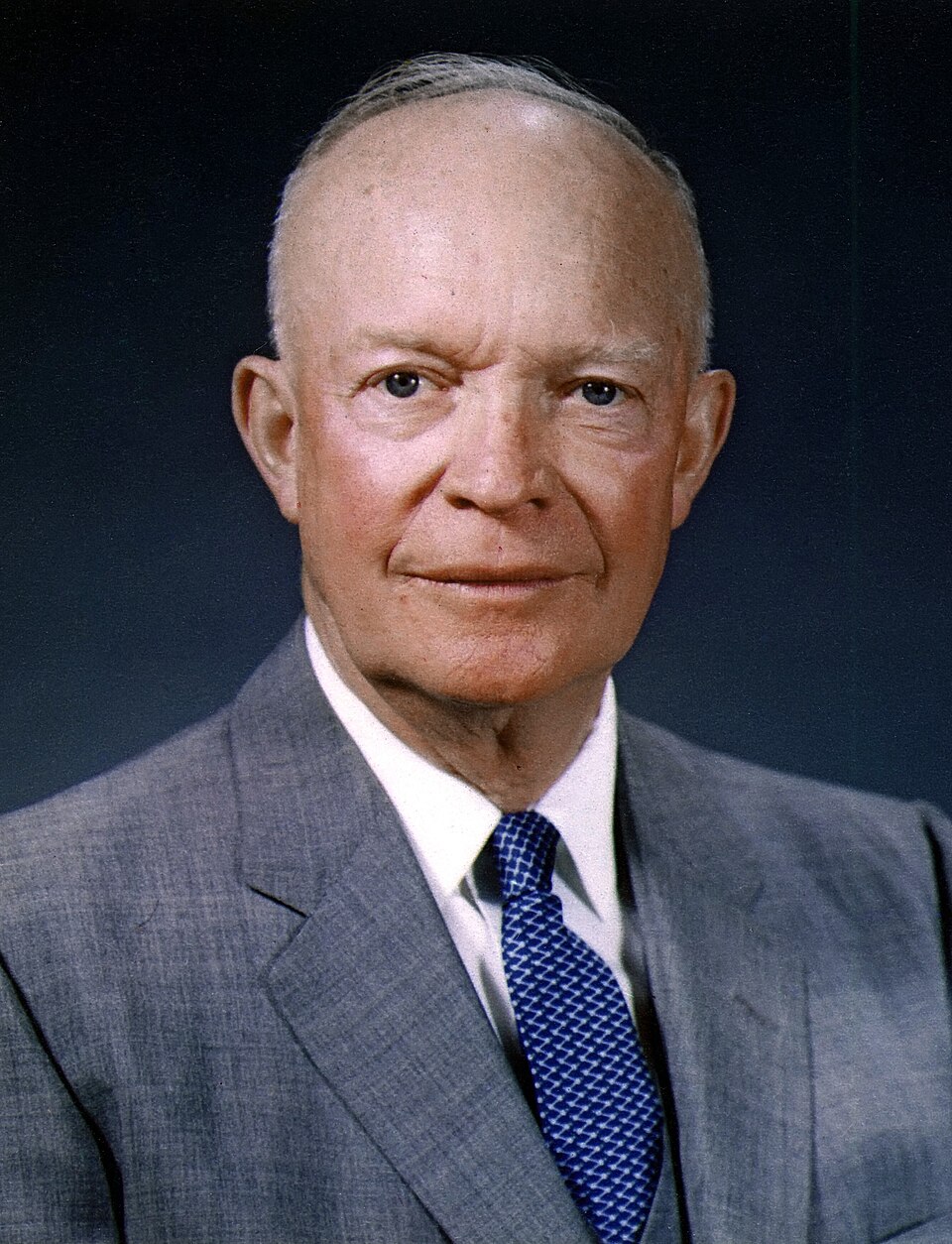
President whose farewell address warning about the military-industrial complex provides the conceptual framework for analyzing Northrop Grumman's structural influence.
Major competitor in military aircraft, satellites, and missile defense; tanker contract competition with Northrop Grumman illustrated political dynamics of procurement.