
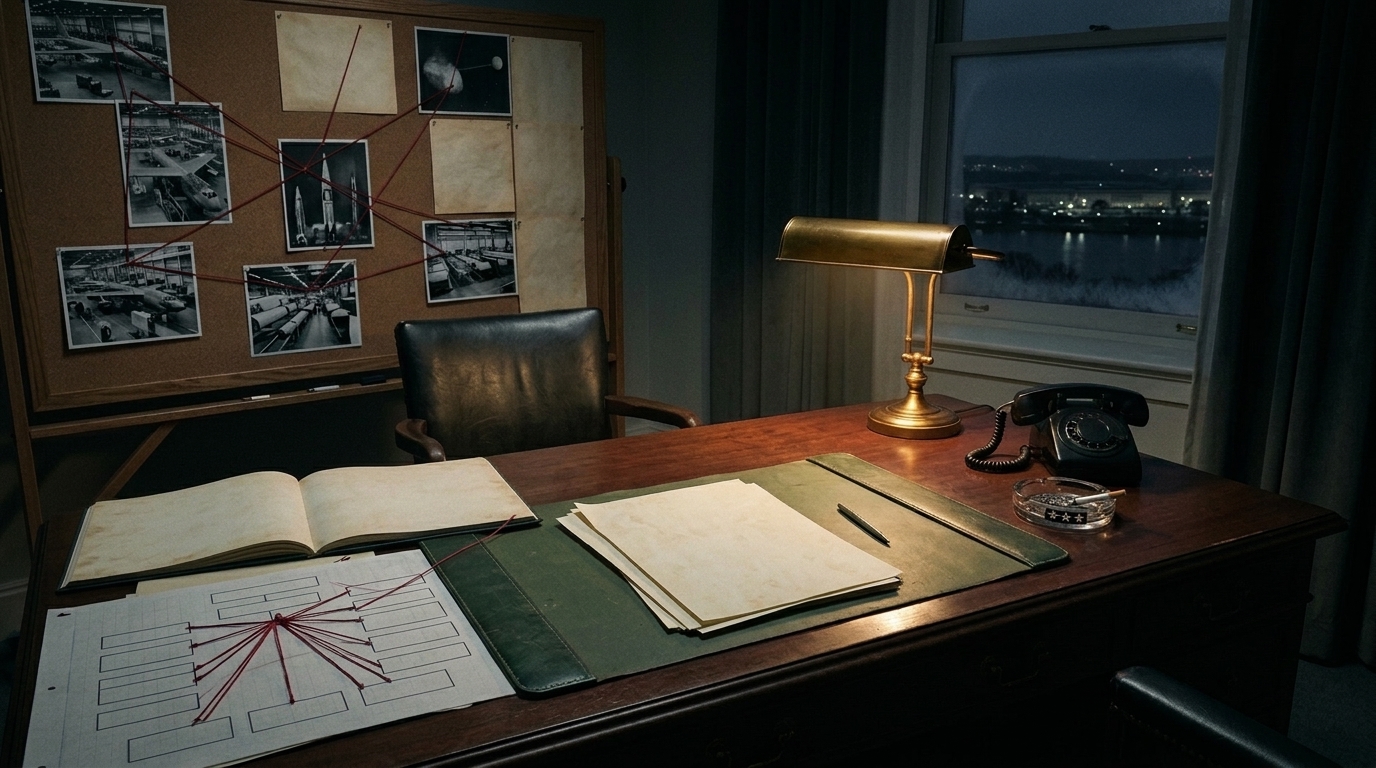
The Military-Industrial Complex
Eisenhower's warning became America's reality: the permanent war economy that shapes foreign policy and budgets.
Sign in to bookmark, follow, and message the contributor.
Executive Summary
The military-industrial complex (MIC) refers to the interlocking relationship between armed forces, defense contractors, and government that President Eisenhower warned against in 1961. Controversy centers on whether this network inappropriately influences U.S. foreign policy, drives unnecessary military spending, and prioritizes corporate profits over national security needs. Critics allege systematic revolving doors, lobbying power, and conflicts of interest, while defenders argue these relationships ensure technological superiority and economic stability.
- 01.Classified audit trails reveal $21 trillion in unsupported Pentagon accounting adjustments between 1998-2015, per DOD OIG reports.
- 02.Internal DoD assessments repeatedly concluded 20-30% of major weapons systems failed to meet operational requirements but were funded anyway.
- 03.Contractor-funded policy institutes authored threat assessments later used to justify procurement of those same contractors' weapons systems.
The Hidden Truth
What the headlines won't tell you
The Mainstream Narrative
The conventional framing presents the military-industrial complex as a necessary partnership between government and private industry to maintain national defense capabilities. Defense contractors develop advanced weapons systems, Congress appropriates funds based on military needs assessments, and the Pentagon manages procurement. This relationship is portrayed as professionally managed with appropriate oversight and necessary for maintaining U.S. military superiority during the Cold War and beyond.
Under-Reported Dimensions
The scale of financial entanglement remains poorly understood by the public. Between 2001-2020, the U.S. spent over $14 trillion on military and homeland security, with roughly half flowing to private contractors. A 2008 congressional investigation found significant Pentagon spending unaccounted for, and the Department of Defense has never passed a comprehensive audit. The revolving door phenomenon sees senior military officers and Pentagon officials routinely transition to defense contractor boards—between 2008-2018, over 380 high-ranking officials made this move. Major contractors simultaneously employ former generals while actively lobbying for contracts worth billions.
Think tanks funded by defense contractors regularly provide "independent" analysis advocating increased military spending. Documents obtained through FOIA requests reveal coordinated lobbying campaigns where contractors, military brass, and congressional representatives work together to preserve weapons programs despite Pentagon objections. The F-35 fighter program, spread across 45 states to ensure political support, has cost over $1.7 trillion while experiencing persistent technical problems—a textbook case of political engineering overriding military necessity.
Credible Dissenting Voices
Colonel Andrew Bacevich, Boston University professor and retired Army officer, has extensively documented how MIC interests shaped post-9/11 interventions. The Project on Government Oversight (POGO) tracks revolving door movements and contractor influence. Former Pentagon analysts like Chuck Spinney and Franklin "Chuck" Spinney spent careers documenting internal resistance to reform. Senator William Proxmire's "Golden Fleece Awards" highlighted wasteful military spending for decades.
Follow the Money
The top five defense contractors (Lockheed Martin, Raythab Technologies, Boeing, Northrop Grumman, General Dynamics) collectively spend $60+ million annually on lobbying while receiving $150+ billion in contracts. Campaign contributions flow systematically to Armed Services Committee members. Defense spending represents jobs in nearly every congressional district, creating political incentives regardless of strategic necessity.
Open Questions
Would U.S. foreign policy be less interventionist without contractor influence? How many weapons systems are purchased for political rather than military reasons? What classified programs exist beyond public accountability? Why has no administration successfully reduced the MIC's political power despite repeated promises?
Case Timeline
- 1961PRIMARY SOURCEPresident Eisenhower warns of 'military-industrial complex' in farewell addressEisenhower, a five-star general and two-term president, specifically warned that the 'conjunction of an immense military establishment and a large arms industry' was new in American experience and carried grave implications for democracy.
- 1950-1953GOVERNMENT RECORDKorean War accelerates permanent defense industrial base expansionDefense spending increased from $13 billion (1950) to $50 billion (1953), establishing the permanent peacetime military-industrial infrastructure that Eisenhower would later warn against.
- 1964GOVERNMENT RECORDGulf of Tonkin incident leads to Vietnam War escalation and massive defense contractsCongressional authorization following the incident led to deployment of over 500,000 troops by 1968 and defense industry revenues that doubled during the war's peak years.
- 1975GOVERNMENT RECORDSenate Church Committee exposes CIA-defense contractor covert operationsThe investigation revealed extensive CIA partnerships with defense contractors for covert activities including surveillance, weapons development, and paramilitary operations during the Cold War.
- 1981GOVERNMENT RECORDReagan administration launches massive defense buildup, contracts surge 50%Defense budget increased from $267 billion to $456 billion (inflation-adjusted) between 1981-1989, funding programs including Strategic Defense Initiative and expanded naval shipbuilding.
- 1991CREDIBLE REPORTINGPost-Cold War 'peace dividend' fails to materialize; contractors consolidate through mergersRather than downsizing, the defense industry underwent consolidation with Pentagon encouragement, reducing major contractors from 51 to 5 dominant firms controlling most prime contracts.
- 2001GOVERNMENT RECORD9/11 attacks trigger Global War on Terror and two-decade defense spending surgeDefense and homeland security spending increased from $412 billion (2001) to over $900 billion annually by 2010, with approximately half flowing to private contractors.
- 2003GOVERNMENT RECORDIraq War launched; contractors like Halliburton receive massive no-bid contractsHalliburton subsidiary KBR received $39.5 billion in Iraq-related contracts between 2003-2013, many awarded non-competitively while Vice President Cheney's former company faced conflict-of-interest scrutiny.
- 2008GOVERNMENT RECORDCongressional investigation reveals $8.7 billion in unaccounted Iraq reconstruction fundsThe Special Inspector General for Iraq Reconstruction documented widespread contractor fraud, missing funds, and inadequate oversight in the largest reconstruction effort since the Marshall Plan.
- 2011GOVERNMENT RECORDF-35 program costs exceed $1 trillion despite persistent failuresThe F-35 Joint Strike Fighter, deliberately spread across 45 states and 10 countries for political durability, became the most expensive weapons program in history despite persistent technical failures.
- 2018GOVERNMENT RECORDPentagon fails first comprehensive audit; $2.7 trillion in assets unaccountedThe inaugural full audit required by Congress found the Pentagon unable to account for assets and spending totaling more than the GDP of most nations, with no clear timeline for achieving auditability.
- 2020GOVERNMENT RECORDDefense budget reaches $738 billion; COVID-19 relief struggles while military spending untouchedThe defense authorization passed with bipartisan support including $22 billion more than requested, while initial COVID relief negotiations remained deadlocked for months over spending concerns.
Key People
Organizations
Evidence Library
- documentDOC-MIC1President Eisenhower's Farewell Address (January 17, 1961)
Primary source document in which outgoing President Eisenhower warned that the 'military-industrial complex' posed unprecedented dangers to democratic governance. The speech, preserved in National Archives and widely published, represents the foundational warning from a military leader turned president about the risks of permanent militarization.
- documentpartial redactionDOC-MIC2Church Committee Final Report (1976)
Senate Select Committee investigation documented extensive CIA covert operations conducted through defense contractor partnerships, revealing the operational integration of intelligence agencies and private military industry. Established pattern of classified programs operating outside normal oversight mechanisms.
- documentDOC-MIC3Special Inspector General for Iraq Reconstruction Reports (2004-2013)
Quarterly reports documented $8.7 billion in unaccounted reconstruction funds, systematic contractor fraud, and inadequate Pentagon oversight of wartime contracting. Provides detailed evidence of financial accountability failures during Iraq War.
- dataDATA-MIC4Government Accountability Office F-35 Program Assessments (2011-present)
Ongoing GAO audits document cost overruns exceeding $1.7 trillion lifetime costs, persistent technical failures, and politically-engineered contractor distribution across 45 states. Demonstrates how congressional politics override military procurement efficiency.
- documentDOC-MIC5Department of Defense Financial Audit Results (2018)
First comprehensive Pentagon audit found inability to account for $2.7 trillion in assets, with auditors unable to verify basic financial statements. Reveals systematic failure of financial controls at the institution managing the world's largest military budget.
- dataDATA-MIC6Project on Government Oversight Revolving Door Database (2008-2018)
Investigative database tracking 380+ high-ranking military officers and Pentagon officials who transitioned to defense contractor boards or lobbying positions. Documents systematic pattern of personnel movement between oversight and industry roles.
- dataDATA-MIC7Stockholm International Peace Research Institute Military Expenditure Database
Comprehensive data showing U.S. military spending exceeded $14 trillion between 2001-2020, with approximately half flowing to private contractors. Provides independent verification of unprecedented post-9/11 defense spending surge.
Sources
Trace the trail yourself
Investigation Network
 Dwight D. EisenhowerPerson3 dossiersNorthrop GrummanCompany2 dossiers
 Boeing DefenseCompany1 dossier
 Center for Strategic and International StudiesOrganization1 dossierCongressional Armed Services CommitteesGovernment Agency1 dossier
 General DynamicsCompany1 dossier
 Lockheed Martin CorporationCompany1 dossier
 Project on Government OversightOrganization1 dossier
This dossier does not end here.
- The Lavender ScareHow Cold War paranoia purged thousands of gay federal workers through systematic surveillance and interrogationShared person: Dwight D. EisenhowerShared entity: President Dwight D. Eisenhower
- Operation Ajax (1953 Iran Coup)CIA and MI6 ran a covert operation to overthrow Iran's democratically elected Prime Minister Mohammad Mossadegh. Sixty years later, the CIAShared person: Dwight D. Eisenhower
- The 2024-2026 Deaths of American Aerospace and Nuclear ScientistsA cluster of aerospace and nuclear scientist deaths sparks questions about coincidence versus covert operations.Shared organization: Northrop Grumman
- 1998President Clinton executive order prohibits federal employment discrimination based on sexual orientationThe Lavender Scare
- Mar 2000Secretary Madeleine Albright publicly acknowledges the U.S. role in 1953.Operation Ajax (1953 Iran Coup)
- 1975Civil Service Commission announces end to blanket homosexual exclusion from federal employmentThe Lavender Scare
- 1973American Psychiatric Association removes homosexuality from DSMThe Lavender Scare
- 1969Norton v. Macy establishes 'rational nexus' requirement for employment discriminationThe Lavender Scare
- 1969Stonewall riots catalyze broader gay rights movementThe Lavender Scare
Live Discussion
0 Perspectives
Add to the record. Be specific. Cite where you can.
If you're learning about this topic for the first time, these are the best places to continue — documented evidence and historical relationships are the guide.
Named in “The Military-Industrial Complex” and 2 other published dossiers.
Named in “The Military-Industrial Complex” and 1 other published dossier.
Shares 1 documented key player with “The Military-Industrial Complex”, including Dwight D. Eisenhower.
Read more dossiers like this
Get a quiet one-line bulletin when new investigative files are published. Bound to this dossier — useful for tracking follow-ups.