
The Tuskegee Syphilis Experiment
US government watched 399 Black men die of untreated syphilis for four decades—while cure existed
Sign in to bookmark, follow, and message the contributor.
Executive Summary
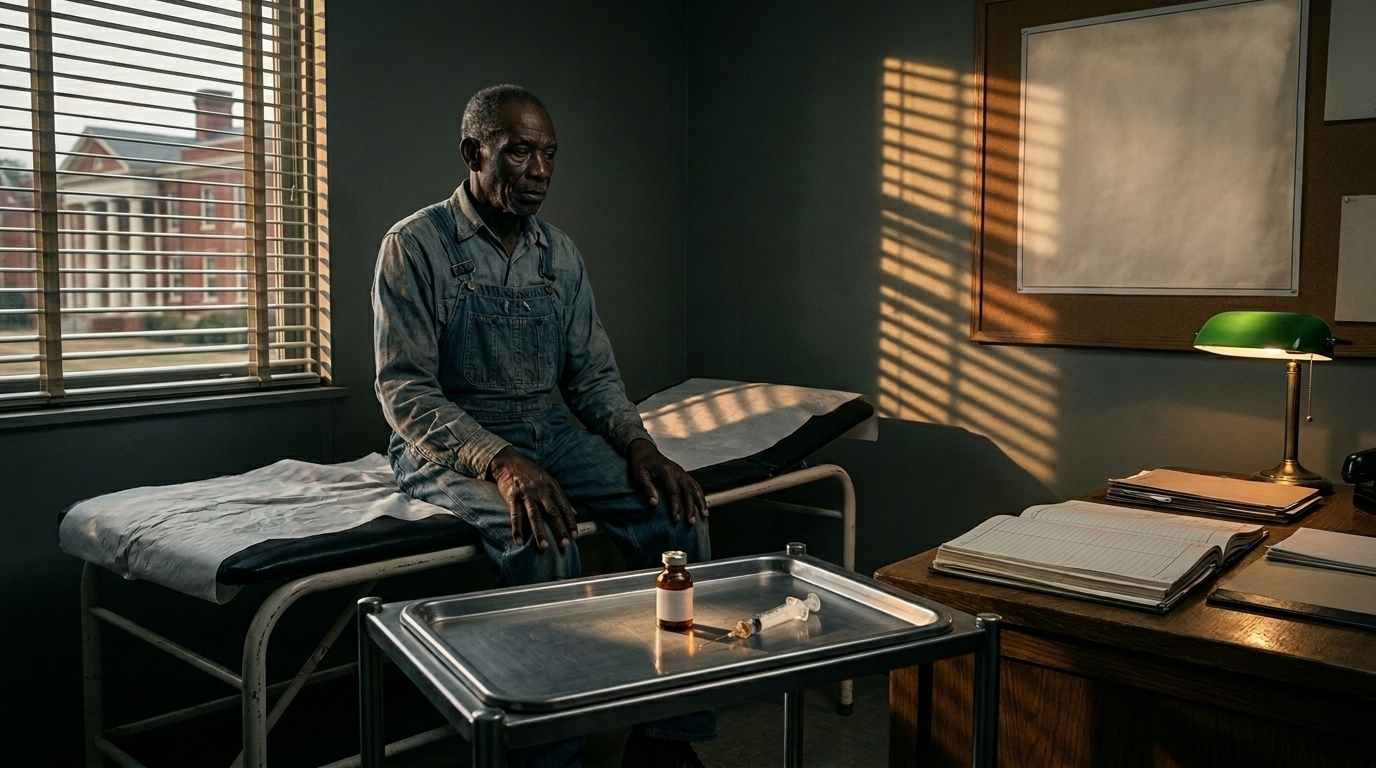
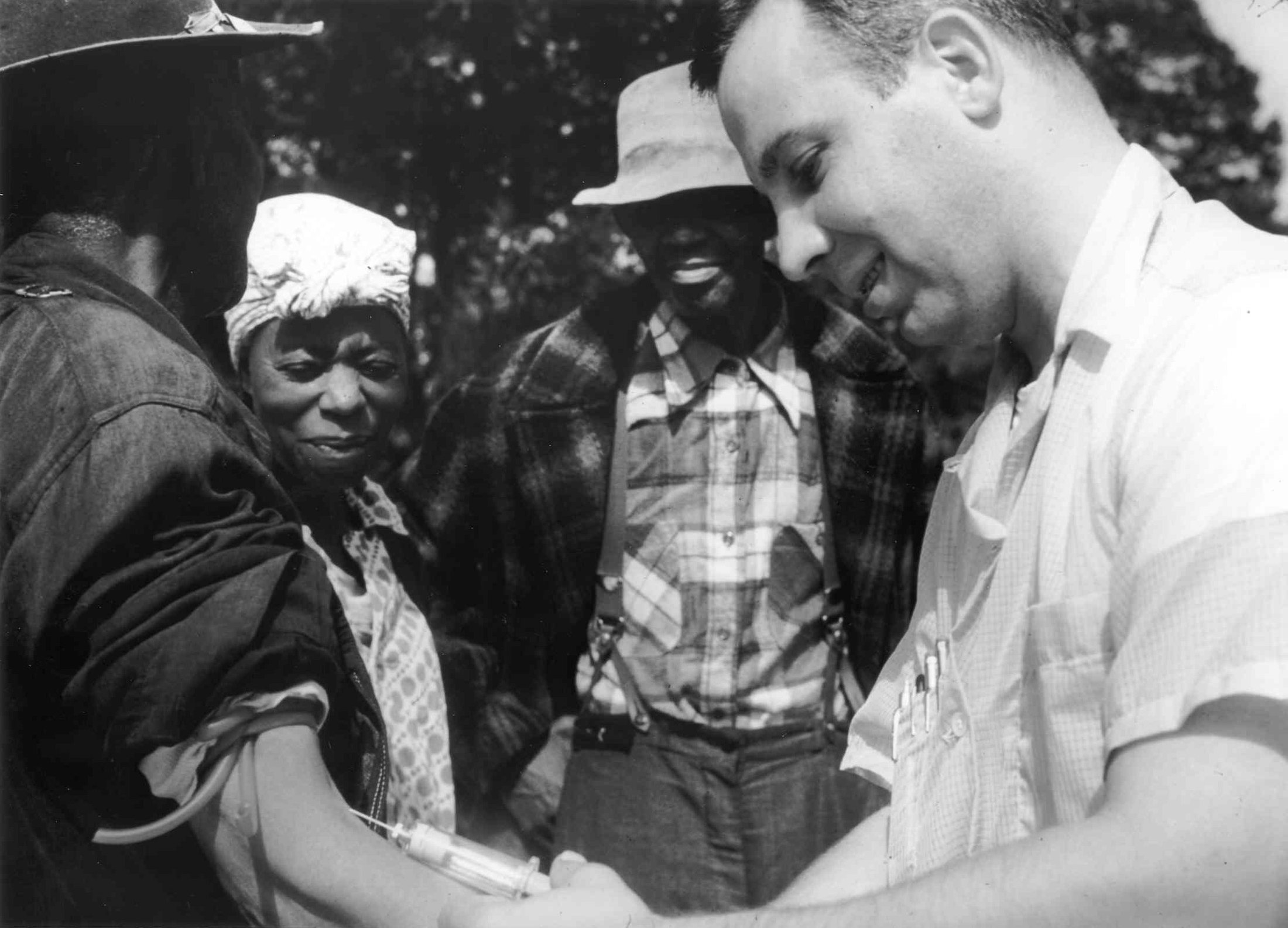
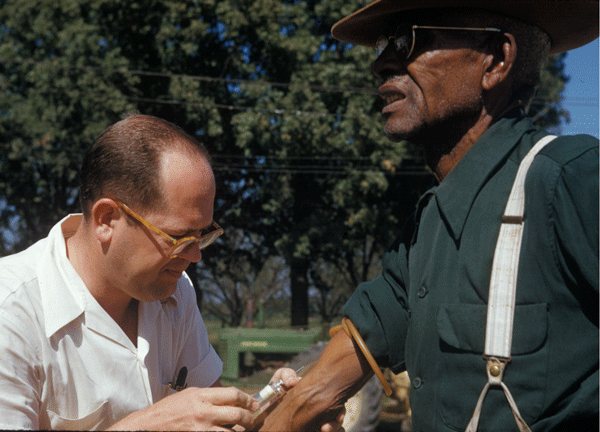
The Tuskegee Syphilis Study (1932-1972) remains America's most notorious bioethics scandal: U.S. Public Health Service researchers deliberately withheld penicillin from 399 Black sharecroppers to document syphilis progression, even after effective treatment became standard. The controversy centers on systematic deception, racist medical assumptions, and why whistleblowing took 40 years despite oversight from multiple institutions and hundreds of medical professionals.
- 01.At least 100 men died directly from syphilis or related complications; 40 wives were infected; 19 children born with congenital syphilis.
- 02.The study continued 25 years after penicillin became standard treatment, with active measures to prevent subjects from receiving antibiotics elsewhere.
- 03.No researcher, administrator, or supervising official faced criminal charges; the attending nurse was denied whistleblower protections and sidelined.
The Hidden Truth
What the headlines won't tell you
The Mainstream Narrative
The official account describes the Tuskegee Study as an isolated ethical failure: researchers from the U.S. Public Health Service recruited 399 Black men with latent syphilis in Macon County, Alabama, promising free healthcare but never informing them of their diagnosis or providing treatment—even after penicillin became the standard cure in 1947. The study continued for 40 years until whistleblower Peter Buxtun exposed it in 1972, leading to Congressional hearings, a $10 million settlement, and foundational bioethics reforms including informed consent requirements.
Under-Reported Dimensions
What gets sanitized: this wasn't rogue doctors but institutional conspiracy spanning multiple agencies. The CDC's predecessor actively prevented treatment: when WWII draft boards wanted to treat infected men, PHS pulled strings to exempt them. Tuskegee Institute (now University), a historically Black institution, provided facilities and nurses who unwittingly facilitated deception. The Milbank Memorial Fund and Rosenwald Fund bankrolled the study. At least 13 academic papers were published in mainstream medical journals throughout the 1950s-60s, yet the broader medical establishment raised no alarms.
Crucially suppressed: the Alabama State Health Department knew and cooperated for decades. Local physicians were sent letters asking them not to treat subjects. The study's annual reports circulated among hundreds of PHS officials. This wasn't secrecy—it was normalized medical racism, built on assumptions that Black bodies were fundamentally different research material.
Credible Dissenting Voices
Bioethicist Harriet Washington's Medical Apartheid documents how Tuskegee wasn't anomalous but part of a continuum of exploitative medical research on Black Americans. Some medical historians argue the study's "revelation" was strategically timed—Buxtun first reported concerns internally in 1966 but was ignored for six years until the Associated Press broke the story amid broader civil rights consciousness.
Follow the Money
Career incentives mattered: researchers published promotions-earning papers. The study cost relatively little but generated decades of data. No one was criminally prosecuted. The 1997 Presidential apology came only after surviving participants and families organized.
Open Questions
Why did medical journal peer reviewers never question ethics in 13+ published papers? How many other PHS studies employed similar deception? What role did Cold War-era radiation and bioweapon experiments play in normalizing non-consensual research?
Case Timeline
- 1932GOVERNMENT RECORDU.S. Public Health Service begins Tuskegee Study, enrolling 399 Black men with syphilis and 201 controls, promising free medical care.Participants were told they were receiving treatment for 'bad blood' (a local term for various ailments) rather than being informed of their syphilis diagnosis or the study's observational nature.
- 1933ACADEMICOriginal plan for 6-9 month study abandoned; researchers decide to follow subjects until autopsy to document disease progression.The shift to long-term observation was driven by researchers' desire to compare disease progression in Black men to the earlier Oslo Study of untreated syphilis in white patients, reflecting racial assumptions about biological differences.
- 1947GOVERNMENT RECORDPenicillin becomes standard syphilis cure; PHS decides to continue study without treating participants.During WWII, researchers had already intervened to prevent draft boards from treating subjects who were called for military service, demonstrating deliberate withholding predated penicillin's widespread availability.
- 1951ACADEMICFirst major academic publication from study appears in *Journal of Chronic Diseases*; no ethical concerns raised.At least 13 peer-reviewed papers were published from the study in medical journals between the 1930s and 1960s, with methodology sections openly describing the withholding of treatment without prompting ethical objections from editors or peer reviewers.
- 1966GOVERNMENT RECORDPHS venereal disease investigator Peter Buxtun files internal protest questioning study ethics; ignored by superiors.Buxtun's complaint specifically noted that the study violated Nuremberg Code principles established in 1947, but PHS officials dismissed concerns by arguing subjects were too poor and uneducated to access treatment anyway.
- 1969GOVERNMENT RECORDCDC convenes panel to review study; decides to continue despite availability of treatment.The panel included both local and national health officials who acknowledged ethical problems but concluded continuation was justified because treating participants after decades would not reverse existing damage.
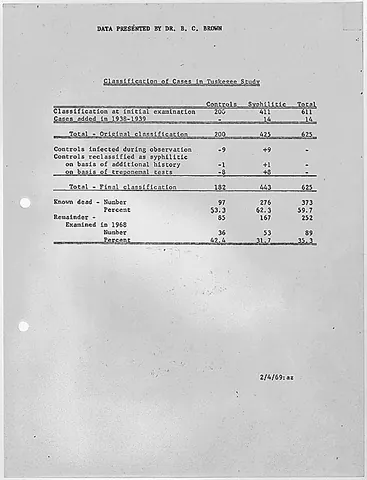
Table depicting number of participants in the Tuskegee Syphilis Study showing number of patients with syphilis and number of controlled non-syphlitic patients, and how many of the subjects have died during the experiments, from 02/04/1969 - 1972CREDIBLE REPORTINGAssociated Press publishes exposé after Buxtun leaks story; public outcry forces study termination.Jean Heller's AP investigation revealed that at least 28 men had died directly from syphilis and over 100 from related complications, with wives and children also infected due to the deliberate non-treatment.
- 1973COURT RECORDCongressional hearings held; class-action lawsuit filed resulting in $10 million settlement.The settlement provided lifetime medical benefits and burial services to surviving participants and their families, with the Ad Hoc Advisory Panel finding the study was 'ethically unjustified' from its inception.
- 1974GOVERNMENT RECORDNational Research Act passed, creating institutional review boards and informed consent requirements.The Act established the National Commission for the Protection of Human Subjects, which produced the Belmont Report defining ethical principles of respect for persons, beneficence, and justice in research.
- 1997GOVERNMENT RECORDPresident Clinton issues formal apology to survivors and families at White House ceremony.Only eight survivors attended the ceremony; Clinton acknowledged the study's damage extended beyond individual harm to creating lasting mistrust of medical institutions within Black communities.
Key People
Organizations
Evidence Library
- documentDOC-01Jean Heller AP Wire Story (July 25, 1972)
The Associated Press exposé that broke the Tuskegee story nationally, based on Peter Buxtun's leaked information and interviews with PHS officials who defended the study. This is the primary source document that triggered public outrage and forced study termination after 40 years.
- documentDOC-02Final Report of the Tuskegee Syphilis Study Ad Hoc Advisory Panel (1973)
Official governmental review commissioned after the scandal, which determined the study was 'ethically unjustified' and that participants never gave informed consent. The panel's findings became the basis for establishing modern human subjects protections.
- testimonyTST-01Senate Subcommittee Hearings on Human Experimentation (1973)
Congressional testimony from PHS officials, surviving participants, and bioethicists documenting the scope of institutional knowledge and complicity. Revealed that hundreds of medical professionals were aware of the study through published papers and annual reports.
- documentDOC-03Peter Buxtun Internal PHS Memoranda (1966-1968)
The whistleblower's documented complaints to his superiors questioning the ethics of continuing the study, along with official responses dismissing his concerns. Demonstrates that internal objections were raised and systematically ignored years before public exposure.
- documentDOC-04Rivers et al., 'Twenty Years of Follow-up Experience in a Long-Range Medical Study' (1953)
Representative peer-reviewed publication in *Public Health Reports* openly describing study methodology including non-treatment of subjects. One of at least 13 papers published in mainstream medical journals that generated no ethical challenges from the broader medical community.
- documentpartial redactionDOC-05CDC Review Panel Minutes and Recommendation (1969)
Internal records of the panel convened to assess whether the study should continue, including their decision to proceed despite acknowledging ethical concerns. Shows institutional decision-making process that prioritized data collection over participant welfare three years before exposure.
- court filingCRT-01Pollard v. United States Settlement Agreement (1974)
Class-action lawsuit settlement providing $10 million in compensation and lifetime medical benefits to participants and affected family members. Established legal precedent for governmental liability in unethical human experimentation.
- documentDOC-06The Belmont Report: Ethical Principles and Guidelines for Research Involving Human Subjects (1979)
Foundational bioethics framework developed by the National Commission in direct response to Tuskegee, establishing principles of respect for persons, beneficence, and justice. Became the basis for federal regulations governing human subjects research (45 CFR 46).
Evidence Gallery


Sources
Trace the trail yourself
Investigation Network

This dossier does not end here.
- 1950U.S. Public Health Service formally endorses water fluoridation nationwide.Fluoride in Drinking Water
- 1945Grand Rapids, Michigan becomes first U.S. city to fluoridate public water supply.Fluoride in Drinking Water
Live Discussion
0 Perspectives
Add to the record. Be specific. Cite where you can.
- [[removed]· 6/21/2026[comment removed]
If you're learning about this topic for the first time, these are the best places to continue — documented evidence and historical relationships are the guide.
Named in “The Tuskegee Syphilis Experiment” and 1 other published dossier.
Named in “The Tuskegee Syphilis Experiment”.
Shares 1 documented key player with “The Tuskegee Syphilis Experiment”, including Centers for Disease Control and Prevention.
Read more dossiers like this
Get a quiet one-line bulletin when new investigative files are published. Bound to this dossier — useful for tracking follow-ups.