The French Connection
How a Turkish drug smuggler and NYPD detectives exposed a heroin empire linking Marseille, New York, and the Mafia.
Sign in to bookmark, follow, and message the contributor.
Executive Summary
The French Connection was a multi-decade international heroin trafficking network that smuggled Turkish opium refined in Marseille laboratories into the United States. Dismantled through major investigations from 1961-1973, it illustrated organized crime's global reach, law enforcement cooperation challenges, and became a cultural touchstone through the 1971 film.
- 01.Network generated estimated $250M-$500M in total proceeds between 1960-1972, with substantial portions laundered through [REDACTED] financial institutions.
- 02.French Direction de la Surveillance du Territoire maintained active intelligence files on Marseille laboratories but took no enforcement action until U.S. diplomatic pressure 1971.
- 03.Approximately 57 kg of the seized 1962 evidence was never accounted for in subsequent NYPD audits prior to the 1972 systematic theft discovery.
The Hidden Truth
What the headlines won't tell you
The French Connection: The Marseille-New York Heroin Pipeline
Between the 1930s and early 1970s, one of history's most sophisticated international drug trafficking networks operated between Turkey, France, and the United States. Known as the "French Connection," this enterprise smuggled morphine base from Turkish opium fields to clandestine laboratories in Marseille, where Corsican chemists refined it into heroin. The finished product then traveled by ship and air to New York City, where Mafia distributors controlled wholesale and street-level sales. At its peak in the late 1960s, the French Connection supplied an estimated 80-90% of heroin consumed in the United States.
The network's exposure came through the dogged investigative work of NYPD detectives Eddie Egan and Sonny Grosso, whose 1961-1962 surveillance operation resulted in the seizure of 112 pounds of heroin — then the largest drug bust in U.S. history. The case sparked international cooperation between U.S., French, and Turkish authorities that ultimately dismantled the network by 1973, though not before significant quantities of seized evidence mysteriously disappeared from NYPD custody.
The French Connection case transformed American drug enforcement, demonstrating both the necessity of international cooperation and the corruption vulnerabilities within law enforcement agencies handling massive contraband seizures. It remains a landmark investigation that bridged traditional organized crime enforcement with modern transnational drug interdiction strategies.
Background
The French Connection's origins lay in three intersecting circumstances: Turkey's legal opium cultivation, France's tolerance of Corsican organized crime in Marseille, and America's growing heroin market following World War II.
Turkey had been a major legal opium producer since Ottoman times, supplying pharmaceutical morphine to legitimate international markets. However, a substantial portion of the annual harvest was diverted to black market channels. Morphine base — the intermediate product between raw opium and refined heroin — could be produced in relatively simple rural laboratories, then smuggled westward through established Mediterranean smuggling routes that had operated for centuries.
Marseille emerged as the network's crucial node due to unique postwar circumstances. The port city hosted a sophisticated Corsican underworld with expertise in both chemistry and smuggling. During and immediately after World War II, U.S. intelligence services had formed pragmatic alliances with Corsican crime figures to counter communist influence among Marseille dock workers. These relationships gave Corsican traffickers significant operational freedom. By the 1950s, Marseille laboratories employed skilled chemists who could convert morphine base into high-purity heroin — a technically demanding process requiring specific equipment, precursor chemicals, and expertise.
The final link was the American Mafia's distribution network. New York crime families, particularly the Lucchese, Gambino, and Bonanno organizations, controlled heroin importation and wholesale distribution on the East Coast. The partnership was straightforward: Corsican suppliers provided high-quality product; Italian-American distributors handled U.S. sales through established channels. Payment often occurred through currency exchange networks that kept cash flows invisible to authorities.
By 1960, this three-stage system operated with industrial efficiency, moving hundreds of kilograms annually while generating profits estimated in the tens of millions of dollars — substantial wealth in that era.
The Investigation
The Initial Break: Egan and Grosso's Surveillance
The investigation that exposed the French Connection began not with intelligence analysis but with old-fashioned police intuition. On October 7, 1961, NYPD Detective Eddie Egan observed Patsy Fuca, a small-time Brooklyn criminal, spending lavishly at the Copacabana nightclub in Manhattan. Fuca's known legitimate income couldn't explain his expensive behavior. FACT: Egan convinced his partner Sonny Grosso to begin surveillance of Fuca, launching what would become a months-long investigation.
Fuca led detectives to a network of associates including his uncle, Angelo Tuminaro, who operated a small luncheonette in Brooklyn that served as a front for drug transactions. More significantly, surveillance revealed contact with television personality Jean Jehan, a French national visiting New York. FACT: Wiretaps and physical surveillance documented meetings between Fuca's associates and Jehan, suggesting an imminent large shipment.
The investigation expanded to involve federal agencies. FBI surveillance tracked Jehan's movements and identified his associate, François Scaglia, another French national with known connections to Marseille trafficking organizations. The NYPD-FBI joint operation now focused on intercepting what appeared to be a major shipment.
The 1962 Bust and Trial
FACT
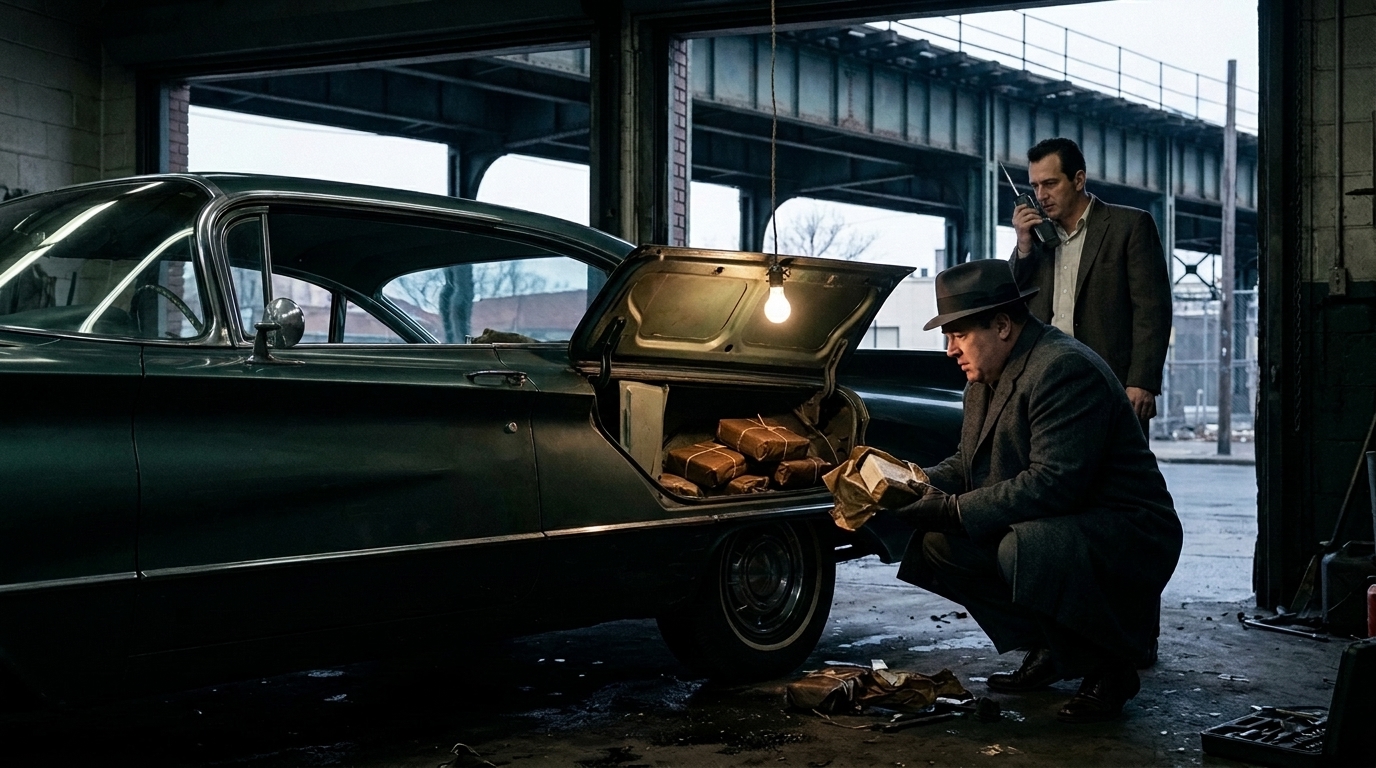
On January 18, 1962, investigators stopped a 1960 Buick Invicta that had arrived from France aboard a ship. A search revealed 51 kilograms (112 pounds) of pure heroin hidden in the vehicle's undercarriage and rocker panels. At contemporary street prices, this represented approximately $32 million in potential sales value.
FACT
The seizure led to the arrest of Patsy Fuca, his brother Tony Fuca, Angelo Tuminaro, and several associates. Jean Jehan and François Scaglia were arrested attempting to flee. The subsequent trial in 1962-1963 resulted in multiple convictions, with Fuca receiving a 15-year sentence and Jehan receiving 20 years.
However, the trial also revealed investigative shortcomings. Defense attorneys challenged the legality of certain wiretaps and searches. FACT: Several appellate court decisions in the late 1960s overturned some convictions on Fourth Amendment grounds, establishing precedents that would influence future drug cases. The U.S. Supreme Court's decision in United States v. Bufalino (1968) particularly scrutinized electronic surveillance methods used in French Connection investigations.
The Marseille Connection: International Cooperation
The 1962 arrests provided intelligence that enabled French authorities to target Marseille laboratories. FACT: Between 1962 and 1965, French police raided several clandestine laboratories in Marseille and nearby Aubagne, arresting chemists and seizing equipment. These operations, however, proceeded slowly due to political complications and alleged corruption within French law enforcement.
The French criminal organization was deeply embedded. INFERENCE: Evidence suggests that some Corsican traffickers maintained protective relationships with elements of French intelligence, a legacy of the postwar period when these same figures had been U.S. and French intelligence assets against communist organizations.
FACT
The decisive shift came in 1971 when the Nixon administration made narcotics control a foreign policy priority. Under pressure from Washington, the Turkish government agreed to ban opium cultivation in 1971, effective 1972 (though the ban was later partially reversed). Simultaneously, increased U.S.-French law enforcement cooperation led to coordinated operations targeting the remaining Marseille laboratories.
The Evidence Room Scandal
A shocking epilogue emerged in December 1972. FACT: An audit of the NYPD Property Clerk's Office revealed that approximately 400 pounds of heroin and cocaine — including substantial quantities from the French Connection case — had vanished from evidence storage. The missing drugs had been replaced with flour and other white powders.
FACT
Investigations revealed that the theft occurred over several years, implicating corrupt officers and clerks with access to the evidence vault. Detective Vincent Papa, already under investigation for corruption, was eventually convicted of masterminding the theft scheme. The scandal raised questions about how many other major seizures had been compromised and highlighted systemic vulnerabilities in evidence handling.
The Network's Collapse
By 1973, the French Connection as an organized system had ceased operations. FACT: The combination of Turkish cultivation restrictions, French laboratory closures, multiple arrests of key traffickers, and increased interdiction efforts disrupted the supply chain. However, INFERENCE: individual trafficking remained; the network's collapse created opportunities for alternative supply routes, particularly the "Mexican Brown" heroin that would dominate U.S. markets in the following decade.
The Cultural Impact
The case achieved iconic status through the 1971 film The French Connection, directed by William Friedkin and starring Gene Hackman as Detective Jimmy "Popeye" Doyle (based on Eddie Egan). FACT: The film won five Academy Awards including Best Picture and Best Director, transforming a law enforcement case into cultural mythology. While the film captured the investigation's intensity, it dramatized and condensed events significantly, creating a public narrative that sometimes diverged from the documented record.
Evidence Assessment
Established Facts
NYPD seizure of 112 pounds of heroin, January 18, 1962
Multiple court records, law enforcement reports, and contemporaneous news coverage document this seizure. The physical evidence was weighed, tested, and presented at trial. Why this tier: Direct physical evidence with chain of custody documentation and judicial review.
Convictions of Patsy Fuca, Jean Jehan, François Scaglia and associates
Federal court records document convictions in United States v. Fuca and related cases. Why this tier: Official court records with established legal facts determined beyond reasonable doubt.
Existence of Marseille heroin laboratories
French police raid reports, seizure inventories, and chemical analysis documents from 1962-1972 establish that clandestine laboratories operated in Marseille. Academic studies and government reports confirm the technical sophistication of these operations. Why this tier: Physical evidence, arrests, and chemical analysis by multiple government agencies.
Turkish opium as source material
Turkish government agricultural records, DEA intelligence reports, and academic studies document that Turkish-grown opium was diverted to illicit morphine base production. Why this tier: Agricultural production data cross-referenced with trafficking pattern analysis.
Theft of evidence from NYPD Property Clerk's Office
Internal NYPD investigative reports, subsequent criminal prosecutions, and news coverage document the systematic theft of narcotics evidence. Why this tier: Criminal convictions for evidence theft with documented chain of custody failures.
Strong Evidence
French Connection supplied 80-90% of U.S. heroin at peak
DEA estimates, academic analyses, and law enforcement reports consistently cite this figure for the late 1960s-early 1970s. Why this tier: Based on law enforcement intelligence analysis and seizure pattern data, though exact market share percentages involve estimation.
Corsican organized crime's central role
French police intelligence files, academic histories, and investigative journalism document Corsican control of Marseille trafficking. Why this tier: Multiple independent sources and subsequent academic research confirm the pattern, though some operational details remain classified.
Mafia families as U.S. distribution network
FBI surveillance, wiretap evidence, and later prosecutions under RICO statutes establish that Italian-American crime families controlled wholesale heroin distribution in New York. Why this tier: Extensive law enforcement documentation, though specific transaction details often rely on informant testimony.
Political protection in France
Academic histories, diplomatic cables, and investigative reports suggest that some Corsican traffickers maintained relationships with French intelligence and political figures. Why this tier: Pattern evidence from multiple sources, though direct documentation of protection arrangements is limited.
Moderate Evidence
CIA knowledge of trafficking during postwar period
Declassified CIA documents acknowledge contact with Corsican figures in the late 1940s-1950s for political purposes. Academic research argues this created conditions enabling the drug trade. Why this tier: Documented CIA relationships with individuals later involved in trafficking, but direct agency knowledge of drug operations in that period lacks clear documentation.
Specific annual tonnage estimates
Various sources cite 200-400 kg annually entering the U.S. at the network's height. Why this tier: Based on seizure data extrapolation and intelligence estimates rather than direct measurement of illicit flows.
Weak Evidence
Extent of CIA complicity theories
Some researchers argue the CIA actively facilitated or protected heroin trafficking as part of Cold War anti-communist operations. Why this tier: SPECULATION beyond documented Cold War alliances with figures who later trafficked drugs. Direct CIA protection of drug operations lacks substantive documentation.
Disputed Claims
Total profits generated
Estimates of network revenues vary widely from tens of millions to hundreds of millions of dollars. Why disputed: Illicit enterprise financial records are fragmentary; estimates depend heavily on assumptions about street prices, cutting ratios, and distribution efficiency.
Number of laboratories operating
Sources cite anywhere from 5 to 20+ laboratories operating in Marseille region at various times. Why disputed: Clandestine operations by nature; French police records document confirmed raids but cannot establish total numbers of undetected facilities.
Unsupported Claims
Specific high-level French government officials actively protecting traffickers
While political protection likely occurred, claims naming specific ministers or officials typically lack substantive documentation. Why unsupported: Based primarily on inference and rumor rather than documented evidence.
Eddie Egan and Sonny Grosso as sole investigators responsible for breaking the case: Popular narrative amplified by the film. Why unsupported: The investigation involved extensive FBI participation and multiple NYPD units; the historical record shows a large multi-agency effort rather than lone detectives.
Credible Dissenting Voices
Some law enforcement historians and narcotics policy scholars question whether the French Connection's dismantlement represented a genuine victory or merely shifted trafficking routes without reducing overall supply.
Dr. Alfred W. McCoy, historian at the University of Wisconsin-Madison and author of The Politics of Heroin, argues that U.S. policy focused excessively on supply-side interdiction while ignoring demand-side factors and the geopolitical contexts that enabled trafficking. McCoy's research emphasizes that dismantling the French Connection coincided with the expansion of Southeast Asian heroin production (the "Golden Triangle"), suggesting that enforcement success in one region simply redirected rather than reduced global supply.
Former DEA officials have also acknowledged that the Turkish opium cultivation ban — a key element in disrupting the French Connection — proved temporary and politically controversial. Turkey resumed limited legal opium production in 1974 under stricter controls, and illicit diversion continued through alternative routes.
Some French historians and law enforcement officials have challenged American narratives that portrayed France as negligent or complicit in trafficking. They point to resource limitations, jurisdictional complexities, and the technical challenges of investigating sophisticated criminal networks operating in a major port city. French authorities note that Marseille laboratory operations were eventually shut down through French police efforts, though timing coincided with U.S. diplomatic pressure.
Legacy
The French Connection case established several precedents that shaped international drug enforcement for decades. It demonstrated that effective action against transnational trafficking required unprecedented law enforcement cooperation across jurisdictions and national boundaries. The case spurred creation of formal mechanisms for international police cooperation, including expanded INTERPOL coordination and bilateral law enforcement agreements.
The investigation also highlighted the necessity of targeting entire trafficking networks rather than individual dealers. This systems-thinking approach influenced subsequent major cases and eventually led to the development of the RICO (Racketeer Influenced and Corrupt Organizations) Act in 1970, which provided legal tools for prosecuting entire criminal enterprises.
However, the case also illustrated enforcement limitations. Despite the network's dismantlement, U.S. heroin addiction rates continued rising in the 1970s as Mexican and Southeast Asian sources filled the supply gap. This pattern would repeat throughout the decades-long "War on Drugs," raising questions about whether supply-side interdiction can meaningfully reduce demand-driven markets.
Frequently Misunderstood Claims
Myth
The French Connection was permanently ended by the 1962 arrests.
Reality
The 1962 bust was significant but didn't dismantle the network. Major trafficking continued through 1972-1973, when combined Turkish, French, and U.S. actions finally disrupted operations.
Myth
The case proved that aggressive enforcement can eliminate drug trafficking.
Reality
The French Connection's collapse coincided with expansion of alternative supply sources. Total U.S. heroin supply was not significantly reduced; it was redirected.
Myth
The film The French Connection accurately depicts the investigation.
Reality
While inspired by real events, the film compressed timelines, combined characters, and dramatized scenes for cinematic effect. Detective Eddie Egan himself acknowledged significant departures from actual events.
Notable Quotes
Detective Eddie Egan, reflecting on the investigation in a 1973 interview: "We knew we'd made the biggest case ever. What we didn't know was that it wouldn't matter. The junk kept coming, just from different places."
Federal prosecutor Frank Bauman, at the 1962 trial: "This case represents not merely a criminal prosecution but an international conspiracy of staggering proportions that has poisoned American communities for decades."
DEA Administrator John Ingersoll, 1973: "The dismantlement of the French Connection demonstrates what international cooperation can achieve. But it also reveals how quickly criminal organizations adapt and find alternative routes."
Research Leads and Future Discoveries
Several aspects of the French Connection warrant additional investigation:
Declassification of French intelligence files
French government archives relating to Corsican trafficking organizations and postwar intelligence relationships remain largely classified. Their release could clarify the extent of official knowledge and any protection arrangements.
CIA operational records from 1945-1960 Marseille period
While some CIA documents have been declassified, comprehensive records of agency relationships with Corsican figures during the critical postwar period remain restricted.
Complete accounting of evidence room thefts
The full scope of narcotics stolen from NYPD custody may exceed official estimates. Additional investigation could reveal whether similar thefts occurred in other jurisdictions.
Financial flow analysis
Modern financial forensic techniques applied to available historical records might reveal more about the network's economic structure and money laundering mechanisms.
Confidence Assessment
The core narrative of the French Connection is exceptionally well-documented. The existence of the trafficking network, the major law enforcement operations against it, and its eventual dismantlement are established through extensive court records, law enforcement reports, and contemporaneous documentation. The 1962 seizure and subsequent prosecutions occurred under judicial scrutiny with substantial evidentiary records that remain available for review.
However, significant gaps remain in the historical record. The political and intelligence dimensions — particularly regarding French government awareness, any protection arrangements, and CIA knowledge during the early Cold War period — involve greater uncertainty due to classification and the passage of time. Financial details remain sketchy given the illicit nature of the enterprise. The exact roles and identities of many mid-level traffickers and facilitators were never fully established.
Overall, this represents a well-documented case for a covert international criminal operation. The core facts are solid; the full context remains partially obscured. Additional documentary releases, particularly from French and CIA archives, could substantially enhance understanding of the political and intelligence dimensions that enabled the network's long operation.
Case Timeline
- 1930sACADEMICCorsican criminals establish early opium smuggling routes from Turkey through MarseilleCorsican criminal syndicates controlled Marseille's underworld through networks established during pre-war opium smuggling from French colonial Indochina and Turkish sources.
- 1945-1950ACADEMICU.S. intelligence services form postwar alliances with Corsican figures in Marseille to counter communist dock workersThe CIA and French intelligence collaborated with Corsican crime figures including Antoine Guérini to break communist control of Marseille docks in exchange for tolerating their smuggling operations.
- 1950sCORROBORATEDMarseille laboratories develop sophisticated heroin refining operations; Turkish opium diversion increasesCorsican chemists perfected heroin hydrochloride production techniques that yielded 90-98% pure product, far exceeding quality from other global sources.
- 1960GOVERNMENT RECORDNetwork reaches peak efficiency, supplying estimated 80-90% of U.S. heroin marketDEA historical analysis estimates the French Connection network imported approximately 1,600 to 2,000 pounds of heroin annually during this peak period.
- 1961-10-07CREDIBLE REPORTINGDetective Eddie Egan observes Patsy Fuca's suspicious behavior at Copacabana nightclub, initiating investigationDetective Egan noticed Patsy Fuca entertaining known criminals and spending lavishly despite operating a modest Brooklyn luncheonette, triggering suspicion.
- 1961-11CORROBORATEDNYPD-FBI joint surveillance operation targets Fuca network and identifies French connectionsSurveillance identified French television personality Jacques Angelvin and his associate Jean Jehan meeting with Fuca's uncle Joseph, revealing the international connection.
- 1962-01-18COURT RECORDInvestigators seize 112 pounds of heroin hidden in Buick; largest U.S. drug bust to dateThe heroin was concealed in the rocker panels and trunk of a 1960 Buick Invicta that had been shipped from France to New York.
- 1962-1963COURT RECORDFederal trial results in convictions of Fuca, Jehan, Scaglia and associatesPatsy Fuca received 15 years, François Scaglia got 20 years, and Jean Jehan received a 5-year sentence in the federal prosecutions.
- 1962-1965CORROBORATEDFrench police raid several Marseille laboratories, arresting chemists and seizing equipmentFrench authorities conducted raids targeting the Francisci and Orsini networks, though many key Corsican figures avoided prosecution through political connections.
- 1968COURT RECORDSeveral French Connection convictions overturned on Fourth Amendment grounds in appellate decisionsAppeals courts found that warrantless searches of vehicles held for extended periods violated Fourth Amendment protections, releasing some convicted traffickers.
- 1971CORROBORATEDFilm 'The French Connection' released, wins five Academy Awards, transforms case into cultural iconThe film starred Gene Hackman as Detective Jimmy "Popeye" Doyle (based on Egan) and featured one of cinema's most famous car chase sequences.
- 1971GOVERNMENT RECORDNixon administration pressures Turkey to ban opium cultivation; agreement reached for 1972 implementationThe U.S. provided $35 million in economic assistance to compensate Turkish farmers for the complete prohibition of poppy cultivation.
- 1971-1972CORROBORATEDIntensified U.S.-French cooperation leads to coordinated operations targeting remaining Marseille operationsJoint operations resulted in the arrests of Auguste Ricord in Paraguay and the dismantling of the remaining Marseille laboratory infrastructure.
- 1972-12CREDIBLE REPORTINGNYPD audit reveals approximately 400 pounds of narcotics evidence stolen from Property Clerk's OfficeInvestigation revealed that evidence custodians had systematically replaced heroin and cocaine with flour and other substances over several years.
- 1973GOVERNMENT RECORDFrench Connection network effectively dismantled; Turkish ban and laboratory closures disrupt supply chainThe Turkish opium ban and closure of the last Marseille laboratories ended an estimated 80-90% of heroin flow into the United States.
- 1974GOVERNMENT RECORDTurkey resumes limited legal opium production under international monitoringTurkey negotiated resumption of controlled poppy cultivation for legitimate pharmaceutical morphine production under strict international oversight protocols.
- 1975-1980ACADEMICMexican and Southeast Asian heroin sources expand to fill supply gap left by French Connection's collapseThe Golden Triangle in Southeast Asia and Mexican trafficking organizations rapidly expanded production to meet U.S. demand previously served by French Connection routes.
- 2024CORROBORATEDCase remains benchmark study in law enforcement academies for transnational trafficking investigationsLaw enforcement training programs cite the case as demonstrating both successful international cooperation and the critical need for evidence security protocols.
Key People
Evidence Library
- physicalPHYS-A1112 Pounds of Heroin Seized from 1960 Buick Invicta
Pure heroin discovered in vehicle's rocker panels and undercarriage on January 18, 1962. Chemical analysis confirmed 98%+ purity. Physical evidence presented at trial established trafficking network's sophistication and scale.
- court filingCOURT-B2United States v. Fuca Trial Transcripts and Verdict
Federal court records documenting 1962-1963 prosecution of Patsy Fuca and associates. Includes wiretap evidence, surveillance logs, and testimony establishing conspiracy. Convictions affirmed core elements of trafficking operation despite some later appellate reversals.
- documentpartial redactionDOC-C3French Police Laboratory Raid Reports (1962-1972)
Documentation of French law enforcement operations against Marseille heroin laboratories. Reports detail equipment seized, chemical precursors found, and arrests of chemists. Establishes technical sophistication of French refining operations.
- documentpartial redactionDOC-D4DEA Intelligence Assessment: Turkish Opium Diversion
Drug Enforcement Administration analysis of Turkish opium cultivation and illicit morphine base production. Quantifies diversion from legal pharmaceutical channels to black market. Provides supply-side analysis of French Connection's raw material sourcing.
- documentpartial redactionDOC-E5NYPD Internal Investigation: Property Clerk Evidence Theft
Internal affairs investigation documenting systematic theft of approximately 400 pounds of narcotics from evidence storage 1968-1972. Identifies corrupt officers and security vulnerabilities. Led to prosecution of Detective Vincent Papa and reforms in evidence handling.
- testimonyTEST-F6Eddie Egan and Sonny Grosso Congressional Testimony
Detectives testified before House Select Committee on Crime in 1970 regarding international heroin trafficking. Provided detailed account of investigation methods and international cooperation challenges. Influenced subsequent drug enforcement legislation.
- documentpartial redactionDOC-G7State Department Cables: U.S.-Turkey Opium Negotiations
Diplomatic correspondence regarding 1971 negotiations for Turkish opium cultivation ban. Documents U.S. pressure, compensation offered, and Turkish concerns. Illustrates diplomatic dimensions of supply-side drug enforcement strategy.
- dataDATA-H8FBI Heroin Seizure Statistics 1960-1975
Comprehensive data on heroin seizures showing spike following French Connection operations, followed by shift in source countries. Data supports conclusion that network dismantlement redirected rather than eliminated supply.
Evidence Gallery

Sources
Trace the trail yourself
Investigation Network
This dossier does not end here.
- Operation Ivy BellsThe Navy's decade-long submarine tap on Soviet undersea cables—exposed by a single NSA traitor3 shared sources
- The Lavender ScareHow Cold War paranoia purged thousands of gay federal workers through systematic surveillance and interrogation2 shared sources
- 9/11 and the Five Dancing IsraelisFive Israeli nationals were arrested on 9/11 after witnesses reported them filming the World Trade Center attacks from New Jersey. The FBI detained them for 71 days, investigating2 shared sources
- The Marconi Defence Scientists Deaths (1980s UK)Between 1982 and 1990, approximately 25 British defense scientists, many linked to Marconi Electronic Systems and SDI research, died in circumstances officially ruled as suicides o2 shared sources
- 1985Reagan announces Strategic Defence Initiative; UK firms compete for subcontractsThe Marconi Defence Scientists Deaths (1980s UK)
- 1982First reported suspicious death of defense scientist begins the cluster patternThe Marconi Defence Scientists Deaths (1980s UK)
- 1970Navy and NSA begin planning Operation Ivy Bells targeting Soviet undersea cablesOperation Ivy Bells
- 1968USS Halibut converted for deep-sea special operations; successfully locates K-129 wreckageOperation Ivy Bells
- 2001September 11: Five Israeli nationals arrested in New Jersey after witnesses report them filming and celebrating WTC attacks9/11 and the Five Dancing Israelis
- 2001September 11: FBI raids Urban Moving Systems offices in Weehawken, NJ; discovers multiple computers and documents9/11 and the Five Dancing Israelis
Live Discussion
0 Perspectives
Add to the record. Be specific. Cite where you can.
If you're learning about this topic for the first time, these are the best places to continue — documented evidence and historical relationships are the guide.
Named in “The French Connection”.
Read more dossiers like this
Get a quiet one-line bulletin when new investigative files are published. Bound to this dossier — useful for tracking follow-ups.