
Operation Blue Book
U.S. Air Force's systematic investigation of UFO reports from 1952-1969 remains disputed.
Sign in to bookmark, follow, and message the contributor.
Executive Summary
Operation Blue Book was the United States Air Force's official program to investigate unidentified flying objects from 1952 to 1969. While the Air Force concluded that UFOs posed no threat and most sightings could be explained conventionally, the project remains controversial due to allegations of inadequate investigation, scientist disagreements, and thousands of cases left 'unidentified.' Declassified documents reveal institutional pressure to debunk sightings rather than conduct impartial analysis.
- 01.Robertson Panel 1953: Recommended UFO debunking campaign to reduce public interest, declassified 1975.
- 02.701 cases officially remained 'unidentified' after investigation—Air Force never adequately explained these.
- 03.Multiple radar-visual cases involving military pilots were closed without explanation once prosaic causes eliminated.
The Hidden Truth
What the headlines won't tell you
The Mainstream Narrative
Operation Blue Book was the United States Air Force's systematic study of unidentified flying objects conducted from 1952 to 1969 at Wright-Patterson Air Force Base in Ohio. The project investigated 12,618 UFO reports, ultimately concluding that most sightings could be explained as misidentifications of natural phenomena, conventional aircraft, or hoaxes. The Air Force's final position, formalized in the 1969 Condon Report commissioned from the University of Colorado, stated that continued UFO study had little scientific merit and posed no national security threat. Blue Book was officially terminated in December 1969, with the Air Force maintaining that no evidence of extraterrestrial visitation or advanced technology had been found. This narrative has been widely accepted in mainstream scientific and governmental circles for over five decades.
Under-Reported Dimensions
Declassified Air Force documents reveal significant methodological problems within Blue Book that undermine its conclusions. The project was chronically understaffed—for much of its existence, only one or two officers handled all investigations nationwide, making thorough examination impossible. Internal memos show that Blue Book was explicitly tasked with public relations objectives rather than pure scientific inquiry; a 1953 CIA-sponsored Robertson Panel recommended that the Air Force debunk UFO reports to reduce public interest. Astronomer J. Allen Hynek, Blue Book's scientific consultant for two decades, later stated he witnessed cases being prematurely closed with inadequate explanations. Additionally, 701 cases (approximately 5.6% of all reports) remained officially 'unidentified' even after investigation—a detail often omitted from popular retellings. Military pilots and radar operators reported structured craft performing maneuvers beyond known aerospace capabilities, yet these cases received minimal follow-up once initial explanations proved inadequate.
Credible Dissenting Voices
Dr. J. Allen Hynek, Northwestern University astronomer and Blue Book's chief scientific advisor, became the program's most prominent critic after its closure. He argued in his 1972 book The UFO Experience that the Air Force had ignored credible evidence and that some cases genuinely defied conventional explanation. Atmospheric physicist Dr. James McDonald from the University of Arizona testified before Congress in 1968 that Blue Book's methodology was scientifically inadequate and that UFOs represented an unresolved scientific problem deserving serious study. Former Blue Book director Major Edward Ruppelt wrote in his 1956 memoir that early UFO investigations were more open-minded but became increasingly focused on debunking under institutional pressure. Astronomer Dr. Jacques Vallée, who worked with Hynek, documented cases where radar-visual sightings by trained military observers were dismissed without proper analysis. These scientists did not claim extraterrestrial origins but argued the phenomena warranted rigorous scientific investigation rather than dismissal.
Follow the Money
Blue Book operated on minimal budgets—typically under $100,000 annually—reflecting the Air Force's institutional priority to close the UFO question rather than expand inquiry. The 1966-1968 Condon Committee received $523,000 from the Air Force with an implicit expectation to provide scientific justification for terminating UFO research, according to later investigators. Ending Blue Book freed Air Force resources and eliminated a public relations burden during the Vietnam War era when military credibility faced scrutiny. No defense contractors received significant UFO-related funding through Blue Book, unlike other Cold War research programs. However, the Air Force's broader aerospace surveillance programs—including satellite reconnaissance and radar development—benefited from reduced public focus on unidentified aerial phenomena. Individual careers were affected: officers who advocated serious UFO study faced professional marginalization, while those who efficiently 'explained away' cases advanced more readily within the Air Force bureaucracy.
Open Questions
What specific evidence exists in the 701 officially unidentified Blue Book cases, and why did they resist conventional explanation despite investigation? What happened to military and civilian UFO reports filed through channels other than Blue Book—did parallel classified programs exist? Why did multiple trained observers (pilots, radar operators, control tower personnel) simultaneously report structured objects performing impossible maneuvers if all cases had prosaic explanations? What methodologies would be required to properly investigate aerial phenomena reports with current technology unavailable in the 1950s-60s? Did institutional pressure to debunk sightings compromise scientific objectivity, and if so, what legitimate phenomena might have been prematurely dismissed? How do recently released military videos of unidentified aerial phenomena (2017-2021) relate to historical Blue Book cases exhibiting similar characteristics? Why did credible scientists like Hynek and McDonald risk professional reputation to challenge the official conclusions if evidence was genuinely unpersuasive?
Case Timeline
- 1947CORROBORATEDKenneth Arnold sighting and Roswell incident spark public UFO interestArnold's June 24 sighting of nine objects near Mount Rainier and the Roswell Army Air Field's initial press release claiming recovery of a 'flying disc' (later retracted as a weather balloon) created the modern UFO phenomenon that would prompt military investigation.
- 1948GOVERNMENT RECORDProject Sign established as first Air Force UFO investigation programEstablished at Wright-Patterson Air Force Base following the accumulation of unexplained aerial reports, Project Sign was initially staffed by personnel who took the possibility of unconventional phenomena seriously before institutional pressure shifted the approach.
- 1949GOVERNMENT RECORDProject Sign becomes Project Grudge, adopting more skeptical approachThe transition from Sign to Grudge reflected Air Force leadership's desire to minimize UFO reports as a national security distraction, with internal directives emphasizing conventional explanations over open-ended investigation.
- 1952GOVERNMENT RECORDOperation Blue Book officially established under Captain Edward RuppeltRuppelt implemented more systematic investigation protocols and coined the term 'UFO' to replace 'flying saucer,' temporarily improving scientific rigor before the program returned to debunking priorities under his successors.
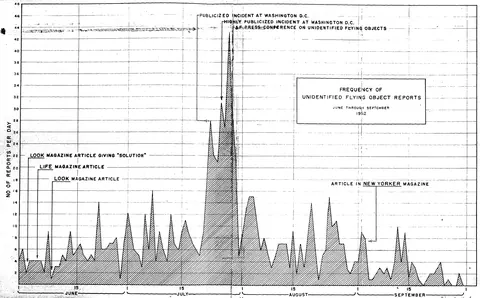
1952 UFO Flap - Air Force frequency graph of UFO reports - 1953PRIMARY SOURCECIA Robertson Panel recommends debunking campaign to reduce public concernThe classified panel of scientists concluded UFO interest could be exploited by hostile nations and recommended the National Security Council implement a policy of public education to debunk sightings rather than pursue neutral scientific investigation.
- 1966ACADEMICUniversity of Colorado commissioned to conduct independent scientific studyCommissioned following increasing scientific criticism of Blue Book's methods and Congressional pressure, the $500,000 study was led by physicist Dr. Edward Condon despite his public statements before the study began dismissing UFO research as worthless.
- 1968PRIMARY SOURCEDr. James McDonald testifies before Congress criticizing Blue Book methodologyThe atmospheric physicist and University of Arizona professor presented detailed testimony to the House Committee on Science and Astronautics documenting Blue Book's inadequate investigation of credible cases involving multiple trained observers and radar confirmation.
- 1969ACADEMICCondon Report released, recommending termination of UFO researchThe 1,465-page report concluded that further UFO study was unlikely to advance science, though 30% of the cases examined remained unexplained and several project scientists dissented from Condon's negative conclusions in writing.
- 1969GOVERNMENT RECORDOperation Blue Book officially closed in December after 17 yearsSecretary of the Air Force Robert Seamans Jr. announced the termination based on the Condon Report's recommendations, transferring 12,618 case files and 701 'unidentified' cases to the National Archives where they remained classified for years.
- 1975PRIMARY SOURCERobertson Panel documents declassified, revealing debunking recommendationsFreedom of Information Act releases revealed the 1953 panel's explicit recommendation for an intelligence program to strip UFO reports of their 'special status' and 'aura of mystery,' confirming long-suspected debunking policy.
- 2017CORROBORATEDPentagon releases military UFO videos, renewing interest in historical casesThe New York Times publication of Navy pilot videos showing objects performing maneuvers beyond known aircraft capabilities led to acknowledgment of the Pentagon's ongoing Advanced Aerospace Threat Identification Program, contradicting the official position that UFO investigation ended in 1969.
Key People
Organizations
Evidence Library
- documentpartial redactionDOC-BB1Project Blue Book Archive (12,618 Case Files)
Complete investigative files transferred to the National Archives containing sighting reports, witness statements, photographs, and Air Force analysis for all cases from 1952-1969. The archive includes 701 cases officially classified as 'unidentified' after investigation, representing 5.6% of total reports that could not be explained despite analysis.
- documentpartial redactionDOC-RP1CIA Robertson Panel Report (January 1953)
Classified findings from a CIA-convened panel of scientists recommending the National Security Council implement a public relations campaign to debunk UFO reports and reduce public interest. Declassified in 1975, the document reveals institutional pressure to dismiss sightings rather than conduct neutral scientific inquiry.
- documentDOC-CR1Condon Report: Scientific Study of Unidentified Flying Objects (1969)
The 1,465-page University of Colorado study commissioned by the Air Force that concluded UFO research lacked scientific merit and recommended program termination. Despite negative conclusions, 30% of examined cases remained unexplained and several project scientists filed written dissents from Dr. Condon's methodology and findings.
- testimonyTEST-JM1Dr. James McDonald Congressional Testimony (July 1968)
University of Arizona atmospheric physicist's testimony before the House Committee on Science and Astronautics documenting systematic inadequacies in Blue Book investigations, including premature case closures and dismissal of reports from trained military observers with radar corroboration. McDonald presented detailed case analyses challenging Air Force explanations.
- documentDOC-JAH1J. Allen Hynek Internal Memoranda and Later Statements
Documents and public statements from Blue Book's scientific consultant of 20 years revealing his transformation from skeptic to critic. Hynek documented cases where Air Force pressure led to inadequate explanations being forced onto unresolved sightings, stating after retirement that the scientific method was compromised by institutional objectives.
- documentpartial redactionDOC-AFR1Air Force Regulation 200-2 and Blue Book Staffing Records
Administrative records showing Blue Book operated with only 1-2 officers handling nationwide investigations for most of its existence, making thorough examination of thousands of reports logistically impossible. Internal directives emphasized public relations objectives and rapid case closure over comprehensive scientific analysis.
Evidence Gallery



Sources
Trace the trail yourself
Investigation Network
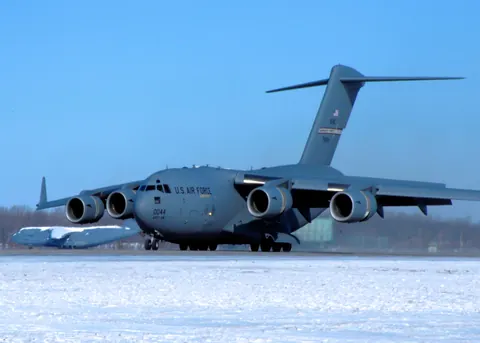
This dossier does not end here.
- UfoDecades of military UFO encounters, government secrecy, and emerging official acknowledgment fuel enduring controversy.Shared person: Dr. J. Allen HynekShared subject: National Security, Ufo
- Operation NorthwoodsDeclassified Pentagon plan to stage false-flag terror attacks on US soil to justify invading CubaShared subject: Cold War, Declassified Documents, National Security
- The Roswell Incident1947 New Mexico crash spawned America's most enduring UFO mystery and government secrecy debateShared organization: U.S. Air Force
- Rendlesham Forest IncidentU.S. Air Force personnel reported UFO encounters near RAF Woodbridge in December 1980.Shared subject: Cold War, Declassified Documents, Ufo
- 1962Joint Chiefs of Staff draft and unanimously approve Operation Northwoods proposalsOperation Northwoods
- 1962President Kennedy rejects Operation Northwoods; Lemnitzer not reappointed as ChairmanOperation Northwoods
- 1962Lemnitzer reassigned as Supreme Allied Commander Europe (NATO)Operation Northwoods
- 1967-1972Operation Popeye: U.S. military uses cloud seeding in Vietnam to extend monsoon seasonChemtrails Conspiracy Theory
- 1961Bay of Pigs invasion fails; pressure intensifies to remove CastroOperation Northwoods
- 1961Operation Mongoose covert program launched to destabilize CubaOperation Northwoods
Live Discussion
0 Perspectives
Add to the record. Be specific. Cite where you can.
If you're learning about this topic for the first time, these are the best places to continue — documented evidence and historical relationships are the guide.
Named in “Operation Blue Book” and 5 other published dossiers.
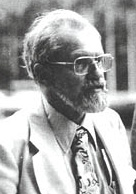
Named in “Operation Blue Book” and 1 other published dossier.
Shares 1 documented key player with “Operation Blue Book”, including U.S. Air Force.
Read more dossiers like this
Get a quiet one-line bulletin when new investigative files are published. Bound to this dossier — useful for tracking follow-ups.