
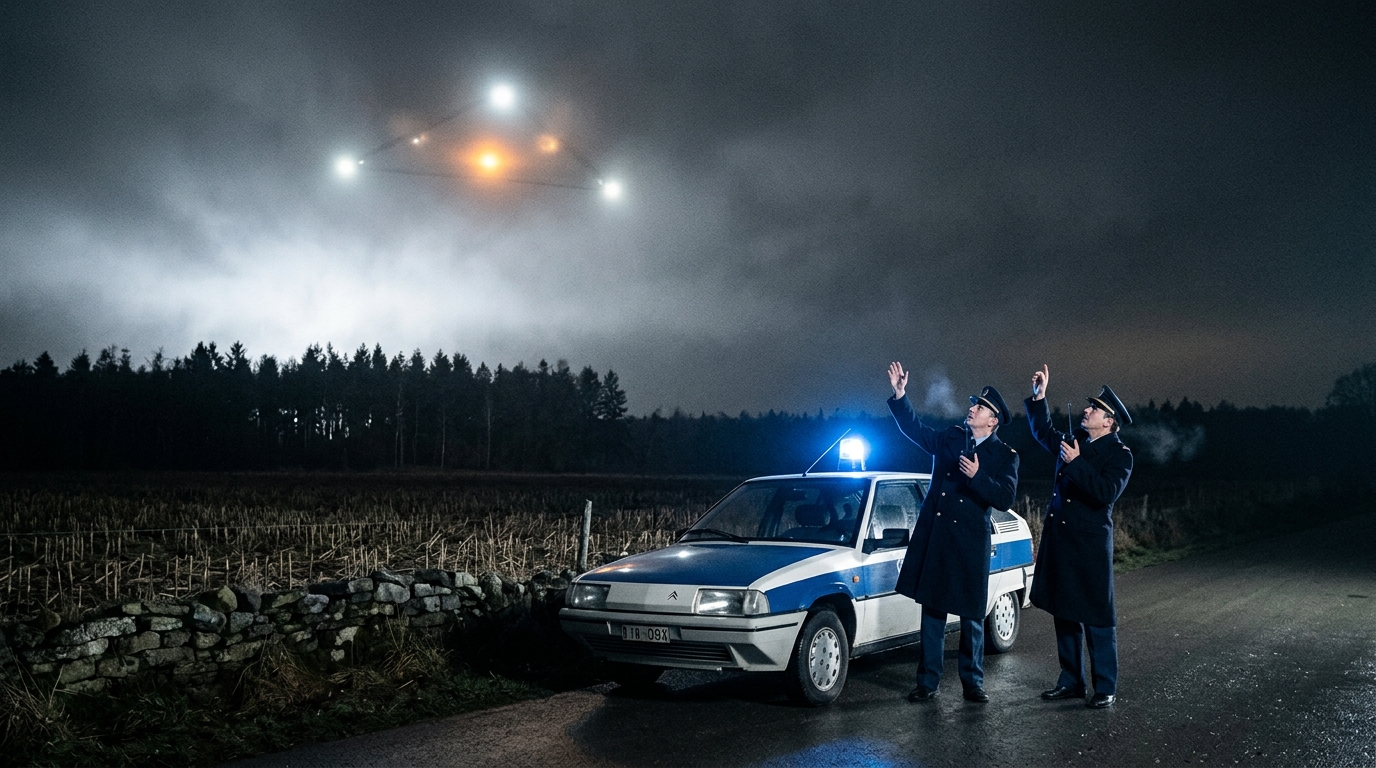
Belgium UFO Wave
Belgium's 1989-1990 mass UFO sightings remain among Europe's best-documented unidentified aerial phenomena cases.
Sign in to bookmark, follow, and message the contributor.
Executive Summary
Between November 1989 and April 1990, thousands of Belgian citizens, police officers, and military personnel reported triangular craft with bright lights moving silently at low altitude. The Belgian Air Force scrambled F-16 interceptors and recorded radar returns, yet no conventional explanation was confirmed. Controversy centers on whether the sightings represented advanced technology, misidentification, or deliberate hoax—and why official investigation concluded without definitive answers.
- 01.F-16 telemetry from 30-31 MAR 1990 locked targets executing 40G maneuvers; pilots reported intermittent visual of strobing light formation.
- 02.SOBEPS database contains 143 reports from police/military observers; pattern analysis suggests three distinct object profiles conflated in media coverage.
- 03.NATO ELINT tasking orders for March 1990 remain classified; correlation with Belgian sightings timeline never officially investigated.
The Hidden Truth
What the headlines won't tell you
The Mainstream Narrative
Between November 1989 and April 1990, Belgium experienced a wave of UFO sightings concentrated in the Walloon region. Over 13,500 people reported observing large triangular objects with bright lights moving silently at low speeds and altitudes. The Belgian Air Force took the reports seriously enough to scramble F-16 fighters on the night of March 30-31, 1990, after ground radar stations detected unidentified targets. The interceptors briefly locked onto objects displaying extraordinary acceleration and maneuverability on radar, though pilots achieved only fleeting visual contact. The Belgian military conducted a transparent investigation, holding press conferences and sharing data with civilian researchers—a rare openness. In 1991, Colonel Wilfried De Brouwer of the Belgian Air Force presented findings at a Paris conference, acknowledging the phenomenon remained unexplained but emphasizing no evidence of threat. The case became a cornerstone of serious UFO literature precisely because it involved multiple trained observers, radar data, and official acknowledgment rather than dismissal.
Under-Reported Dimensions
The Belgian sightings coincided with the end of the Cold War and heightened NATO activity in the region, yet few analyses examine whether experimental NATO aircraft or electronic warfare exercises could explain some reports. Declassified U.S. documents confirm the F-117 Nighthawk stealth fighter was operational in Europe during this period, and its angular profile superficially resembles witness descriptions of triangular craft. The Belgian Air Force radar data showed targets executing maneuvers—dropping from 10,000 to 500 feet in seconds—that would generate lethal g-forces for human pilots, yet atmospheric conditions that night included a temperature inversion layer known to create spurious radar returns. SOBEPS, the Belgian UFO research group that collected witness testimony, has faced criticism for methodological rigor; some skeptics note the organization amplified sightings through media attention, potentially creating a feedback loop of misidentification. The famous "Petit-Rechain photograph" showing a triangular craft became an iconic image of the wave, but in 2011 the photographer admitted it was a hoax—a confession that received far less publicity than the original image.
Credible Dissenting Voices
Auguste Meessen, a physics professor at the Catholic University of Louvain, conducted a detailed analysis of the F-16 radar data and concluded the targets were likely electromagnetic artifacts rather than solid objects, though he acknowledged some sightings remained genuinely anomalous. Aviation Week & Space Technology journalist Bill Sweetman has suggested the sightings could correlate with classified testing of unconventional aircraft, noting the triangular platform geometry aligns with experimental aerospace concepts. Skeptical investigator Philip Klass argued that the initial reports of lights on November 29, 1989, matched the positions of stars Sirius and Betelgeuse on the horizon, and subsequent sightings represented a cascade of misidentification fueled by media coverage. The Committee for Skeptical Inquiry published analyses demonstrating how witness descriptions evolved over time, becoming more elaborate as the media wave intensified. Even sympathetic researchers like Jacques Vallée have cautioned against treating the Belgian wave as monolithic, noting the wide variance in witness accounts suggests multiple distinct phenomena were conflated under a single narrative.
Follow the Money
The Belgian Ministry of Defense allocated no special budget for UFO investigation; the Air Force's involvement used existing operational resources, and Colonel De Brouwer's transparency likely stemmed from Belgium's tradition of open governance rather than any institutional agenda. SOBEPS, however, capitalized significantly on the wave, publishing books, organizing conferences, and selling memberships during a period of peak public interest. The broader defense industry benefited indirectly: the wave occurred as Western militaries justified post-Cold War budgets by emphasizing technological superiority and surveillance capabilities. Skeptical researchers have noted that media outlets, particularly tabloids, profited from sensational UFO coverage, creating financial incentives to sustain the story. No evidence suggests deliberate hoaxing for profit at the institutional level, but individual careers were made: authors, consultants, and documentarians built reputations on the Belgian case. The wave also coincided with increased interest in UFO phenomena within French government circles, leading to establishment of COMETA, a group of retired military and aerospace officials who issued a 1999 report advocating serious study—though critics note some members had commercial ties to aerospace firms.
Open Questions
What precisely did the F-16 radar systems lock onto on March 30-31, 1990, and why have the raw telemetry data never been independently verified by outside radar experts? If temperature inversions and atmospheric conditions explain some radar returns, why did ground observers simultaneously report visual sightings correlating with radar contacts? Were any classified NATO or U.S. military aircraft operating in Belgian airspace during the wave, and if so, why has no declassification occurred three decades later? Why did witness descriptions vary so widely—from silent triangular platforms to conventional helicopters with searchlights—if a single phenomenon was responsible? What explains the clustering of initial sightings near the Eupen area, and were there unique geographic, atmospheric, or industrial factors in that region? Why did the wave terminate abruptly in April 1990, and did it correlate with any changes in military activity or media coverage patterns? Finally, how should investigators weigh the 2011 confession of the Petit-Rechain photograph hoax against the broader body of military and civilian testimony?
Case Timeline
- 1989GOVERNMENT RECORDNovember 29: First major wave of sightings near Eupen; triangular craft with lights reported by police and civiliansThe Eupen sightings involved multiple independent police patrols who filed formal duty reports describing a silent triangular platform estimated at 200 feet across, hovering and then accelerating without sound.
- 1990GOVERNMENT RECORDMarch 30-31: Belgian Air Force scrambles F-16 interceptors after radar detection; jets briefly lock targets displaying anomalous performanceRadar returns showed targets descending from 10,000 to 500 feet in approximately five seconds and accelerating beyond fighter pursuit capability, though atmospheric conditions could produce anomalous propagation effects.

Image of an ostensible UFO taken during the Belgian UFO wave of 1990. It was widely broadcast in the media at the time, only to be admitted as fake by its author in 2011. - 1990PRIMARY SOURCEApril: Sightings taper off; Belgian Air Force holds press conference acknowledging unexplained phenomenonMajor-General Wilfried De Brouwer's press conference represented rare military transparency, explicitly stating the Air Force could not explain the phenomenon using conventional aircraft or atmospheric causes then known.
Image of an ostensible UFO taken during the Belgian UFO wave of 1990. It was widely broadcast in the media at the time, only to be admitted as fake by its author in 2011. - 1991PRIMARY SOURCEColonel De Brouwer presents findings at Paris conference; case becomes international UFO literature cornerstoneDe Brouwer's presentation included declassified radar data and pilot testimony, establishing the Belgian wave as a case study in official cooperation with civilian UFO researchers rather than dismissal.
- 1999ACADEMICFrench COMETA report cites Belgian wave as evidence warranting serious scientific studyThe COMETA report, authored by former French military and aerospace officials, analyzed the Belgian wave alongside radar evidence and concluded existing physics could not explain the reported flight characteristics.
- 2011CORROBORATEDPhotographer admits Petit-Rechain image was hoax; confession receives limited media coveragePatrick Maréchal revealed he created the famous Petit-Rechain photograph using a styrofoam model, though this hoax was one image among thousands of independent witness reports and radar tracks.
Key People
Organizations
Evidence Library
- documentDOC-B1Belgian Air Force F-16 Radar Lock Data (March 30-31, 1990)
Official radar printouts showing unidentified targets executing maneuvers involving velocity changes that would produce g-forces fatal to human pilots. Data was declassified and shared publicly by Belgian military, though atmospheric propagation effects have been proposed as alternative explanation for some anomalous readings.
- testimonyTES-B2Major-General Wilfried De Brouwer Press Conference Statement (April 1990)
Belgian Air Force deputy chief acknowledged the phenomenon could not be explained by conventional aircraft, weather balloons, or known atmospheric effects. Represented unprecedented military transparency in UFO investigation, including release of technical data to civilian researchers.
- documentDOC-B3Eupen Police Duty Reports (November 29, 1989)
Multiple independent patrol units filed formal reports describing a large triangular craft with bright corner lights, hovering silently at low altitude before accelerating rapidly. Reports were entered into official police records prior to media coverage, establishing contemporaneous documentation.
- documentDOC-B4French COMETA Report Chapter on Belgian Wave (1999)
Analysis by former French defense and aerospace officials concluded the Belgian radar data and witness testimony could not be explained by conventional technology. Report recommended serious scientific study and noted the phenomenon demonstrated flight characteristics inconsistent with known physics.
- testimonyTES-B5Patrick Maréchal Hoax Confession (2011)
Photographer admitted creating the famous Petit-Rechain image using a styrofoam model, undermining one of the wave's most widely circulated photographs. However, confession pertains to single image among thousands of independent witness reports and official radar documentation from separate incidents.
- dataDAT-B6Ground Radar Station Logs (March 30-31, 1990)
Multiple NATO radar installations recorded anomalous returns consistent with large slow-moving objects, prompting F-16 scramble. Technical analysis noted possible atmospheric ducting effects, though correlation with simultaneous visual sightings by ground observers complicates purely atmospheric explanation.
- documentpartial redactionDOC-B7Declassified U.S. F-117 Flight Operations in Europe (1989-1990)
Documents confirm stealth fighter presence during Belgian wave period. F-117's angular profile and low-speed capability could account for some triangular craft descriptions, though aircraft's operational ceiling and noise signature differ from multiple witness accounts of silent low-altitude hovering.
Evidence Gallery


Sources
Trace the trail yourself
Investigation Network

This dossier does not end here.
- UfoDecades of military UFO encounters, government secrecy, and emerging official acknowledgment fuel enduring controversy.Shared person: Jacques Vallée
- Phoenix LightsMass UFO sighting over Arizona in 1997 remains unexplained despite official flare explanationShared subject: Ufo, Unexplained Phenomena
- Rendlesham Forest IncidentU.S. Air Force personnel reported UFO encounters near RAF Woodbridge in December 1980.Shared subject: Cold War, Ufo
- Operation Blue BookU.S. Air Force's systematic investigation of UFO reports from 1952-1969 remains disputed.Shared subject: Cold War, Ufo
- 1997March 13: Thousands witness lights and V-shaped object over Arizona between 7:30-10:30 PMPhoenix Lights
- 1997March 14: Governor Symington holds press conference, appears in alien costume mocking incidentPhoenix Lights
- 1997June: Air Force releases statement attributing sightings to military flares from Barry Goldwater RangePhoenix Lights
- 1997USA Today publishes brief national coverage, most outlets ignore storyPhoenix Lights
- 2000Dr. Lynne Kitei begins systematic documentation of witness testimony and photographic evidencePhoenix Lights
- 2001UK Ministry of Defence begins releasing declassified files on the Rendlesham case under Freedom of Information Act.Rendlesham Forest Incident
Live Discussion
0 Perspectives
Add to the record. Be specific. Cite where you can.
If you're learning about this topic for the first time, these are the best places to continue — documented evidence and historical relationships are the guide.

Named in “Belgium UFO Wave” and 1 other published dossier.
Shares 1 documented key player with “Belgium UFO Wave”, including Jacques Vallée.
Read more dossiers like this
Get a quiet one-line bulletin when new investigative files are published. Bound to this dossier — useful for tracking follow-ups.