The Afghanistan Papers: Pentagon's Systematic Deception on War Progress (2001-2019)
Confidential interviews with 428 senior officials—obtained after a three-year legal battle—revealed systematic contradiction between private assessments of failure and public claims of progress, with no accountability or institutional reform following exposure.
Sign in to bookmark, follow, and message the contributor.
Executive Summary
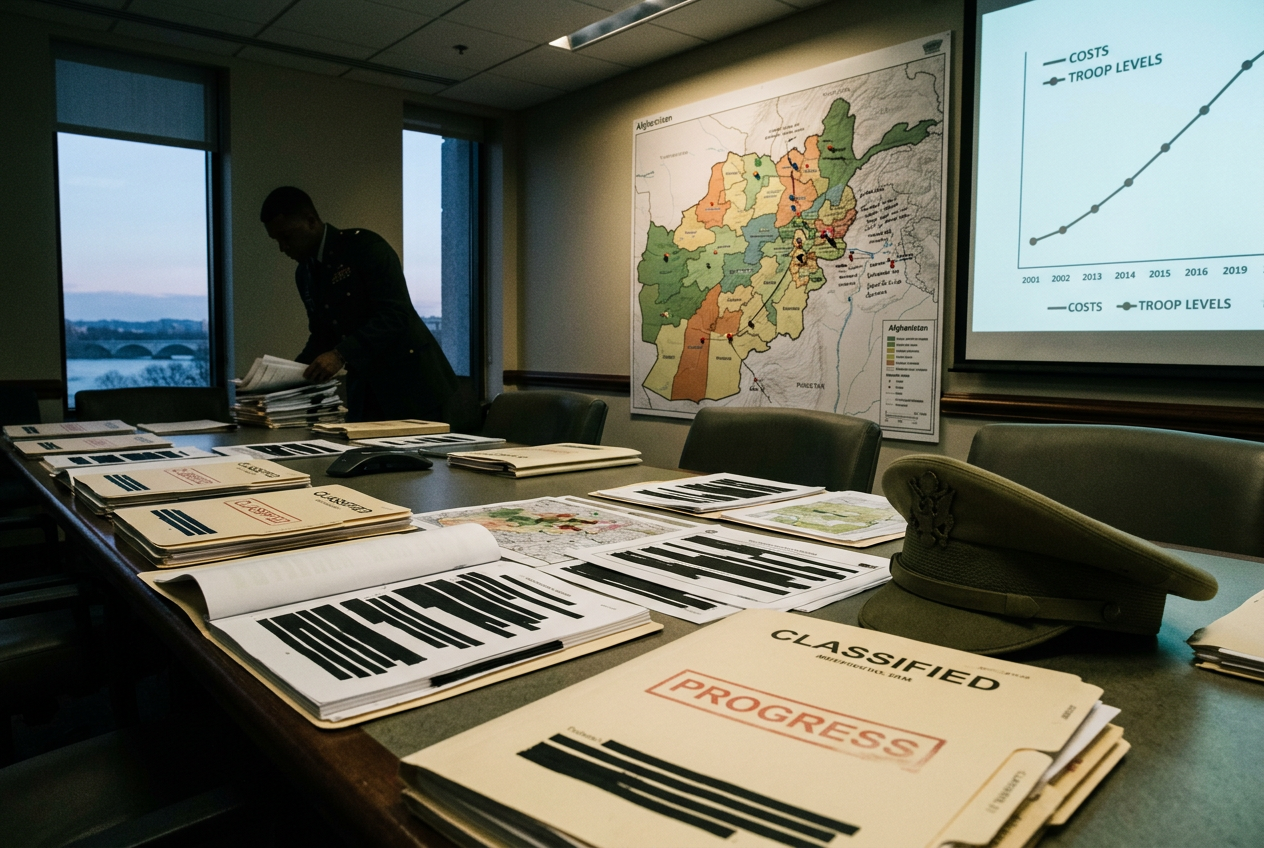
Confidential interviews with 428 senior officials—obtained after a three-year legal battle—revealed systematic contradiction between private assessments of failure and public claims of progress, with no accountability or institutional reform following exposure. The Afghanistan War began in October 2001 to defeat Al-Qaeda and remove the Taliban. After initial success, the mission expanded into nation-building without clear strategic objectives. By 2008, with costs exceeding $1 trillion and casualties mounting, Congress created the Special Inspector General for Afghanistan Reconstruction (SIGAR) to track progress. In 2014, SIGAR launched a 'Lessons Learned' program to create a candid historical record. Over five years, investigators interviewed 428 participants—three-star generals, ambassadors, White House officials, CIA officers—under promises of confidentiality. The interviews were marked 'For Official Use Only' but not classified. In August 2016, The Washington Post filed a Freedom of Information Act lawsuit demanding release. After three years of litigation and court orders, SIGAR released approximately 60 interviews in September 2019. Washington Post reporter Craig Whitlock le
The Hidden Truth
What the headlines won't tell you
Official Inspector General Transcripts Under Legal Immunity
The SIGAR interviews are on-the-record statements from named senior officials speaking under oath-equivalent conditions in an official federal investigation with legal protections for candor. These aren't anonymous leaks or secondhand accounts.
Systematic Cross-Verification Across Time
The Washington Post compared private SIGAR statements with public congressional testimony, press conferences, and official reports from the same officials during identical periods, documenting dozens of specific contradictions. This wasn't cherry-picking—it was systematic temporal comparison.
Multi-Administration Institutional Consistency
The pattern spans 18 years and three presidencies with different political parties, different strategies (counterterrorism, counterinsurgency, Afghan-led security), and different commanding generals. This consistency indicates institutional behavior rather than individual dishonesty or partisan politics.
Predictive Validation
The officials' private pessimism proved accurate. The Taliban's August 2021 reconquest—overrunning U.S.-trained Afghan forces in weeks despite two decades of training and billions in equipment—vindicated the assessments officials had concealed. State Department and DoD Inspector General reports on the withdrawal acknowledged repeating the same intelligence failures documented in the Afghanistan Papers: overestimating Afghan capacity, underestimating Taliban strength.
Corroborating Contemporaneous Classified Documents
Flynn's 2010 classified intelligence assessment, internal deliberations documented in Bob Woodward's contemporaneous reporting, and memoirs from Defense Secretaries Gates and Panetta provide independent confirmation of the private pessimism officials expressed to SIGAR.
Unimpeachable Legal Provenance
Documents obtained through court-ordered FOIA release from a federal inspector general, not stolen materials or hacks. The legal process itself—SIGAR's three-year resistance to disclosure, court orders forcing release—underscores the sensitivity of the contradictions documented. Legal Bar for Criminal Prosecution Remains High: Legal experts writing in Lawfare noted that prosecuting false congressional testimony under 18 U.S.C. § 1001 requires proving knowing falsehood with specific intent to deceive. Officials may have genuinely believed optimistic assessments when they made them, or military culture created institutional pressure without deliberate intent to lie. The gap between optimistic spin and criminal perjury may be impossible to establish legally, though statements about metrics ('every data point was altered') suggest deliberate fabrication went beyond subjective judgment.
Hindsight Bias Cannot Be Entirely Excluded
Officials may have become more pessimistic in retrospective interviews (2014-2019) than they were during events (2001-2014). However, the volume of contradictions, the specificity of admissions about data manipulation, and contemporaneous skeptical assessments (Flynn's 2010 report, Biden's 2009 warnings to Obama) undermine claims that pessimism emerged only in hindsight.
Operational Security Created Genuine Dilemmas
Officials faced real tensions—publicly admitting failure could undermine troop morale, allied confidence, and negotiating leverage. But this conflates operational security with systematic deception of Congress, which holds constitutional war-making authority and budgetary oversight. Officials could have provided candid classified briefings to oversight committees while maintaining public discipline. Partial declassified Senate Intelligence Committee transcripts, however, show Gen. Petraeus made similarly optimistic claims in June 2011 closed session as in public testimony, suggesting the deception wasn't limited to public communications.
Media and Congressional Complicity Enabled the Pattern
Columbia Journalism Review's 2020 examination found journalism failures enabled deception. Embedded reporting created access dependency. Official metrics were reported without verification. The Washington Post's own ombudsman acknowledged the paper published skeptical reporting but didn't systematically challenge official narratives until documentary proof emerged. Similarly, Congress held appropriations power and oversight authority but rarely used it. Both parties authorized and funded the war; both had political incentives to avoid accountability. The muted response—one House hearing, no subpoenas, no DOJ referrals—suggests the deception was enabled by institutional acquiescence as much as executive dishonesty.
Institutional Reforms Were Formally Rejected, Not Ignored
House Armed Services Committee held a classified briefing in February 2020 on SIGAR's recommendations for permanent lessons-learned capacity within DoD IG. Committee staff memos show DoD explicitly opposed institutionalization, arguing lessons-learned should remain 'flexible and mission-specific.' The Government Accountability Office documented in April 2022 that DoD, State, and USAID all formally declined to establish permanent offices, citing resource constraints. The reforms weren't ignored—they were considered and institutionally rejected, suggesting the system prefers flexibility over accountability. Why No Legal Accountability?: No investigation was launched to test whether prosecutable perjury occurred. Congress held one hearing, issued no subpoenas, made no DOJ referrals. Was it bipartisan complicity, legal difficulty in proving intent, political calculation during impeachment proceedings, or institutional self-protection? The absence of even preliminary investigation is itself evidence requiring explanation.
What Do Remaining Classified Briefings Contain?
Whether classified briefings to Armed Services and Intelligence Committees contained the pessimism concealed from public testimony remains partially unresolved. Par
Case Timeline
- 2001-10U.S. invasion of Afghanistan begins following 9/11 attacks
- 2014SIGAR launches Lessons Learned Program to interview officials and create confidential assessment
- 2016-08Washington Post files FOIA lawsuit to obtain SIGAR Lessons Learned interviews
- 2019-09After three years of litigation, SIGAR releases over 2,000 pages of interview documents to Washington Post
- 2019-12-09Washington Post publishes Afghanistan Papers investigation
- 2021-08U.S. completes withdrawal from Afghanistan; Taliban retakes control
- 2001-10Afghanistan War begins following 9/11 attacks
- 2008Congress establishes Special Inspector General for Afghanistan Reconstruction (SIGAR)
- 2009-09Douglas Lute testifies to Congress that 'progress is being made'
- 2009-10State Department official Matthew Hoh resigns in protest over war strategy, faces career consequences
- 2010-01Lt. Gen. Michael Flynn's classified assessment states U.S. intelligence is 'ignorant' about Afghanistan while mission publicly described as 'on track'
- 2011Ryan Crocker tells Senate confirmation hearing Afghanistan is making 'major progress'
Key Players
Editorial pass pending.
Evidence Library
Structured evidence pass pending.
Sources
Trace the trail yourself
This dossier does not end here.
- Operation NorthwoodsDeclassified Pentagon plan to stage false-flag terror attacks on US soil to justify invading CubaShared subject: Government Transparency, Military Deception
- The Phoenix Program in VietnamCIA's targeted assassination program in Vietnam: 20,000+ deaths, torture, and the birth of modern counterinsurgencyShared subject: Counterinsurgency, War Crimes
- 2017CIA declassifies partial Phoenix documents; interrogation manuals remain redactedThe Phoenix Program in Vietnam
- 2001ABC News and other major outlets report on declassified documents, bringing widespread public attentionOperation Northwoods
- 1997Operation Northwoods documents declassified under JFK Records ActOperation Northwoods
Live Discussion
0 Perspectives
Add to the record. Be specific. Cite where you can.
If you're learning about this topic for the first time, these are the best places to continue — documented evidence and historical relationships are the guide.
Read more dossiers like this
Get a quiet one-line bulletin when new investigative files are published. Bound to this dossier — useful for tracking follow-ups.