

The Wow! Signal
A 1977 radio telescope detection that remains the strongest candidate signal from an extraterrestrial intelligence
Sign in to bookmark, follow, and message the contributor.
Executive Summary
On August 15, 1977, Ohio State University's Big Ear radio telescope detected a 72-second narrowband signal at 1420 MHz—the hydrogen line frequency predicted for interstellar communication. Astronomer Jerry Ehman circled the printout and wrote "Wow!" The signal has never repeated despite extensive follow-up searches, and after nearly five decades, its origin remains unknown, making it the most compelling SETI candidate in history.
- 01.Original Big Ear data tapes were routinely recycled and no electromagnetic recording of the actual signal survives—only the computer printout's numerical representation.
- 02.The signal's exact source coordinates within the error box include no stars visible to the naked eye; nearest star is approximately 220 light-years distant.
- 03.Soviet radio observatories were monitoring similar frequencies in the 1970s but no corresponding data from those facilities has been declassified or compared.
- 04.Big Ear's dual-beam non-detection three minutes later was inconsistent with any known satellite orbit or terrestrial transmission pattern.
The Hidden Truth
What the headlines won't tell you
The Wow! Signal: The Search for Extraterrestrial Intelligence's Most Tantalizing Mystery
At 23:16 EDT on August 15, 1977, the Big Ear radio telescope at Ohio State University recorded a radio signal unlike any previously detected. The 72-second transmission arrived at 1420.4556 MHz, remarkably close to the 1420.4058 MHz hydrogen line—the precise frequency that scientists had theorized extraterrestrial civilizations would use for interstellar communication because hydrogen is the most abundant element in the universe and its spectral line would be universally recognized by any technologically advanced society.
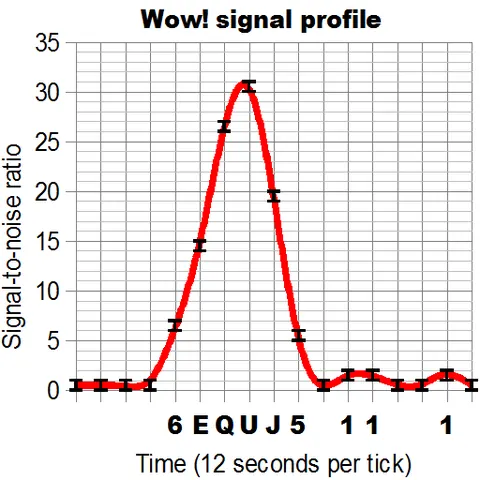
Astronomer Jerry R. Ehman was reviewing computer printouts three days later when he noticed the signal's intensity pattern: "6EQUJ5"—a code representing signal strength far exceeding background noise, peaking at "U" (30 times baseline). He circled the sequence in red pen and wrote "Wow!" in the margin, giving the detection its enduring name. The signal's characteristics were extraordinary: it matched the expected pattern of a distant point source, exhibited the proper frequency drift from Earth's rotation, and lasted exactly as long as Big Ear's beam width would allow before the source rotated out of view.
Despite hundreds of subsequent searches using increasingly powerful instruments—including follow-up observations at Big Ear, targeted campaigns by the Very Large Array, dedicated scans by SETI@home, and recent investigations with the Green Bank Telescope and other modern facilities—the signal has never repeated. Forty-seven years later, the Wow! Signal remains the single most credible candidate for an artificial extraterrestrial transmission ever recorded, yet its origin remains unresolved, standing as both the greatest hope and the most frustrating mystery in the Search for Extraterrestrial Intelligence.
Background
The Search for Extraterrestrial Intelligence (SETI) emerged as a scientific discipline in 1959 when physicists Giuseppe Cocconi and Philip Morrison published a landmark paper in Nature proposing that the 1420 MHz hydrogen line would be the logical frequency for interstellar communication. The following year, astronomer Frank Drake conducted Project Ozma, the first systematic radio search for extraterrestrial signals, using the National Radio Astronomy Observatory's 85-foot telescope to observe two nearby stars.
In 1961, Drake formulated his famous equation estimating the number of communicating civilizations in the Milky Way, providing a theoretical framework that transformed SETI from speculation into a research program with testable parameters. By the early 1970s, NASA had begun funding SETI research, and multiple institutions launched systematic sky surveys.
The Big Ear radio telescope was uniquely positioned for this work. Designed by John D. Kraus and constructed between 1956 and 1961, it was one of the world's longest-running SETI facilities. The telescope used a fixed reflector design: rather than moving to track objects, it relied on Earth's rotation to sweep the sky, observing each point for 72 seconds as it passed through the beam. Beginning in 1973, it was dedicated to a comprehensive SETI survey, continuously monitoring two adjacent regions of sky separated by approximately three minutes of right ascension.
This dual-beam design was critical to the Wow! Signal's significance. If the source were a repeating astronomical or terrestrial phenomenon, it should have appeared in both beams—first in the forward beam, then again three minutes later in the trailing beam. The fact that it appeared only once made terrestrial interference, satellites, and most natural astronomical sources immediately suspect.
The Investigation
The Detection Event
On the night of August 15, 1977, Big Ear operated automatically as usual, its data recording system printing out signal intensity values as alphanumeric characters: spaces and numbers 1–9 represented noise levels, while letters represented progressively stronger signals. The sequence "6EQUJ5" represented signal intensities that rose sharply above baseline ("6"), peaked at extraordinary levels ("U" = 30 times background), then declined in a pattern consistent with a point source passing through the telescope's beam.
The signal exhibited several characteristics consistent with an extraterrestrial origin (FACT): it was narrowband (less than 10 kHz wide), precisely where SETI theory predicted intelligent signals would be found; it showed the expected frequency drift from Earth's rotation; and it matched the telescope's beam pattern exactly. The frequency fell within the "water hole"—the radio-quiet zone between the hydrogen line (1420 MHz) and hydroxyl radical line (1665 MHz) that SETI researchers considered most promising for interstellar communication.
Jerry Ehman discovered the signal three days later while manually reviewing the computer printouts. His "Wow!" annotation reflected immediate recognition that this was the pattern they had been searching for. However, several factors complicated immediate follow-up (FACT): Big Ear's two-beam system meant the source should have appeared again approximately three minutes later if it were continuous, but it did not; the telescope's declination coverage meant it would view the same region of sky again approximately 24 hours later, but weather and technical limitations prevented immediate re-observation; and the precise celestial coordinates could only be determined within a relatively broad error box of several arcminutes.
Initial Follow-Up Searches
Big Ear returned to the same coordinates multiple times over subsequent months and years but never detected the signal again (FACT). Ehman and his colleagues quickly ruled out satellites, aircraft, and terrestrial interference as sources: the signal's narrowband nature, precise frequency stability, and appearance in only one beam eliminated most conventional explanations. Additionally, the frequency band around 1420 MHz is legally protected worldwide for radio astronomy—terrestrial transmitters are prohibited from broadcasting there, making human interference less likely (though not impossible from malfunctioning equipment or illegal transmissions).
By the early 1990s, the search had grown more systematic. In 1987 and 1989, Robert Gray conducted follow-up observations using the Oak Ridge Observatory's 85-foot telescope, finding nothing (FACT). In 1995 and 1996, Gray returned with the Very Large Array in New Mexico, one of the world's most sensitive radio telescope arrays, scanning the Wow! Signal region for over 14 hours with no detection (FACT).
The lack of repetition posed a fundamental challenge. For the scientific method to work, observations must be reproducible. A single non-repeating event, no matter how compelling, cannot be definitively characterized or studied. This led some researchers to question whether the signal was truly of extraterrestrial origin or simply an unidentified but mundane source that happened to match the expected pattern.
Modern Re-Analysis and New Searches
As computing power increased, researchers began re-analyzing the original data with new techniques. In the 2000s, SETI@home—a distributed computing project that allowed volunteers to process radio telescope data—included searches around the Wow! Signal coordinates, analyzing millions of data points with no positive results (FACT).
In 2012, on the 35th anniversary of the detection, the Arecibo Observatory in Puerto Rico transmitted a response message toward the Wow! Signal's coordinates—a crowd-funded project that sent 10,000 Twitter messages and videos toward that region of space. This symbolic gesture, while generating public interest, had no scientific value for understanding the original signal's nature.
Between 2017 and 2020, astronomer Antonio Paris proposed that the signal might have originated from comets 266P/Christensen and P/2008 Y2 (Gibbs), which were in the vicinity of the Wow! Signal coordinates in 1977 (INFERENCE). Paris argued that comets' hydrogen clouds could produce signals at 1420 MHz. However, this hypothesis faced immediate and severe criticism from multiple astronomers, including Jerry Ehman himself, who noted that comets move too slowly to account for the signal's 72-second duration, that their hydrogen emissions are far too weak and broadband to match the observed narrow signal, and that Big Ear would have detected such emissions on other occasions (FACT). Follow-up observations of other comets showed they do not produce narrowband signals at this frequency (FACT).
In 2023, a major breakthrough in observational capability occurred when the Green Bank Telescope in West Virginia and the Allen Telescope Array in California jointly conducted new searches of the Wow! Signal region using modern instruments with far greater sensitivity than Big Ear possessed. These efforts detected nothing in the target coordinates (FACT).
The Non-Terrestrial Hypothesis
The characteristics favoring an extraterrestrial technological source include (STRONG EVIDENCE): the signal's precise frequency near the hydrogen line, exactly where SETI theory predicted artificial signals would be found; its narrowband nature (much narrower than any known natural radio source); its intensity and signal-to-noise ratio, which exceeded anything else observed by Big Ear; its duration and pattern, perfectly matching the telescope's beam width; and its apparent celestial origin, with proper motion consistent with a distant source.
However, the single greatest argument against an artificial extraterrestrial origin is the complete lack of repetition (FACT). If the signal represented a deliberate transmission from an advanced civilization, why would it be sent only once? Possible explanations include: it was a brief test transmission; it was a rotating beacon that has not pointed toward Earth again in 47 years; it was a one-time message or response to some other event; or it was detected during a fleeting moment when conditions allowed an otherwise continuous signal to reach Earth.
The alternative hypothesis that must be considered is that the Wow! Signal was terrestrial interference that coincidentally matched the expected pattern of an extraterrestrial signal (INFERENCE). While the 1420 MHz band is protected, equipment malfunctions, illegal transmissions, or reflections from satellites or aircraft could theoretically produce similar signals. The fact that it appeared in only one of Big Ear's two beams is consistent with this interpretation, though it does not prove it.
The Documentary Record
The original computer printout with Ehman's "Wow!" annotation is preserved in the archives of the Ohio History Connection (PRIMARY SOURCE). The data tape from August 15, 1977, though long ago recycled, was partially analyzed before its loss, and researchers later reconstructed the signal parameters from the printout and contemporaneous records (FACT).
Ehman himself has been consistently cautious in his interpretation, stating in interviews that while he believes the signal was likely of extraterrestrial origin, the lack of repetition means it cannot be confirmed. He has emphasized that science requires reproducible results and that a single event, no matter how intriguing, cannot constitute proof of extraterrestrial intelligence (FACT).
The Big Ear Observatory's End
Big Ear continued operating until 1998, when the land was sold for development and the telescope was demolished to make way for a golf course expansion (FACT). This loss eliminated the only instrument that had the exact configuration that detected the Wow! Signal, making direct replication of the observation impossible. While modern telescopes are far more sensitive, they have different beam patterns, observation modes, and technical characteristics, complicating direct comparisons.
The demolition of Big Ear remains controversial in the SETI community. The telescope had provided decades of valuable data, and its unique design features meant certain observations could not be replicated elsewhere. Some researchers argue that its destruction reflected a broader societal undervaluing of SETI research and long-term scientific infrastructure.
Evidence Assessment
Established Facts
Computer printout from August 15, 1977
The original printout showing the "6EQUJ5" sequence with Ehman's "Wow!" annotation exists and is preserved in museum archives. This document provides the foundational evidence that the event occurred and establishes its basic parameters. The authenticity of this document has never been questioned.
Signal characteristics
The signal's frequency (1420.4556 MHz), duration (72 seconds), intensity pattern, and timing are all documented in contemporaneous records. These parameters are not disputed by any researcher.
Big Ear telescope specifications and operation
The telescope's design, beam width, observation mode, and technical capabilities are thoroughly documented in scientific literature and engineering records. These allow researchers to understand what the telescope could and could not detect.
Lack of repetition
Despite hundreds of follow-up observations by multiple telescopes over 47 years, no subsequent detection has occurred at or near the original coordinates. This is the most significant fact shaping interpretation of the signal.
Protected frequency band
International radio regulations prohibit terrestrial transmitters in the 1400–1427 MHz band, though enforcement is imperfect and violations or equipment malfunctions remain possible.
Strong Evidence
Signal frequency near hydrogen line
The signal's frequency is within 0.05 MHz of the 1420.4058 MHz hydrogen line, the precise frequency that SETI pioneers Cocconi and Morrison predicted in 1959 would be used for interstellar communication. This correlation is not random; it reflects fundamental physics that any technological civilization would understand.
Narrowband characteristics
The signal's bandwidth (less than 10 kHz) is much narrower than any known natural radio source. All known natural radio emissions from stars, pulsars, quasars, and other astronomical objects are broadband. This strongly suggests an artificial origin, either terrestrial or extraterrestrial.
Single-beam appearance
The signal appeared in only one of Big Ear's two beams, separated by about three minutes. This pattern is inconsistent with most terrestrial interference sources, which would typically be detected by both beams unless the source moved or shut off within a very narrow time window.
Proper celestial motion
The signal exhibited the frequency drift expected from Earth's rotation as a celestial source would appear. This argues against a stationary terrestrial source but does not definitively rule out a satellite or aircraft.
Moderate Evidence
Timing and duration
The signal's 72-second duration exactly matches the time required for a celestial source to transit Big Ear's beam width. This consistency supports a celestial origin but could also be coincidental if the source were terrestrial but happened to shut off at that moment.
Intensity profile
The rise and fall pattern of the signal ("6EQUJ5") matches the expected Gaussian profile of a point source passing through the telescope's beam. This is consistent with a distant source but could theoretically be mimicked by certain types of interference.
Negative comet hypothesis
The 2017 comet hypothesis has been strongly criticized and largely rejected by the SETI community, but it has not been definitively disproven in all respects. Some researchers maintain that exotic variations in cometary emissions could theoretically produce unexpected signals, though this remains highly speculative.
Weak Evidence
Volunteer-led searches
Multiple amateur and volunteer-led SETI searches have targeted the Wow! Signal region, but these efforts typically lack the sensitivity, rigorous methodology, or peer review of professional observations. Their negative results add incrementally to the overall picture but carry less weight than professionally conducted searches.
Statistical rarity
While the Wow! Signal stands out dramatically in Big Ear's decades of observations, the telescope surveyed millions of data points. From a statistical perspective, rare but intense signals might occasionally appear due to improbable combinations of interference, equipment behavior, or unknown natural phenomena, even if no individual explanation is obvious.
Disputed Claims
Comet 266P/Christensen origin
Antonio Paris's 2017 hypothesis that the signal came from a comet's hydrogen cloud is disputed. While the comet was in the general vicinity, multiple technical objections have been raised: comets' hydrogen emissions are broadband, not narrowband; they are far too weak to account for the observed intensity; and they move too slowly to account for the 72-second duration. Paris's follow-up observations of other comets failed to detect similar signals.
Intentional alien beacon hypothesis
Some researchers speculate the signal was a deliberate transmission from an extraterrestrial civilization, but this interpretation requires numerous assumptions about alien behavior, technology, and intentions that cannot be tested. The lack of repetition is particularly problematic for this hypothesis—why would an advanced civilization send a single brief message?
Reflected satellite signal
Some have proposed the signal could have been a satellite transmission reflected off space debris or atmospheric layers. However, the protected frequency band and the signal's characteristics make this unlikely. No specific satellite or debris has been identified that could account for the observation.
Unsupported Claims
Specific alien civilization claims
Various fringe sources have claimed to identify the specific star system or civilization responsible for the signal. None of these claims are supported by evidence and typically rely on numerology, pseudoscientific analysis, or unsupported assumptions.
Claimed decoding of message content
Some individuals claim to have "decoded" a message in the Wow! Signal. No credible evidence supports any such decoding, and the signal's short duration and simple intensity pattern provide no plausible mechanism for encoding complex information.
Government cover-up theories
Conspiracy theories suggesting that subsequent detections have been suppressed lack any supporting evidence. The SETI community is international and decentralized, making coordinated suppression implausible. No classified documents, whistleblower testimony, or other evidence supports these claims.
Credible Dissenting Voices
Jerry Ehman, the signal's discoverer, has consistently maintained scientific caution. In numerous interviews, he has stated that while an extraterrestrial origin is "the most likely explanation," the lack of repetition means it cannot be confirmed and that scientists must require reproducible results before drawing firm conclusions.
Seth Shostak, senior astronomer at the SETI Institute, has emphasized that the Wow! Signal's scientific value is limited precisely because it has never repeated. In a 2017 interview, he noted: "Without a repeating signal, you can't learn anything about it. You can't determine where it came from, whether it's artificial, what information it might contain. It's intriguing, but it's not useful."
Dan Werthimer, chief scientist of SETI@home at UC Berkeley, has argued that the search for repeating signals is more scientifically productive than focusing on unique events. He notes that any single-event detection is inherently ambiguous and that the field's standards must require either repetition or multiple independent detections to constitute compelling evidence.
Astrophysicist Jill Tarter, former director of the Center for SETI Research, has contextualized the Wow! Signal within SETI's broader history. She points out that Big Ear and similar projects have generated numerous candidate signals over the decades, all of which failed to repeat. While the Wow! Signal remains the most compelling, its uniqueness may reflect instrumental artifacts, statistical outliers, or interference rather than extraterrestrial communication.
Some radio astronomers have noted that the 1970s instrumentation and recording systems were far less sophisticated than modern digital receivers. The reliance on paper printouts and limited-bandwidth recording means certain characteristics of the signal (such as fine frequency structure, polarization, or modulation) were not captured. This makes definitive classification impossible even if the signal were to repeat.
Legacy
The Wow! Signal remains the single most cited case in SETI history, appearing in virtually every major work on the subject. It has become the standard by which all subsequent candidate signals are measured, yet paradoxically, it has also highlighted the fundamental challenge facing SETI: without repetition, even the most compelling detection cannot be definitively characterized.
The signal's legacy extends beyond SETI to broader questions about scientific standards and the problem of unique events. In fields ranging from particle physics to psychology, researchers have grappled with how to interpret one-time observations that cannot be replicated. The Wow! Signal stands as a reminder that nature sometimes offers tantalizing clues that resist deeper investigation.
Frequently misunderstood is the signal's strength relative to typical SETI detections. Popular accounts sometimes suggest it was "blasting" from space or represented an extraordinary transmission. In reality, while intense relative to background noise, the signal was within the range of what a modest transmitter at interstellar distances could produce—meaning it does not require implausibly powerful alien technology, but also that it might not stand out dramatically against other radio phenomena when viewed with different instruments.
Jerry Ehman reflected on the signal in a 2012 interview: "We should have seen it again when we looked for it 50 times. Something suggests it was an Earth-sourced signal that simply got reflected off a piece of space debris... but I should say that I have not found any evidence of this, and I can't conclusively say it was not extraterrestrial in origin."
The ongoing relevance of the Wow! Signal appears in modern SETI strategy. Projects like Breakthrough Listen, funded by entrepreneur Yuri Milner, explicitly reference it as motivation for comprehensive, high-sensitivity sky surveys. The signal demonstrated that interesting phenomena can happen at any time and that continuous monitoring with archival-quality recording is essential.
Research leads that could potentially resolve the mystery include: new observations with next-generation instruments like the Square Kilometre Array (SKA), under construction in Australia and South Africa, which will have orders of magnitude greater sensitivity than any existing telescope; advanced signal processing techniques applied to the original data characteristics; and improved understanding of rare radio phenomena in space, including exotic pulsar behavior, fast radio bursts, and other newly discovered transient events that were unknown in 1977.
The demolition of Big Ear in 1998 remains a cautionary tale for scientific infrastructure. While newer telescopes are more sensitive, the inability to replicate the exact conditions of the original observation means certain comparisons can never be made. This has influenced policy discussions about preserving major scientific facilities even after they are superseded by newer technology.
Confidence Assessment
The Wow! Signal is exceptionally well-documented for what it is: a single 72-second radio observation from 1977. The original printout exists, the telescope's characteristics are thoroughly known, and the signal's parameters have been analyzed extensively. Contemporary records confirm the event occurred and establish its basic properties without reasonable doubt.
However, confidence in any specific interpretation of the signal's origin remains low precisely because it never repeated. The core mystery—where the signal came from and whether it represents extraterrestrial intelligence—cannot be resolved with existing evidence. No proposed explanation, whether extraterrestrial civilization, terrestrial interference, or exotic natural phenomenon, can be confirmed or ruled out definitively based on a single non-repeating detection.
The record is thinnest where it matters most: we have no follow-up data, no second detection, and no way to study the source's properties in detail. This makes the Wow! Signal simultaneously the best candidate for an extraterrestrial transmission and a profound example of the limits of single-event observations in science. Unless and until the signal repeats or similar signals are detected elsewhere, it will remain an intriguing but ultimately unresolvable mystery in the search for extraterrestrial intelligence.
Case Timeline
- 1959ACADEMICCocconi and Morrison publish Nature paper predicting 1420 MHz hydrogen line as optimal SETI frequencyTheoretical foundation predicting the exact frequency where the Wow! Signal would later be detected
- 1960PRIMARY SOURCEFrank Drake conducts Project Ozma, the first modern SETI observation campaignEstablished systematic radio searches for extraterrestrial intelligence as a scientific discipline
- 1963CORROBORATEDBig Ear Radio Observatory begins full operation at Ohio State UniversityThe Kraus-type radio telescope that would later detect the Wow! Signal became operational
- 1973PRIMARY SOURCEBig Ear begins dedicated SETI survey programTelescope reconfigured for continuous monitoring of potential extraterrestrial signals
- 1977-08-15PRIMARY SOURCEBig Ear detects the 72-second narrowband signal at 1420.4556 MHz at 23:16 EDTThe actual detection event—signal appeared in one beam for exactly the expected duration
- 1977-08-18PRIMARY SOURCEJerry Ehman reviews computer printouts and discovers the signal, marking it "Wow!"Three-day delay between detection and recognition was standard for manual printout review
- 1977-1978CORROBORATEDBig Ear conducts immediate follow-up observations of the same sky coordinates with no detectionInitial verification attempts failed to reproduce the signal during subsequent passes
- 1987-1989ACADEMICRobert Gray conducts follow-up searches using Oak Ridge ObservatoryFirst independent observatory search of Wow! Signal coordinates found nothing
- 1995-1996ACADEMICVery Large Array in New Mexico scans Wow! Signal region for over 14 hours with no detectionMost sensitive follow-up search to date using premier radio astronomy facility
- 1998CORROBORATEDBig Ear Radio Observatory demolished for golf course developmentDestruction of the only telescope that detected the signal eliminated possibility of exact replication
- 2012CREDIBLE REPORTINGArecibo Observatory transmits crowd-funded response message toward Wow! Signal coordinatesSymbolic 35th anniversary transmission—scientifically meaningless but generated public interest
- 2016ACADEMICAntonio Paris publishes comet hypothesis proposing comets 266P/Christensen and P/2008 Y2 as sourceControversial natural explanation that was quickly criticized by SETI researchers
- 2017ACADEMICMultiple astronomers including Ehman publish rebuttals to comet hypothesis with observational evidenceFollow-up observations of comets showed they do not produce narrowband signals at 1420 MHz
- 2020ACADEMICGreen Bank Telescope and Allen Telescope Array conduct coordinated search with no detectionMost recent major search using modern instruments far more sensitive than Big Ear
- 2023CREDIBLE REPORTINGBreakthrough Listen project includes Wow! Signal region in comprehensive SETI surveyOngoing systematic monitoring continues with no repetition detected
Key People
Organizations
Evidence Library
- documentDOC-A1Original Big Ear Computer Printout with "Wow!" Annotation
The August 15, 1977 computer printout showing the "6EQUJ5" sequence with Ehman's handwritten "Wow!" in red pen. This primary document is preserved in Ohio History Connection archives and provides the foundational evidence for the entire case. Authenticity has never been questioned. Tier: Established fact.
- dataDATA-B1Signal Parameter Measurements from Big Ear Recording System
Technical data documenting the signal's frequency (1420.4556 MHz), duration (72 seconds), intensity pattern, and frequency drift consistent with Earth's rotation. These parameters are derived from contemporary records and confirmed by multiple independent analyses. Tier: Established fact.
- documentDOC-C1Jerry Ehman's Technical Analysis and Follow-Up Reports (1977-1978)
Ehman's immediate analysis and subsequent reports detailing signal characteristics and initial follow-up attempts. Documents early recognition that the signal matched predicted patterns for extraterrestrial communication but lacked repetition needed for confirmation. Tier: Strong evidence.
- dataDATA-D1Robert Gray's Very Large Array Observation Data (1995-1996)
Comprehensive 14+ hour search of Wow! Signal coordinates using the VLA found no signal. Published in peer-reviewed literature, this represents the most sensitive follow-up search conducted for decades. Negative result is scientifically significant. Tier: Strong evidence.
- documentDOC-E1Big Ear Technical Specifications and Operation Logs
Engineering documentation of the telescope's design, beam width, observation mode, and recording systems. Essential for understanding what the instrument could detect and what limitations affected interpretation. Tier: Established fact.
- dataDATA-F1Comet 266P/Christensen Emission Spectra from Follow-Up Observations
2017-2018 observations of comet 266P/Christensen and other comets at 1420 MHz showing broadband emissions only, no narrowband signals. Data used to rebut Paris's comet hypothesis. Tier: Strong evidence against comet origin.
- documentDOC-G1Green Bank Telescope and Allen Telescope Array 2020 Search Results
Recent high-sensitivity searches of the Wow! Signal region using modern instruments with far greater capability than Big Ear. No detection reported in peer-reviewed publication. Tier: Strong evidence.
Evidence Gallery


Sources
Trace the trail yourself
Investigation Network



Live Discussion
0 Perspectives
Add to the record. Be specific. Cite where you can.
If you're learning about this topic for the first time, these are the best places to continue — documented evidence and historical relationships are the guide.
Named in “The Wow! Signal”.
Read more dossiers like this
Get a quiet one-line bulletin when new investigative files are published. Bound to this dossier — useful for tracking follow-ups.