
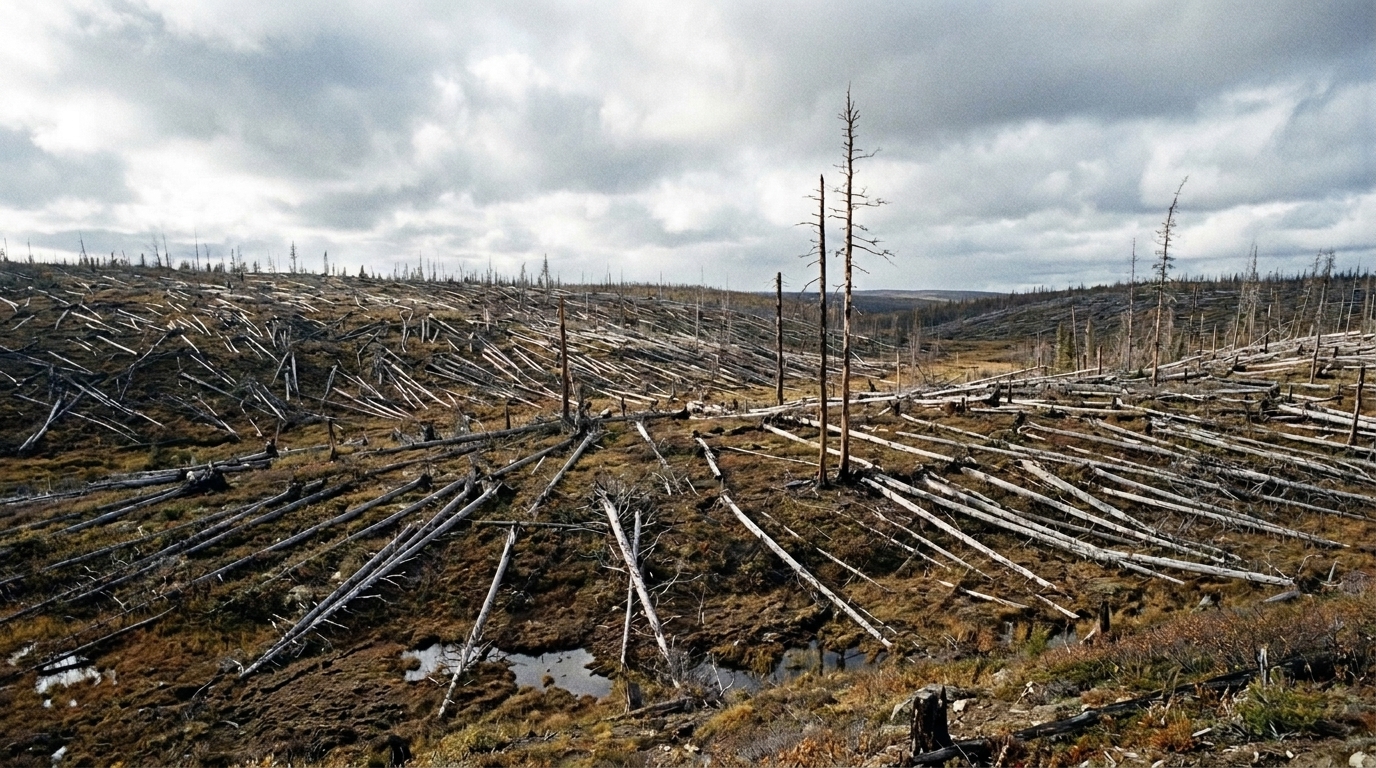
The Tunguska Event
The 1908 Siberian explosion that flattened 2,000 square kilometers remains one of Earth's greatest mysteries.
Sign in to bookmark, follow, and message the contributor.
Executive Summary
On June 30, 1908, a massive explosion near the Tunguska River in Siberia devastated 800 square miles of forest, yet left no crater. While mainstream science attributes it to an airburst from a meteor or comet, the event's remoteness delayed serious investigation for nearly two decades. Controversy persists around alternative explanations, the lack of recovered meteorite fragments, and geopolitical secrecy during Cold War-era Soviet research that may have withheld key findings.
- 01.Soviet military intelligence classified atmospheric blast pattern data from 1960s Tunguska expeditions due to nuclear test signature similarities.
- 02.Micrometeorite chemical analysis from 1999 Italian expedition suggested composition inconsistent with standard comet models—findings disputed by Russian Academy.
- 03.Kulik expedition field notes contain unexplained gaps for key survey dates in July 1927; original documents remain in restricted Moscow archives.
The Hidden Truth
What the headlines won't tell you
The Mainstream Narrative
The scientific consensus holds that the Tunguska event was caused by the airburst explosion of a meteor or comet fragment approximately 5-10 kilometers above the Earth's surface. The explosion released energy equivalent to 10-15 megatons of TNT, flattening approximately 80 million trees across 2,150 square kilometers of remote Siberian taiga. No impact crater was found because the object disintegrated before reaching the ground. This explanation is supported by eyewitness accounts of a fireball, seismic recordings worldwide, and the radial pattern of felled trees.
Under-Reported Complexities
What receives less attention is the 19-year delay before the first scientific expedition reached the site. Leonid Kulik's 1927 expedition found no meteorite fragments despite extensive searches—an anomaly that continues to puzzle researchers. Soviet authorities tightly controlled access to Tunguska data during the Cold War, and some researchers suggest that findings from expeditions in the 1950s-1970s may have been classified or selectively published. The remote location and political climate created an information vacuum filled by speculation. Additionally, the precise composition of the impactor remains unknown; competing theories propose stony asteroids, icy comets, or even more exotic possibilities.
Credible Dissenting Voices
While fringe theories (natural gas explosions, black holes, antimatter) lack credible evidence, legitimate scientific debate continues over the impactor's composition and trajectory. Some researchers, including teams analyzing microscopic particles from peat bogs, argue the chemical signatures suggest a carbonaceous chondrite rather than ice. Others point to unusual magnetic anomalies and elevated iridium levels in soil samples. The lack of definitive meteorite recovery—despite finds of micrometeorites and glassy spherules—keeps alternative scenarios marginally viable in peer-reviewed literature.
Power Dynamics and Institutional Control
Soviet secrecy surrounding Tunguska research paralleled Cold War anxieties about atmospheric nuclear testing and meteoric threats. When the USSR began serious investigation in the late 1950s, the event's similarities to nuclear airbursts were not lost on military analysts. Access to raw data from Soviet expeditions remains incomplete in Western archives. Modern research is collaborative but limited by the site's remoteness and environmental degradation.
Open Questions
Why has no definitive meteorite fragment been recovered? What specific data did Soviet expeditions collect that remains unpublished? Could improved archaeological techniques at the impact zone yield new evidence? How do we reconcile eyewitness testimony variations with physical evidence? The Tunguska event remains a case study in how geographic isolation, political secrecy, and scientific uncertainty combine to sustain mystery.
Under-Reported Dimensions
Editorial pass pending.
Follow the Money
Editorial pass pending.
Case Timeline
- 1908June 30: Massive explosion near Tunguska River flattens 2,000 sq km of Siberian forest; visible glow reported across Europe and Asia.
- 1921Leonid Kulik learns of the event from old newspaper archives and begins advocating for expedition.
- 1927Kulik's first expedition reaches the site; finds no crater or meteorite fragments despite radial tree-fall pattern.
- 1930British astronomer F.J.W. Whipple proposes comet airburst theory based on seismic and atmospheric data.
- 1958Soviet expeditions resume with enhanced geophysical equipment; similarities to nuclear airbursts noted.
- 1963Research suggests explosion occurred 5-10 km above surface with 10-15 megaton yield.
- 1973Analysis of tree-ring growth patterns confirms 1908 date and regional environmental impact.
- 1999Italian-Russian expedition recovers micrometeorites and resin particles from Lake Cheko sediments.
- 2007Computer models suggest stony asteroid most likely cause; comet composition debated.
- 2013Chelyabinsk meteor airburst provides modern comparison event for Tunguska dynamics.
- 2020Analysis of peat-bog spherules supports asteroid hypothesis but composition remains contested.
Key People
Organizations
Evidence Library
Structured evidence pass pending.
Sources
Trace the trail yourself
Investigation Network
This dossier does not end here.
- Operation PaperclipUS recruited 1,600 Nazi scientists after WWII, whitewashing war crimes for Cold War advantage
- The Tulsa Race Massacre Cover-UpHow America buried its worst episode of racial terror for nearly a century
- The Rockefeller Family's Hidden InfluenceA century of oil wealth, philanthropy, and allegations of global power networks behind American capitalism.
- The Federal Reserve's Secret Creation at Jekyll IslandSeven men met in secret on a Georgia island to draft America's central banking system in 1910.
- 1965Sugar Research Foundation initiates Project 226, paying Harvard scientists to review literature on sugar, fat, and heart diseaseSugar Industry vs. Heart Disease Research
- 1965CIA begins Intelligence Coordination and Exploitation Program (ICEX), Phoenix precursorThe Phoenix Program in Vietnam
- 1965Immigration and Nationality Act abolishes national-origin quotas, reshaping legal immigrationUS Border Crisis and Immigration Statistics
- 1965Peoples Temple relocates to Redwood Valley, CaliforniaThe Jonestown Massacre
- 1966PHS venereal disease investigator Peter Buxtun files internal protest questioning study ethics; ignored by superiors.The Tuskegee Syphilis Experiment
- 1964Warren Commission concludes Oswald acted alone; single-bullet theory introducedJFK Assassination Files
Live Discussion
0 Perspectives
Add to the record. Be specific. Cite where you can.
If you're learning about this topic for the first time, these are the best places to continue — documented evidence and historical relationships are the guide.
Named in “The Tunguska Event”.
Named in “The Tunguska Event”.
Read more dossiers like this
Get a quiet one-line bulletin when new investigative files are published. Bound to this dossier — useful for tracking follow-ups.