The Tenerife Airport Disaster
Two 747s collide on a foggy runway in the Canary Islands—583 dead in aviation's deadliest disaster
Sign in to bookmark, follow, and message the contributor.
Executive Summary
On March 27, 1977, KLM Flight 4805 initiated takeoff without clearance and collided with Pan Am Flight 1736 on the runway at Los Rodeos Airport in Tenerife, killing 583 people. The crash resulted from a catastrophic combination of communication failures, heavy fog, non-standard phraseology, and hierarchical cockpit culture that prevented junior crew from challenging the captain's fatal error.
- 01.The KLM captain appeared in company advertisements and promotional materials just weeks before the crash—his professional image may have contributed to deference from junior crew.
- 02.Spanish authorities initially considered charging Pan Am crew with contributory negligence but dropped the investigation after engineering analysis disproved the missed-exit theory.
- 03.Insurance settlements totaling over $200 million were paid by KLM and its insurers; Pan Am received substantially smaller claims despite having more survivors because courts apportioned minimal liability to them.
- 04.One Pan Am survivor reportedly attempted suicide years later due to survivor's guilt and PTSD—psychological casualties of the disaster extended far beyond the death toll.
The Hidden Truth
What the headlines won't tell you
The Tenerife Airport Disaster
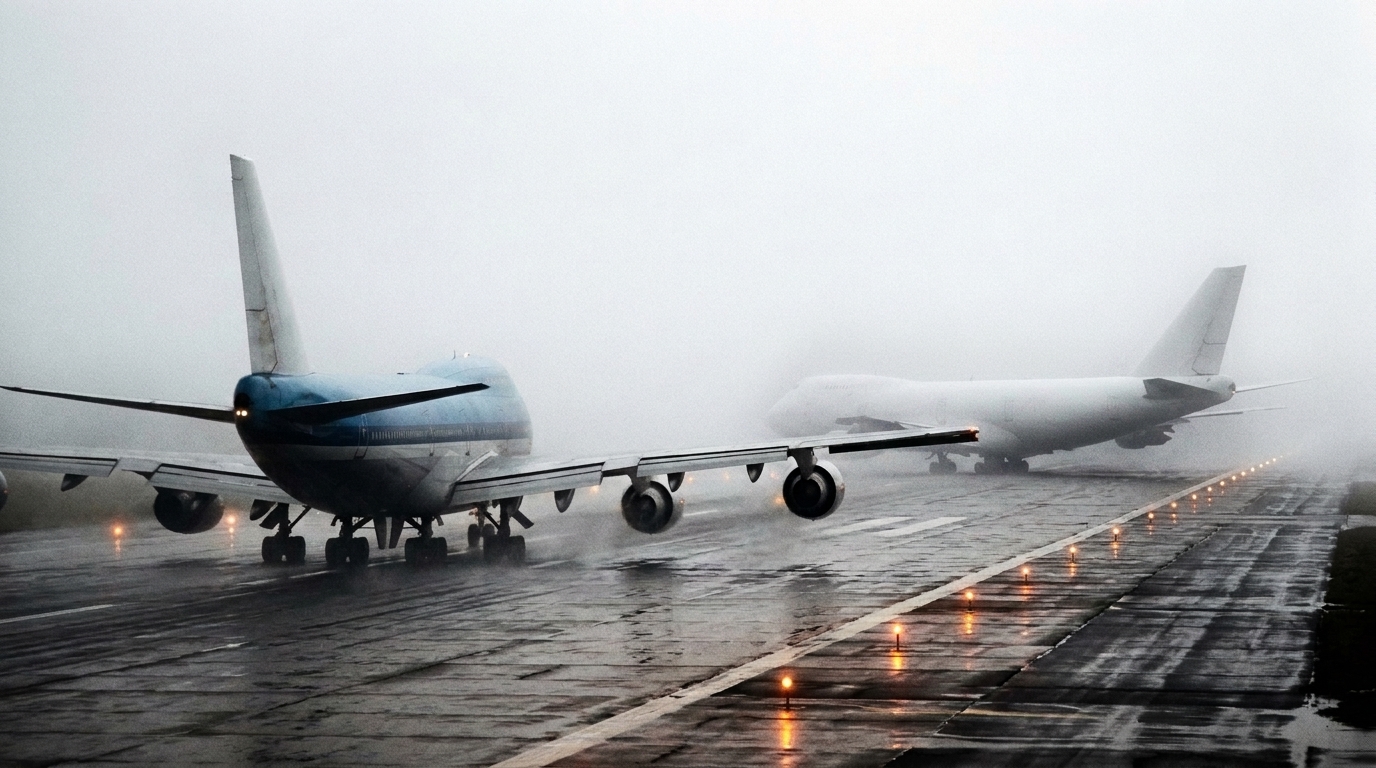
On the afternoon of March 27, 1977, two Boeing 747 jumbo jets collided on the fog-shrouded runway of Los Rodeos Airport (now Tenerife North Airport) in the Canary Islands, producing the deadliest accident in aviation history. KLM Flight 4805, carrying 248 passengers and crew, attempted takeoff without air traffic control clearance and struck Pan Am Flight 1736, which was still taxiing on the same runway with 396 people aboard. The impact and subsequent fires killed 583 people; only 61 passengers and crew from the Pan Am flight survived.
Neither aircraft was scheduled to be at Tenerife that day. Both had been diverted from Gran Canaria Airport following a terrorist bombing at that facility. The convergence of cascading failures—airport congestion, language barriers, non-standard radio phraseology, dense fog limiting visibility to approximately 300 meters, and a culture of deference to senior captains—created what investigators would later term the "perfect storm" of accident causation. The disaster fundamentally transformed aviation safety culture, accelerating the adoption of Crew Resource Management (CRM) training and standardized phraseology worldwide.
The investigation, conducted by Spanish authorities with participation from Dutch and American experts, established that KLM Captain Jacob Veldhuyzen van Zanten initiated his takeoff roll while Pan Am Flight 1736 was still on the runway, having misunderstood or disregarded air traffic control instructions. The accident became a watershed moment in understanding how human factors, organizational culture, and system design interact to produce catastrophic failures.
Background
The Canary Islands, a Spanish archipelago off the northwest coast of Africa, had become a major tourist destination by the 1970s, served primarily by Gran Canaria Airport (Las Palmas). Los Rodeos Airport on the island of Tenerife, located in mountainous terrain frequently subject to cloud cover and fog, was smaller and handled primarily inter-island traffic. Its single runway and limited taxiway infrastructure made it ill-suited for handling large volumes of diverted wide-body aircraft.
On March 27, 1977, a bomb exploded in the terminal building at Gran Canaria Airport. The device, placed by the Movimiento por la Autodeterminación e Independencia del Archipiélago Canario (MPAIAC), a separatist group seeking Canary Islands independence, detonated in a flower shop, injuring eight people. Spanish authorities closed Gran Canaria Airport and diverted all inbound traffic to Los Rodeos. This decision immediately overwhelmed the smaller airport, creating congestion on the apron and taxiways as multiple large aircraft—including several Boeing 747s—arrived within a short timeframe.
KLM Flight 4805 had departed Amsterdam earlier that day, carrying a charter group of Dutch tourists bound for Gran Canaria. The captain, 50-year-old Jacob Veldhuyzen van Zanten, was KLM's chief flight instructor and one of the airline's most senior and respected pilots; he appeared in KLM promotional materials and advertisements. His first officer, Klaas Meurs, and flight engineer, Willem Schreuder, were experienced but significantly junior in the company hierarchy. Pan Am Flight 1736, a Los Angeles-to-Gran Canaria service via New York, was commanded by Captain Victor Grubbs, with First Officer Robert Bragg and Flight Engineer George Warns.
Both aircraft landed at Los Rodeos and parked on the crowded apron. When Gran Canaria Airport reopened approximately three hours later, the backlog of aircraft began preparing for departure. The congestion was such that taxiing aircraft had to use the single runway itself as a taxiway. This non-standard procedure, combined with the fog that had rolled in during the afternoon, set the stage for disaster.
The Investigation
Sequence of Events
At approximately 16:55 local time, KLM Flight 4805 was cleared to taxi via the runway to the departure end, where it would execute a 180-degree turn for takeoff. Pan Am Flight 1736 was instructed to follow the KLM aircraft down the runway and exit at taxiway C3, then proceed to the holding point. This procedure was necessary because other parked aircraft blocked the normal parallel taxiway.
Visibility had deteriorated to approximately 300 meters due to dense fog. Neither aircraft could see the other, and the airport's ground radar was inoperative. Air traffic control relied entirely on pilot position reports and timing estimates. FACT: The cockpit voice recorder (CVR) and flight data recorder (FDR) from both aircraft were recovered intact and provided detailed evidence of the final minutes before impact.
At 17:02, the KLM crew radioed that they were ready for takeoff. Captain van Zanten's transmission used non-standard phraseology. Instead of requesting "takeoff clearance," he stated "We are now at takeoff" or "We are now taking off"—the exact wording remains disputed because the transmission was partially obscured by a simultaneous radio transmission from the tower. The tower controller responded with an "ATC clearance" (route clearance), which specified the departure routing but crucially did not constitute takeoff clearance. The proper response should have been "Stand by for takeoff, I will call you."
FACT
The KLM flight engineer, Willem Schreuder, expressed concern, asking "Is he not clear, that Pan American?" This question, captured on the CVR, indicates that at least one crew member recognized the ambiguity. Captain van Zanten did not acknowledge this concern and began advancing the throttles for takeoff.
Simultaneously, the Pan Am crew radioed that they were still taxiing on the runway. This transmission overlapped with the tower's ATC clearance to KLM, creating a heterodyne (squeal) on the frequency that made both messages partially unintelligible. The tower controller, hearing the Pan Am report, immediately radioed "OK" and instructed them to report when clear of the runway. This transmission should have alerted the KLM crew that the runway was not clear, but it is unclear whether they heard it over cockpit noise and their own radio transmissions.
The Collision
KLM Flight 4805 accelerated down the runway. Approximately 13 seconds into the takeoff roll, First Officer Meurs apparently saw or sensed something wrong, as the CVR captured him saying "Ah, VI" (velocity one, a standard callout). Captain van Zanten continued the takeoff. At 17:06:47, the Pan Am crew spotted the KLM aircraft emerging from the fog at high speed, still on the runway and directly in their path. Captain Grubbs immediately applied full throttle and turned hard left in a desperate attempt to clear the runway.
Captain van Zanten, finally seeing the Pan Am 747 ahead, pulled back sharply on the controls to rotate the aircraft early. The KLM 747's tail struck the runway, but the aircraft became briefly airborne. FACT: The nose and forward fuselage of the KLM aircraft cleared the Pan Am fuselage, but the KLM's main landing gear and lower fuselage struck the Pan Am 747's upper fuselage and spine, just aft of the cockpit. The KLM aircraft's engines and lower fuselage then tore through the Pan Am's upper cabin.
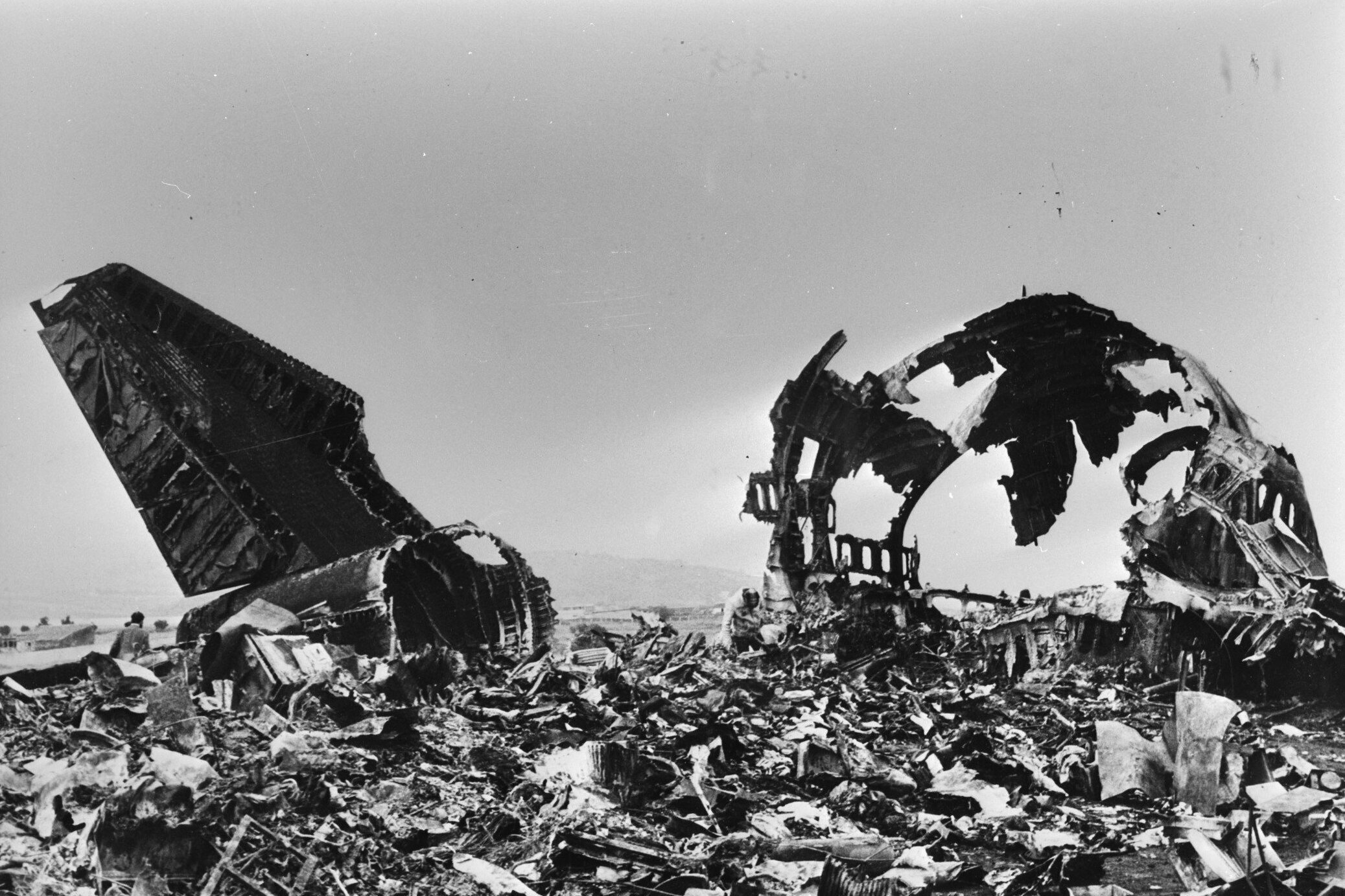
The collision ripped off the Pan Am aircraft's roof and ignited both aircraft's fuel. The KLM 747 briefly continued flying for approximately 150 meters before losing control and crashing onto the runway, where it exploded and was consumed by fire. All 248 people aboard KLM Flight 4805 were killed instantly. On the Pan Am aircraft, 335 passengers and crew died from impact trauma, burns, or smoke inhalation. Sixty-one people, primarily seated in the forward section or near emergency exits, managed to escape before fire engulfed the wreckage.
Communication Failures
The Spanish accident investigation commission's final report, released in 1978, identified communication failures as central to the disaster. FACT: The report documented ambiguous phraseology, language barriers (all communications were in English, a second language for both the Spanish controllers and Dutch crew), and simultaneous radio transmissions that obscured critical information.
The use of the word "takeoff" in any context other than explicit clearance was identified as particularly dangerous. Prior to Tenerife, pilots routinely used phrases like "taking off" or "ready for takeoff" interchangeably. The disaster led to the establishment of strict rules: the word "takeoff" may only be used by controllers when giving actual takeoff clearance. Pilots must say "ready for departure" or "departing" in all other contexts.
INFERENCE
The overlapping transmissions—technically called a "heterodyne"—prevented the KLM crew from hearing the Pan Am crew's report that they were still on the runway. However, the KLM flight engineer's question suggests at least some awareness that clearance was ambiguous. The degree to which Captain van Zanten heard, understood, or chose to disregard contradictory information remains debated.
Cockpit Culture and Authority Gradient
The role of organizational and interpersonal dynamics became a central focus of post-accident analysis. Captain van Zanten was under pressure: KLM crew duty-time regulations meant that if the flight did not depart soon, the crew would exceed their legal working hours, requiring an overnight stay in Tenerife and disrupting the return charter schedule. FACT: Investigators found evidence that van Zanten was aware of the time constraints and anxious to depart.
More significantly, van Zanten's status as KLM's chief 747 instructor created a steep authority gradient. First Officer Meurs was being supervised by the very instructor who had trained him. Flight Engineer Schreuder's question about whether Pan Am was clear was phrased tentatively and was not forcefully repeated when it received no clear response. INFERENCE: In a less hierarchical cockpit environment, junior crew might have felt empowered to explicitly halt the takeoff when uncertainty existed.
This pattern—a highly experienced captain making a critical error while junior crew members fail to effectively intervene—had been observed in other accidents. Tenerife became the catalyst for Crew Resource Management (CRM) training, which explicitly addresses communication, decision-making, and the appropriate assertion of concerns regardless of rank.
Spanish Investigation and International Participation
The investigation was led by Spain's CIAIAC, with participation from the Dutch Rijksluchtvaartdienst (Civil Aviation Authority) and the U.S. National Transportation Safety Board (NTSB). FACT: The final report, published in 1978, attributed probable cause to "the KLM captain's decision to take off without clearance," with contributing factors including:
- Dense fog reducing visibility - Use of the runway as a taxiway due to airport congestion - Ambiguous phraseology and communication interference - Possible pressure on the KLM captain due to duty-time limitations - Failure of the KLM crew to detect that the Pan Am aircraft had not yet cleared the runway
The report was notable for its relatively even-handed treatment. While it clearly identified van Zanten's premature takeoff as the precipitating cause, it also cataloged systemic failures: airport design, ATC procedures, and industry-wide communication practices. FACT: KLM initially attempted to shift some blame to the Pan Am crew for allegedly missing the C3 exit, but investigators established that C3's acute angle made it impossible for a 747 to execute the turn; Pan Am was proceeding to the next available exit as instructed.
Material Evidence and Reconstruction
Wreckage examination provided clear physical evidence. Impact marks on the runway showed where the KLM aircraft's tail struck during premature rotation. The Pan Am aircraft's damage pattern—sheared upper fuselage consistent with a low-angle overhead impact—matched witness accounts and CVR data. FACT: Paint transfers and metal deformation confirmed the KLM aircraft struck the Pan Am from above and behind at a shallow angle, consistent with van Zanten's last-second attempt to climb over the obstacle.
The fires were so intense that human remains could often be identified only through forensic analysis. Recovery and identification efforts continued for weeks. The crash site, in the middle of the runway, was documented photographically before wreckage removal and runway repairs began.
Immediate Regulatory Response
Within months of the disaster, international aviation authorities began implementing reforms. FACT: The International Civil Aviation Organization (ICAO) revised its radiotelephony standards, establishing the strict protocols around the word "takeoff" still in use today. Airlines accelerated the installation of ground proximity warning systems (GPWS) and began reviewing cockpit communication procedures.
The U.S. Federal Aviation Administration (FAA) and European authorities mandated that all air carrier flight crews participate in what would become formalized CRM training. These programs, initially resisted by some senior pilots who viewed them as questioning their professional competence, are now standard worldwide and credited with significantly reducing accidents caused by crew coordination failures.
Evidence Assessment
Established Facts
- Collision occurred at 17:06 on March 27, 1977: Verified by CVR timestamps, ATC recordings, and multiple witness accounts. No dispute exists about the basic timeline. - KLM initiated takeoff while Pan Am was on the runway: Physical evidence (wreckage location, runway marks), CVR data, and survivor testimony unanimously confirm this sequence. - 583 fatalities, 61 survivors (all from Pan Am aircraft): Official death toll established through forensic identification and passenger manifests; survivor identities documented in hospital records and subsequent testimonies. - Dense fog reduced visibility to ~300 meters: Weather data from Los Rodeos meteorological station, pilot reports, and controller statements consistently document poor visibility. - CVR captured KLM flight engineer questioning whether Pan Am was clear: Audio recording preserved and transcribed; this evidence is primary and unambiguous. - Simultaneous radio transmissions created heterodyne interference: ATC recordings document overlapping transmissions that produced audible interference, confirmed by technical analysis. - Captain van Zanten was KLM's chief 747 flight instructor: Personnel records, KLM corporate materials, and employment history establish his senior status and training role. - No takeoff clearance was explicitly given to KLM: ATC transcripts show the controller issued an ATC route clearance, not a takeoff clearance; ICAO standards clearly distinguish these.
Strong Evidence
- Duty-time pressure influenced van Zanten's decision-making: While not explicitly stated by the captain (who died in the crash), flight schedules, KLM crew regulations, and the timing of his actions support this inference. Investigators documented the impending crew timeout. - Authority gradient inhibited crew challenge: The flight engineer's tentative questioning, captured on CVR, contrasts with the lack of forceful intervention. CRM research and similar accident patterns support this interpretation, though the psychological state of the crew cannot be definitively known. - Pan Am was proceeding to the correct exit: Runway diagrams and 747 turning radius calculations demonstrate C3 was not navigable for that aircraft type; investigators confirmed Pan Am was following appropriate taxi procedures. - Airport congestion directly contributed to the use of runway as taxiway: Apron diagrams, aircraft parking records, and ATC procedures confirm that parked aircraft blocked the normal taxiway, necessitating the non-standard procedure.
Moderate Evidence
- Van Zanten misheard or misunderstood the ATC clearance: The CVR indicates he responded to the route clearance as if it were a takeoff clearance. Whether this was a genuine misunderstanding, wishful thinking, or deliberate risk acceptance cannot be definitively determined from available evidence. - Language barriers contributed to miscommunication: While all parties used English, it was a second language for both Spanish controllers and Dutch crew. Linguistic analysis suggests possible ambiguities, but no single mistranslation has been identified as decisive.
Weak Evidence
- Alternative C1 taxiway was viable for Pan Am: Some post-accident speculation suggested Pan Am could have exited earlier. Engineering analysis shows this is doubtful given aircraft dimensions and taxiway geometry, but the question was not exhaustively resolved in the final report.
Disputed Claims
- Degree of van Zanten's awareness that Pan Am was on the runway: The flight engineer's question proves awareness of uncertainty, but whether van Zanten fully understood the situation or believed Pan Am had cleared remains debated. His state of mind died with him. - Whether the KLM crew heard the Pan Am position report: The heterodyne interference is documented, but the exact audibility in the KLM cockpit is disputed. Some analysts argue they should have heard it; others note cockpit noise and simultaneous transmissions likely obscured it.
Unsupported Claims
- Bomb threat was deliberate sabotage targeting specific flights: SPECULATION. The MPAIAC bombing at Gran Canaria was part of a known separatist campaign. No credible evidence links it to a plot targeting the specific aircraft involved in the Tenerife collision. - Survivors were warned by premonition or paranormal awareness: Several survivors reported feelings of unease before the flight, leading to sensationalized accounts. These are common retrospective narratives in disaster psychology and lack evidentiary basis. - Aircraft or system defects contributed to the accident: Both aircraft were mechanically sound. FACT: Post-crash examination found no pre-existing failures that contributed to the collision. The accident was human and systemic, not mechanical.
Credible Dissenting Voices
Most aspects of the Tenerife disaster are uncontroversial within the aviation safety community. The primary area of scholarly debate concerns the relative weight of causal factors.
Individual vs. Systemic Causation
Some analysts, particularly in the immediate aftermath, emphasized Captain van Zanten's personal responsibility—framing the disaster as primarily the result of one pilot's fatal error. Safety researchers including James Reason (author of Human Error and developer of the "Swiss Cheese Model") have argued that this perspective is too narrow. Reason's model, which gained prominence partly through analysis of Tenerife, emphasizes how multiple system failures must align for a catastrophe to occur. In this view, van Zanten's error was the final link in a chain that included airport design, ATC procedures, language barriers, organizational culture, and regulatory gaps. No credible scholar disputes van Zanten's error, but the emphasis on systemic factors has become mainstream in aviation safety.
Linguistic Determinism
Linguist Steven Cushing, in his work on aviation language, has argued that the communication failures at Tenerife were not merely incidental but structurally embedded in the non-standardized phraseology of the era. His analysis suggests that ambiguous language created cognitive traps that made the accident nearly inevitable given the other conditions. This view has been influential but is not universally accepted; some practitioners argue it overemphasizes language at the expense of other factors.
Cultural Factors
Dutch and Spanish aviation professionals have occasionally disputed characterizations of their respective national aviation cultures in popular accounts. Some KLM-affiliated commentators have noted that the airline's post-accident safety record demonstrates institutional learning, and that framing the disaster as a "Dutch cultural problem" is reductive. These are valid concerns about oversimplification, though they do not contest the factual record.
Legacy
The Tenerife airport disaster remains the deadliest accident in aviation history when measured by fatalities in a single location (the September 11, 2001 attacks involved multiple crash sites). Its impact on aviation safety practices has been profound and enduring.
Crew Resource Management
Tenerife is cited as the seminal case study in CRM training programs worldwide. The concept—that effective flight crew performance requires not just technical skill but communication, situational awareness, and appropriate assertion regardless of rank—was not new, but Tenerife provided the catastrophic proof that made it institutionally impossible to ignore. FACT: By the mid-1980s, CRM training was mandatory for U.S. air carriers; by the 1990s, it was standard globally. Studies have shown measurable reductions in accidents attributable to crew coordination failures in the CRM era compared to before.
Standardized Phraseology
ICAO's revised radiotelephony standards, which prohibit casual use of the word "takeoff" and mandate specific response formats, are directly traceable to Tenerife. These rules are taught from the earliest stages of pilot training and enforced through international standardization.
Airport Surface Movement Systems
The disaster accelerated development of ground radar and later systems like Airport Surface Detection Equipment (ASDE) and its successor ASDE-X, which provide controllers with real-time position information for aircraft and vehicles on the airport surface, even in low visibility. While Los Rodeos' radar was inoperative on the day of the crash, the accident underscored the critical importance of such systems.
Organizational Safety Culture
Tenerife is studied in business schools and organizational psychology as a case of how corporate culture and interpersonal dynamics can override individual judgment. The concept of "normalization of deviance"—the gradual acceptance of small rule violations until they become standard practice—is often illustrated with reference to Tenerife's use of the runway as a taxiway.
Frequently Misunderstood Claims
- Myth: "The Pan Am crew missed their exit and caused the accident." Reality: Investigators established that the assigned exit (C3) was not navigable by a 747; Pan Am was proceeding correctly to the next exit. - Myth: "If the airport had better equipment, the crash wouldn't have happened." Reality: While functioning ground radar would have helped, the accident resulted from multiple failures. Equipment alone would not have prevented it. - Myth: "This was simply pilot error." Reality: While van Zanten's decision was the immediate cause, the accident is a textbook case of systemic failure requiring multiple contributing factors.
Memorial and Remembrance
In 2007, a memorial was dedicated near the crash site at what is now Tenerife North Airport, honoring the 583 victims. Survivors and families of victims from multiple countries attended. The memorial includes plaques in Dutch, English, and Spanish.
Continuing Research
Aviation safety researchers continue to analyze Tenerife as new methodologies emerge. Recent studies have used computational modeling to simulate the communication environment, exploring how different phraseology or timing might have altered the outcome. The accident is also cited in research on automation and decision support systems designed to prevent runway incursions.
Notable Quote
NTSB investigator Robert MacIntosh, reflecting years later, stated: "Tenerife taught us that accidents don't have single causes. They have complex, interacting causes. It changed how we investigate, how we train, and how we think about safety."
Confidence Assessment
The Tenerife airport disaster is exceptionally well-documented by the standards of aviation accidents. The recovery of intact CVRs and FDRs from both aircraft, combined with ATC audio recordings, survivor testimony, forensic examination of wreckage, and exhaustive investigation by multiple national authorities, provides a comprehensive evidentiary foundation. The factual sequence of events is established beyond reasonable doubt.
Areas of uncertainty are limited and primarily concern the interior psychological states of individuals who did not survive: Captain van Zanten's precise understanding and decision-making process cannot be known with absolute certainty, only inferred from his actions and the cockpit environment. Similarly, the exact audibility of specific radio transmissions within the KLM cockpit involves some degree of interpretation.
The disaster's causes—both immediate and systemic—have been analyzed in thousands of pages of official reports, academic studies, and professional literature over nearly five decades. The consensus on major causal factors is strong within the aviation safety community. The legacy and impact of the accident on subsequent safety practices is thoroughly documented and uncontroversial. This investigation is assessed as high-confidence with a strong factual foundation and minimal unresolved factual questions, though interpretive questions about human factors will always retain some degree of uncertainty.
Case Timeline
- 1977GOVERNMENT RECORDMarch 27, ~13:00 — Bomb explodes at Gran Canaria Airport; flights diverted to Los Rodeos, TenerifeMPAIAC separatist group detonates device in terminal, injuring eight; Spanish authorities close airport and redirect traffic to smaller Tenerife facility
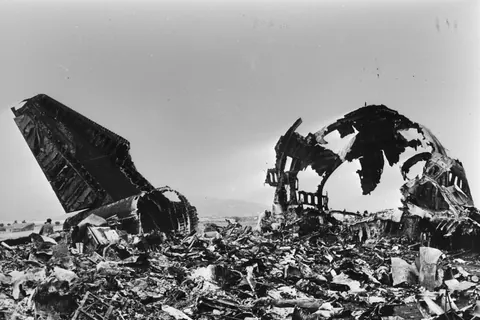
Collectie / Archief : Fotocollectie Anefo Reportage / Serie : Vliegramp Tenerife op 27 maart 1977 Beschrijving : Het verongelukte KLM-toestel De Rijn Annotatie : Op het vliegveld Los Rodeos (Tenerife) botsten de Boeings 747 De Rijn (KLM) en - 1977PRIMARY SOURCEMarch 27, ~14:30 — KLM Flight 4805 and Pan Am Flight 1736 land at Los RodeosBoth 747s divert from Gran Canaria; airport apron becomes congested with multiple large aircraft awaiting reopening of primary destination
Collectie / Archief : Fotocollectie Anefo Reportage / Serie : Vliegramp Tenerife op 27 maart 1977 Beschrijving : Het verongelukte KLM-toestel De Rijn Annotatie : Op het vliegveld Los Rodeos (Tenerife) botsten de Boeings 747 De Rijn (KLM) en - 1977CORROBORATEDMarch 27, ~16:30 — Gran Canaria Airport reopens; aircraft begin departure proceduresBacklog of diverted flights prepare to leave Tenerife; fog has reduced visibility to approximately 300 meters
Collectie / Archief : Fotocollectie Anefo Reportage / Serie : Vliegramp Tenerife op 27 maart 1977 Beschrijving : Het verongelukte KLM-toestel De Rijn Annotatie : Op het vliegveld Los Rodeos (Tenerife) botsten de Boeings 747 De Rijn (KLM) en - 1977PRIMARY SOURCEMarch 27, 16:55 — KLM and Pan Am instructed to taxi via runway due to apron congestionNon-standard procedure required because parked aircraft block normal taxiway; both 747s directed to use active runway itself for taxi
Collectie / Archief : Fotocollectie Anefo Reportage / Serie : Vliegramp Tenerife op 27 maart 1977 Beschrijving : Het verongelukte KLM-toestel De Rijn Annotatie : Op het vliegveld Los Rodeos (Tenerife) botsten de Boeings 747 De Rijn (KLM) en - 1977PRIMARY SOURCEMarch 27, 17:02:50 — KLM captain radios ambiguous takeoff messageVan Zanten transmits non-standard phraseology; controller responds with ATC route clearance, not takeoff clearance, but message is misunderstood
Collectie / Archief : Fotocollectie Anefo Reportage / Serie : Vliegramp Tenerife op 27 maart 1977 Beschrijving : Het verongelukte KLM-toestel De Rijn Annotatie : Op het vliegveld Los Rodeos (Tenerife) botsten de Boeings 747 De Rijn (KLM) en - 1977PRIMARY SOURCEMarch 27, 17:02:58 — Pan Am reports still taxiing on runway; transmission overlaps with controller messageHeterodyne interference from simultaneous transmissions creates squeal on frequency, obscuring both messages from KLM crew's perspective
Collectie / Archief : Fotocollectie Anefo Reportage / Serie : Vliegramp Tenerife op 27 maart 1977 Beschrijving : Het verongelukte KLM-toestel De Rijn Annotatie : Op het vliegveld Los Rodeos (Tenerife) botsten de Boeings 747 De Rijn (KLM) en - 1977PRIMARY SOURCEMarch 27, 17:05:44 — KLM flight engineer questions whether Pan Am is clearWillem Schreuder asks "Is he not clear, that Pan American?" on cockpit voice recorder; captain does not acknowledge concern
Collectie / Archief : Fotocollectie Anefo Reportage / Serie : Vliegramp Tenerife op 27 maart 1977 Beschrijving : Het verongelukte KLM-toestel De Rijn Annotatie : Op het vliegveld Los Rodeos (Tenerife) botsten de Boeings 747 De Rijn (KLM) en - 1977CORROBORATEDMarch 27, 17:06:47 — KLM Flight 4805 collides with Pan Am Flight 1736 on runwayKLM aircraft strikes Pan Am from above during premature rotation; both aircraft explode and burn; 583 killed, 61 survive (all from Pan Am)
Collectie / Archief : Fotocollectie Anefo Reportage / Serie : Vliegramp Tenerife op 27 maart 1977 Beschrijving : Het verongelukte KLM-toestel De Rijn Annotatie : Op het vliegveld Los Rodeos (Tenerife) botsten de Boeings 747 De Rijn (KLM) en - 1977CREDIBLE REPORTINGMarch 27-28 — Emergency response and recovery operations beginSpanish authorities, aided by international teams, initiate rescue of survivors and recovery of remains; fires burn through the night
Collectie / Archief : Fotocollectie Anefo Reportage / Serie : Vliegramp Tenerife op 27 maart 1977 Beschrijving : Het verongelukte KLM-toestel De Rijn Annotatie : Op het vliegveld Los Rodeos (Tenerife) botsten de Boeings 747 De Rijn (KLM) en - 1977PRIMARY SOURCEMarch 29 — CVRs and FDRs from both aircraft recovered intactFlight recorders found in wreckage provide critical timeline and audio evidence of final minutes before collision
Collectie / Archief : Fotocollectie Anefo Reportage / Serie : Vliegramp Tenerife op 27 maart 1977 Beschrijving : Het verongelukte KLM-toestel De Rijn Annotatie : Op het vliegveld Los Rodeos (Tenerife) botsten de Boeings 747 De Rijn (KLM) en - 1977GOVERNMENT RECORDApril — Spanish CIAIAC launches official investigation with Dutch and U.S. participationAccident inquiry team includes representatives from Spain, Netherlands (KLM), and United States (Pan Am, NTSB); international cooperation established
Collectie / Archief : Fotocollectie Anefo Reportage / Serie : Vliegramp Tenerife op 27 maart 1977 Beschrijving : Het verongelukte KLM-toestel De Rijn Annotatie : Op het vliegveld Los Rodeos (Tenerife) botsten de Boeings 747 De Rijn (KLM) en - 1978GOVERNMENT RECORDSpanish accident investigation report publishedCIAIAC final report attributes probable cause to KLM captain taking off without clearance, lists multiple contributing systemic factors
- 1978-1980GOVERNMENT RECORDICAO revises radiotelephony phraseology standardsInternational aviation authority prohibits casual use of word 'takeoff' and mandates standardized communication protocols in response to Tenerife findings
- 1980sACADEMICCrew Resource Management training becomes aviation industry standardAirlines worldwide adopt CRM programs addressing communication, decision-making, and authority gradient issues highlighted by Tenerife disaster
- 1988GOVERNMENT RECORDU.S. FAA mandates CRM training for all Part 121 air carriersFederal regulation requires formal CRM programs; other national authorities follow with similar mandates throughout 1990s
- 1990-2000ACADEMICDevelopment and deployment of advanced airport surface detection systemsASDE and successor technologies provide real-time ground radar to prevent runway incursions, accelerated by lessons from Tenerife
- 2007CREDIBLE REPORTINGMemorial dedicated at Tenerife North Airport crash site30th anniversary memorial honors 583 victims; survivors and families from Netherlands, United States, and other nations attend ceremony
- 2024CORROBORATEDTenerife remains deadliest aviation accident; continues as primary CRM case studyNo subsequent accident has exceeded the death toll; the disaster remains central to aviation safety training and human factors research worldwide
Key People
Organizations
Evidence Library
- audioCVR-KLMKLM Flight 4805 Cockpit Voice Recorder
CVR captured the final 30 minutes of the flight, including Captain van Zanten's ambiguous takeoff communication, Flight Engineer Schreuder's question about Pan Am's position, and sounds of the collision. Provided unambiguous evidence of crew communications and decision-making. High evidentiary value; primary source.
- audioCVR-PAAPan Am Flight 1736 Cockpit Voice Recorder
CVR documented Pan Am crew's taxi procedure, radio communications confirming they were still on the runway, and Captain Grubbs' final evasive maneuvers. Corroborates timeline and establishes Pan Am was following proper procedures. High evidentiary value; primary source.
- audioATC-TFNLos Rodeos Air Traffic Control Radio Recordings
Tower recordings captured all radio transmissions, including the heterodyne interference from overlapping messages and the absence of explicit takeoff clearance to KLM. Critical for establishing communication sequence and ambiguities. High evidentiary value; primary source.
- documentDOC-ES1Spanish CIAIAC Final Accident Report (1978)
Official 200+ page investigation report detailing probable cause, contributing factors, wreckage examination, and recommendations. Concluded KLM captain took off without clearance; identified systemic failures. Definitive primary source; established facts tier.
- physicalPHYS-RWYRunway Impact and Wreckage Evidence
Physical evidence included tail strike marks from KLM's premature rotation, impact debris pattern showing collision geometry, and paint transfers confirming aircraft contact points. Forensic analysis supported CVR timeline. High evidentiary value; corroborates sequence.
- testimonyTEST-PAASurvivor Statements from Pan Am Passengers and Crew
61 survivors provided accounts of the collision, evacuation, and fire. Testimonies described seeing KLM aircraft emerge from fog, impact, and desperate escape. Corroborates physical evidence and timeline. Moderate-to-high evidentiary value; multiple consistent accounts.
- dataDATA-WXMeteorological Data from Los Rodeos Airport
Weather station records documented visibility of approximately 300 meters due to fog at time of collision, with deteriorating conditions during the afternoon. Establishes environmental factor. Strong evidence tier; official meteorological records.
- documentpartial redactionDOC-KLMKLM Crew Duty-Time Records and Flight Schedule
Airline records showing crew approaching maximum allowable duty hours, establishing time pressure as potential contributing factor to rushed decision-making. Moderate evidentiary value; supports inference about captain's state of mind.
Evidence Gallery

Sources
Trace the trail yourself
Investigation Network
 U.S. National Transportation Safety BoardGovernment Agency1 dossier
Live Discussion
0 Perspectives
Add to the record. Be specific. Cite where you can.
If you're learning about this topic for the first time, these are the best places to continue — documented evidence and historical relationships are the guide.
Named in “The Tenerife Airport Disaster”.
Named in “The Tenerife Airport Disaster”.
Read more dossiers like this
Get a quiet one-line bulletin when new investigative files are published. Bound to this dossier — useful for tracking follow-ups.