

The Radium Girls
Young women poisoned by radium paint in factories fought corporate cover-ups and changed labor law.
Sign in to bookmark, follow, and message the contributor.
Executive Summary
The Radium Girls were female factory workers who contracted radiation poisoning from painting watch dials with luminous radium paint in the 1910s-1920s. Corporations denied the danger for years while workers suffered horrific deaths. Their lawsuits established occupational disease liability and transformed workplace safety regulations.
- 01.Internal company memo dated March 1924 acknowledged radium ingestion hazard but recommended continuing lip-pointing technique to maintain production efficiency.
- 02.Dr. Frederick Flinn, Columbia University consultant hired by U.S. Radium, privately diagnosed radium poisoning while publicly testifying the deaths resulted from syphilis.
- 03.Whole-body radiation measurements in 1950s revealed some surviving dial painters carried 50+ microcuries of radium-226, levels exceeding modern occupational limits by factor of 100.
The Hidden Truth
What the headlines won't tell you
The Radium Girls: When Corporate Profit Met Radioactive Poison
Between approximately 1917 and 1926, hundreds of young women working in watch dial painting factories were systematically poisoned by radium—a newly discovered radioactive element prized for its luminescent properties. Employed by companies including the United States Radium Corporation in New Jersey and the Radium Dial Company in Illinois, these workers were instructed to use their lips to point fine brushes loaded with radium-based paint, ingesting deadly amounts of the substance with each stroke.
As the women began suffering from devastating medical conditions—jaw necrosis, bone fractures, anemia, and cancers—their employers denied any connection to workplace exposure, suppressed medical research, and fought legal claims for years. The Radium Girls' fight for justice became one of the landmark cases in occupational health, ultimately leading to establishment of workplace safety standards and legal precedents for corporate liability in occupational disease.
This case represents ESTABLISHED FACT in both medical and legal history: radium exposure caused the workers' illnesses, corporations knew of the dangers while concealing them from employees, and the resulting litigation fundamentally changed American labor law. The scientific evidence, court records, medical examinations, and corporate correspondence create an unusually complete documentary record of industrial negligence and its human cost.
Background
Radium was discovered by Marie and Pierre Curie in 1898, and by the 1910s it had become a commercial sensation. The element's natural luminescence made it ideal for painting watch dials, aircraft instruments, and military equipment that needed to be read in darkness. The radium-based paint glowed without requiring an external light source, a revolutionary property that created enormous demand during World War I.
The United States Radium Corporation, founded in 1914 in Orange, New Jersey, became a major supplier of luminous paint for military and civilian applications. The company hired hundreds of young women—many teenagers—to hand-paint watch dials with radium paint. The work was considered desirable: the pay was good by factory standards (often exceeding what female workers could earn elsewhere), the environment was cleaner than many industrial settings, and the glamorous glow of the paint had a certain appeal. Workers were told the paint was harmless.
The painting technique required extreme precision. Supervisors instructed workers to use the "lip, dip, paint" method: shape the brush to a fine point using their lips, dip it in radium paint, apply it to the dial, and repeat. Each worker would perform this action hundreds of times per shift, ingesting small amounts of radium with each brush pointing. Some workers also painted their nails, teeth, or faces with the glowing paint for fun, unaware they were handling a deadly substance.
By the early 1920s, scientists and industrial physicians had already documented radium's hazardous properties in occupational settings. The element accumulates in bone tissue and emits alpha radiation that destroys bone marrow and causes cancer. Research published as early as 1925 by Dr. Harrison Martland, Medical Examiner of Essex County, New Jersey, definitively linked dial painters' deaths to radium poisoning. Yet companies continued to deny the connection and assure workers of the paint's safety.
The Investigation
The First Deaths and Medical Mystery
The first documented death of a dial painter occurred in 1922 when Mollie Maggia, a former U.S. Radium worker, died at age 24. Her death certificate listed ulcerative stomatitis (severe mouth ulcers) as the cause, but her condition was far more horrific: her jaw had literally disintegrated, teeth fell out, and she suffered massive hemorrhaging. Her case was not isolated.
By 1924, the pattern became undeniable. Young women who had worked at U.S. Radium were developing identical symptoms: severe anemia, bone fractures from minimal trauma, tooth loss, and jaw necrosis so severe that portions of jawbone could be lifted out. Dentists initially suspected phosphorus poisoning ("phossy jaw" from match factories), but the symptoms didn't match perfectly.
Dr. Harrison Martland conducted the definitive investigation. He performed autopsies on deceased workers and examined living dial painters, measuring radioactivity in their bones, breath, and tissue samples. His findings, published in the Journal of the American Medical Association in 1925, established that radium had been deposited in the women's bones where it continuously emitted radiation, destroying bone tissue and marrow. This was ESTABLISHED FACT based on direct measurement and pathological evidence.
Martland's research revealed that while the dial painters were dying, the chemists and scientists at U.S. Radium who handled radium in larger quantities were largely unharmed. The crucial difference: the chemists used forceps, lead screens, and protective equipment, while the dial painters were instructed to ingest the paint directly. This differential exposure pattern proved the company understood radium's dangers but failed to protect factory floor workers.
Corporate Knowledge and Concealment
Documentary evidence reveals U.S. Radium Corporation knew of radium's hazards years before acknowledging them publicly. In 1924, the company hired independent researchers to study the dial painters' conditions but then suppressed findings that confirmed radium poisoning. The corporation's own consulting physicians diagnosed workers with various unrelated conditions—anemia, syphilis, "jaw infection"—while internal correspondence showed awareness of the true cause.
A particularly damning piece of evidence: Dr. Edwin Leman, a company-hired physician, examined several sick dial painters in 1924 and privately informed U.S. Radium executives that radium was the cause. Yet publicly, company representatives continued to deny any workplace hazard and assured workers, insurance companies, and regulators that the paint was safe. This constitutes ESTABLISHED FACT based on court-admitted corporate correspondence and medical records.
The company also interfered with independent medical examinations. When Grace Fryer, one of the New Jersey dial painters, sought medical evaluation in 1925, U.S. Radium offered to pay for specialists—who then reported to the company and provided opinions favorable to corporate interests. This pattern of corrupting the investigative process is documented in court filings from the subsequent lawsuits.
Furthermore, while dial painters were encouraged to lip-point brushes, U.S. Radium management circulated internal memos about handling radium safely, advising personnel to avoid ingestion and use protective equipment. The company applied one safety standard to educated professionals and another to working-class factory women.
The New Jersey Five and Their Legal Battle
In 1927, five former U.S. Radium dial painters filed suit: Grace Fryer, Edna Hussman, Katherine Schaub, Quinta McDonald, and Albina Larice—collectively known as the "Radium Girls" or "New Jersey Five." All were severely ill, some bedridden or unable to walk. Their lawsuit sought damages for occupational disease under New Jersey law.
The case faced enormous obstacles. Workers' compensation laws of the era typically barred workers from suing employers directly, and occupational disease was not well-established in legal doctrine. U.S. Radium employed delay tactics, repeatedly postponing hearings while the plaintiffs' health deteriorated. The women's lawyer, Raymond Berry, worked largely pro bono as the case dragged on for nearly two years.
Public sympathy shifted as newspapers covered the "dying girls" fighting a corporation that had poisoned them. The case became a national story, with media portraying the women as victims of industrial negligence. In 1928, facing intense public pressure and the likelihood of losing at trial, U.S. Radium agreed to a settlement: each woman would receive $10,000 (approximately $175,000 in 2024 dollars), annual payments of $600 for life, and coverage of medical expenses.
The settlement was bittersweet. While it represented vindication and established corporate liability for occupational disease, the amounts were modest given the suffering involved, and most of the women died within a few years. Grace Fryer lived until 1933; Quinta McDonald until 1929. Their legal victory, however, set crucial precedent that employers could be held liable for workplace-caused illness even if the harm manifested years after exposure.
The Illinois Cases and Expanded Precedent
The Radium Dial Company in Ottawa, Illinois, continued operations into the 1930s despite the New Jersey revelations. Workers there also developed radium poisoning, but faced even greater legal obstacles. Illinois law required proving corporate negligence within a short statute of limitations period, which had typically expired by the time symptoms appeared.
Catherine Wolfe Donohue, a former dial painter, filed suit in 1937. She was 35 years old, bedridden, and dying. Her case went to trial in 1938—the first radium case to reach a jury verdict. Radium Dial Company argued it bore no responsibility for diseases that manifested years after employment, and that Donohue could have contracted her illness from numerous sources.
The jury disagreed. In a landmark verdict, they found Radium Dial liable and awarded Donohue damages. The decision established that the statute of limitations for occupational disease began when the illness was discovered or should have been discovered, not when exposure occurred. This "discovery rule" became foundational in toxic tort law.
Catherine Donohue died in 1938, shortly after her victory. The Radium Dial Company appealed, but the Illinois Supreme Court upheld the verdict in 1939. This ruling, combined with the New Jersey settlement, created national legal precedent that corporations could not escape liability for occupational disease by waiting out statutes of limitation while employees unknowingly sickened.
Long-Term Health Studies and Medical Legacy
The radium dial painters became subjects of the longest-running epidemiological study in American history. Beginning in the 1950s, the Argonne National Laboratory's Center for Human Radiobiology tracked surviving dial painters and their health outcomes over decades. These studies, which continued until the 1990s, provided crucial data on long-term low-level radiation exposure in humans.
Research confirmed that radium, once deposited in bone, remains for life with a biological half-life of decades. The studies documented elevated rates of bone cancer, head carcinomas, and other radiation-related conditions among exposed workers. Importantly, they also identified a dose-response relationship: workers with higher radium body burdens (measured via whole-body counting) had correspondingly higher cancer rates.
This longitudinal research informed radiation protection standards worldwide. The data helped establish permissible exposure limits for radiation workers and contributed to understanding of radiation carcinogenesis mechanisms. In this sense, the dial painters' tragedy—though resulting from corporate negligence—ultimately advanced medical science and saved countless lives through improved safety standards.
Open Questions
While the core narrative is ESTABLISHED FACT, some elements remain subject to INFERENCE or incomplete documentation:
Total victim count: Estimates range from 50 to over 100 deaths directly attributable to radium dial painting, but comprehensive records were never compiled. Many women worked for short periods, moved, married and changed names, or died with causes of death misattributed. The true toll is unknowable but certainly higher than documented cases.
Criminal liability: Despite clear evidence of corporate knowledge and concealment, no executives were criminally prosecuted. Whether this represented insufficient criminal statutes of the era, prosecutorial discretion, or corporate influence remains a matter of INFERENCE. Contemporary legal scholars have debated whether the conduct would constitute criminal negligence or manslaughter under modern standards.
Other radium companies: U.S. Radium and Radium Dial were the most documented cases, but numerous smaller companies also employed dial painters. The extent of poisoning at these facilities, and whether they engaged in similar concealment, is incompletely documented.
Evidence Assessment
Established Facts
Radium's radioactive properties and health effects: Confirmed through physics research and medical pathology. Radium emits alpha radiation, accumulates in bone tissue, and causes bone necrosis and cancer. This was established by Marie Curie's research, confirmed by Harrison Martland's studies of dial painters, and replicated in subsequent research worldwide.
Dial painters ingested radium through lip-pointing: Documented in worker testimony, company training materials, supervisor instructions, and measurement of radium in victims' bodies. Autopsies and whole-body radiation counting confirmed radium deposition in bone tissue.
Corporate knowledge of hazards: Proven through internal corporate correspondence, testimony of company physicians who diagnosed radium poisoning privately while publicly denying it, and differential safety protocols applied to scientists versus factory workers.
Legal precedents established: Court records document settlements and verdicts in New Jersey (1928) and Illinois (1938). These cases established employer liability for occupational disease and the discovery rule for statutes of limitation, precedents cited in subsequent toxic tort cases.
Strong Evidence
Suppression of medical research: Multiple sources document U.S. Radium hiring researchers, receiving unfavorable findings, and then declining to publish or act on results. Dr. Martland's correspondence and testimony describe company interference in medical examinations. However, some internal deliberations remain undocumented.
Specific death counts at each facility: Medical examiner records, death certificates, and court testimony provide reliable counts for litigants and examined workers, but systematic surveys of all employees were never completed. Documented deaths represent a minimum rather than complete accounting.
Differential safety protocols: Worker testimony and surviving documents describe scientists using safety equipment while dial painters were told the paint was harmless. However, comprehensive safety manuals from the era are not fully preserved, leaving some practices inferred from testimony rather than direct documentation.
Moderate Evidence
Timeline of corporate awareness: While corporate knowledge by 1924 is established, precisely when executives first learned of radium's dangers is inferred from patterns of behavior and scattered correspondence rather than a definitive smoking-gun document. The company's early history (1914-1920) is less completely documented.
Intentionality versus negligence: Whether executives deliberately concealed known dangers or initially believed their own experts' assurances before later suppressing contrary evidence involves interpretation of motivations. The documentary record shows concealment occurred but doesn't always reveal internal decision-making processes.
Weak Evidence
Economic motivations: While clearly U.S. Radium had financial incentive to avoid liability and maintain production, specific calculations of cost-benefit analyses regarding worker safety are not documented. That profit considerations outweighed safety is reasonable INFERENCE but not proven through explicit company documents stating such priorities.
Disputed Claims
Radium as deliberate experiment: Some popular accounts suggest dial painters were subjects of intentional human radiation experiments. This is not supported by evidence. The exposure resulted from industrial negligence and concealment, not scientific experimentation. Companies wanted productive workers, not test subjects.
Government complicity: Claims that federal agencies actively conspired to conceal radium dangers are overstated. Government regulation of workplace safety was minimal in the 1920s. Regulatory failure reflected absence of standards rather than active cover-up, though government did fail to act despite growing evidence.
Unsupported Claims
Radium Girls as eugenics targets: Fringe theories suggest the poisoning targeted working-class women as part of eugenics programs. No evidence supports this. Companies hired dial painters for economic efficiency (detail work, lower wages), not ideological reasons.
Radium paint in consumer products causing widespread poisoning: While radium was used in various consumer products (luminous watches, health tonics), claims of mass poisoning from these products lack documentation. Dial painters' exposure was orders of magnitude higher than consumer exposure.
Credible Dissenting Voices
Historian Roger M. Macklis, in a 1993 article in JAMA, argued that while corporate negligence was real, some popular accounts oversimplify the scientific understanding of the era. Macklis notes that radium's dangers were not immediately obvious when dial painting began in 1917, and that scientific consensus emerged gradually. He cautions against presentism—judging 1920s actors by 2020s knowledge—while still concluding that by mid-1920s, corporate concealment was inexcusable.
Some legal scholars have noted that the Radium Girls cases, while establishing important precedents, also demonstrate limitations of civil litigation as remedy for occupational disease. Professor Carl Bogus (Roger Williams University School of Law) has written that the settlements, while symbolically significant, provided inadequate compensation and that corporate delay tactics effectively reduced liability. This perspective doesn't dispute the core facts but questions whether the legal outcomes represented true justice.
Industrial hygiene historians have debated whether the radium cases represent exceptional corporate malfeasance or were typical of early 20th-century industrial practices. Some argue that minimal workplace safety regulation, rather than unusual corporate villainy, was the root cause. This view holds that systemic regulatory failure, not individual corporate bad actors, explains the tragedy—though it doesn't excuse the documented concealment.
Legacy
Regulatory and Legal Impact
The Radium Girls cases directly influenced establishment of occupational safety and health regulation in the United States. While the Occupational Safety and Health Administration (OSHA) was not created until 1970, the legal precedents from the 1920s-30s established employer liability that created economic incentives for safety improvements.
The "discovery rule" established in the Illinois cases became foundational in toxic tort law, applied to asbestos litigation, environmental contamination cases, and pharmaceutical liability. The principle that statutes of limitation begin when harm is discovered, not when exposure occurred, enabled thousands of subsequent occupational disease claims.
The cases also influenced workers' compensation reform. Many states expanded workers' comp coverage to include occupational diseases and extended time limits for filing claims related to latent conditions. The radium cases demonstrated that workers needed protection from hazards that might not manifest for years.
Scientific and Medical Contributions
The radium dial painters became unwitting subjects of the longest human radiation study in history. Argonne National Laboratory's follow-up studies, tracking survivors from the 1950s through 1990s, provided irreplaceable data on long-term low-level radiation exposure. This research informed radiation protection standards for nuclear workers, medical personnel, and the general public.
Dr. Harrison Martland's research on the dial painters established the pathology of radium poisoning and demonstrated that alpha-emitting radioisotopes deposited in bone are particularly dangerous. His work influenced medical understanding of radiation biology and informed treatment protocols for radiation exposure.
The cases also demonstrated the importance of biomonitoring. Measurement of radium in living workers' bodies allowed correlation of exposure levels with health outcomes, pioneering techniques now standard in occupational medicine.
Cultural Memory and Misunderstanding
The Radium Girls story has been told in books, plays, and documentaries, becoming a cultural touchstone for corporate negligence and workers' rights. However, popular retellings sometimes distort the history:
Myth: The workers glowed in the dark. While workers did paint themselves with radium paint for fun, the amount of radium incorporated in their bodies was insufficient to cause visible glowing. This colorful detail appears in some accounts but is not supported by testimony.
Myth: The companies never admitted wrongdoing. While U.S. Radium and Radium Dial fought liability claims, settlements and verdicts legally established their responsibility. The companies did eventually acknowledge the poisoning, though only after extended litigation.
Myth: All dial painters died young. While mortality rates were elevated, some exposed workers lived into their 70s and 80s. Outcomes varied based on exposure levels and duration of employment. The most severely affected—those who worked longest and ingested the most radium—died young, but not all dial painters suffered the same fate.
Contemporary Relevance
The Radium Girls case remains relevant to ongoing debates about corporate responsibility, occupational safety, and toxic torts. Modern parallels include:
- 3M and PFAS contamination: Similar patterns of corporate knowledge and concealment regarding "forever chemicals." - Asbestos litigation: Application of discovery rule precedents to claims arising decades after exposure. - Tech industry and worker safety: Concerns about exposure to rare earth elements, solvents, and other substances in electronics manufacturing.
As historian Ross Mullner noted: "The radium girls' legacy is not just their suffering, but their courage in fighting back and changing the law for all workers who came after them."
Research Leads and Ongoing Questions
Several areas merit further historical investigation:
Corporate archives: Neither U.S. Radium Corporation nor Radium Dial Company deposited complete archives in public repositories. Internal company records from the 1920s-30s are incompletely preserved. Any surviving documents could illuminate decision-making processes and extent of corporate knowledge.
Smaller radium dial companies: Most research has focused on the two largest firms. Dozens of smaller companies also employed dial painters. Their safety practices and whether workers experienced similar poisoning is largely undocumented.
Government response: Federal Bureau of Labor Statistics and Department of Commerce records from the era may contain reports on radium dial painting that have not been comprehensively analyzed. Government knowledge and inaction deserves fuller documentation.
International cases: Radium dial painting occurred in Europe and elsewhere. Whether similar poisoning and litigation occurred in other countries has not been systematically researched.
Confidence Assessment
The Radium Girls case is one of the best-documented instances of occupational disease in American history. Court records, medical research publications, corporate correspondence admitted as evidence, and extensive survivor testimony create an unusually complete evidentiary record. The core narrative—that dial painters were poisoned by radium, that corporations knew of the danger and concealed it, and that resulting litigation established important legal precedents—is as well-established as any historical fact can be.
Areas of incomplete documentation include: precise timelines of corporate awareness, the full extent of victims beyond litigants, decision-making processes within corporate management, and the complete scope of radium dial painting beyond the two major companies. However, these gaps do not undermine the established core narrative; they represent limitations in granular detail rather than uncertainty about the fundamental facts.
The subsequent decades of medical follow-up, conducted by Argonne National Laboratory with full scientific rigor, provide verification of the long-term health effects that exceeds documentation available for most historical occupational health cases. This case stands as an exemplar of how thorough investigation—combining legal discovery, medical research, and historical documentation—can establish facts with high confidence even about events that occurred a century ago.
Case Timeline
- 1898CORROBORATEDMarie and Pierre Curie discover radiumThe Curies' isolation of radium from pitchblende ore earned Marie the 1911 Nobel Prize in Chemistry, before its toxic properties were understood.
- 1914CORROBORATEDUnited States Radium Corporation founded in Orange, New JerseyThe corporation was established to capitalize on radium's commercial applications, particularly self-luminous watch dials for military use during World War I.
- 1917CORROBORATEDLarge-scale hiring of dial painters begins; workers instructed to lip-point brushesThe lip-pointing technique, called "lip, dip, paint," was promoted by supervisors as safe while managers and scientists used protective equipment when handling the same material.
- 1922CORROBORATEDMollie Maggia dies at age 24; death certificate lists ulcerative stomatitisMollie Maggia's actual cause of death was radium necrosis of the jaw, but the company-influenced death certificate misattributed it to syphilis to deflect blame.
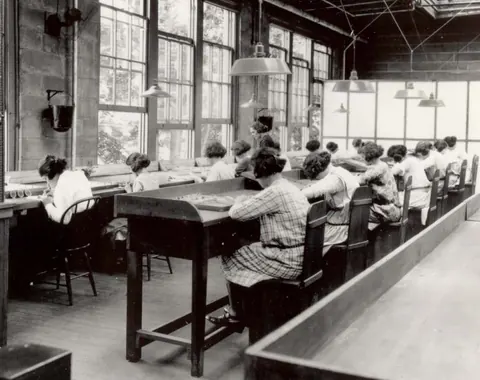
Radium Girls work in a factory of the United States Radium Corporation. - 1924CORROBORATEDMultiple dial painters develop severe anemia, jaw necrosis, and bone fracturesWomen's jawbones literally crumbled and could be lifted out in pieces, while their bones became so brittle they fractured spontaneously during normal movement.
- 1925PRIMARY SOURCEDr. Harrison Martland publishes research definitively linking dial painters' deaths to radium poisoningMartland's JAMA publication documented that radium had deposited in the women's bones and was causing ongoing internal radiation damage, establishing "radium jaw" as a medical diagnosis.
- 1927COURT RECORDGrace Fryer and four other women file suit against U.S. Radium CorporationThe five women (Fryer, Hussman, Schaub, Larice, and Maggia Quinta) became known as the "Radium Girls" or "Society of the Living Dead" due to their deteriorating condition during the legal battle.
- 1928COURT RECORDU.S. Radium settles with the New Jersey Five for $10,000 each plus medical expensesThe settlement came only after intense public pressure and the women's visibly deteriorating health made continuation of the trial untenable for U.S. Radium's public image.
- 1933CORROBORATEDGrace Fryer dies from radiation-induced illnessesFryer survived five years after the settlement, with the radium permanently embedded in her skeleton continuing to emit radiation throughout her body until death.
- 1937COURT RECORDCatherine Wolfe Donohue files suit against Radium Dial Company in IllinoisDonohue's case was complicated by Illinois' strict two-year statute of limitations for occupational injury, which had expired before her symptoms appeared.
- 1938COURT RECORDIllinois jury finds Radium Dial liable; Catherine Donohue dies shortly after verdictThe jury awarded Donohue $5,661 in damages; she died at age 35 before receiving payment, with her body so radioactive it glowed in the dark.
- 1939COURT RECORDIllinois Supreme Court upholds verdict, establishing discovery rule for occupational diseaseThe Illinois Supreme Court established that the statute of limitations begins when disease is discovered, not when exposure occurs, fundamentally changing occupational disease law.
- 1950sACADEMICArgonne National Laboratory begins longitudinal health study of surviving dial paintersThe Center for Human Radiobiology at Argonne tracked bone cancer incidence, radium retention, and long-term health outcomes in the surviving dial painters over decades.
- 1968CORROBORATEDRadium Dial Company plant in Ottawa, Illinois closesBy closure, the Ottawa facility had employed over 1,000 workers during its operational period, many of whom faced elevated cancer risks decades after employment ended.
- 1970GOVERNMENT RECORDOccupational Safety and Health Administration (OSHA) created, informed by radium casesOSHA's regulatory framework drew directly on lessons from the radium cases, including employer duty to disclose workplace hazards and protect workers from known dangers.
- 1990sGOVERNMENT RECORDEPA Superfund cleanup of former radium dial painting facilities beginsCleanup efforts targeted radium-contaminated soil, buildings, and groundwater at multiple sites in New Jersey and Illinois where radioactive material had been improperly disposed.
- 1993ACADEMICArgonne completes final health assessments of surviving dial paintersThe Argonne studies documented 64 bone sarcomas among the dial painter cohort, providing definitive epidemiological evidence of radium's carcinogenic effects in humans.
- 2017CREDIBLE REPORTINGKate Moore publishes "The Radium Girls," renewing public awareness of the caseMoore's extensively researched book drew on corporate records, court documents, and personal correspondence to document how companies prioritized profit over worker safety.
Key People
Organizations
Evidence Library
- documentDOC-M1Harrison Martland's 1925 JAMA Article on Radium Poisoning
Medical Examiner Dr. Harrison Martland's peer-reviewed publication definitively established that dial painters' deaths resulted from radium deposited in bone tissue. Used autopsy findings and radiation measurements to prove causal link. Established Facts tier.
- court filingCRT-D1Donohue v. Radium Dial Company (1938) Trial Verdict
First jury verdict establishing corporate liability for occupational disease with latent effects. Illinois jury found Radium Dial negligent despite years between exposure and illness. Established legal precedent for discovery rule. Established Facts tier.
- testimonyTST-F1Grace Fryer Deposition (1927)
Lead plaintiff described lip-pointing technique, assurances that radium paint was harmless, and progressive deterioration of her health. Deposition documented company training methods and workplace practices. Strong Evidence tier.
- documentpartial redactionDOC-R1U.S. Radium Internal Correspondence (1924-1925)
Corporate memos admitted as trial evidence showing executives received medical reports confirming radium poisoning while publicly denying workplace hazards. Demonstrates corporate knowledge and concealment. Established Facts tier.
- dataDAT-A1Argonne National Laboratory Longitudinal Health Data (1950s-1990s)
Decades of medical follow-up and radiation measurements of surviving dial painters. Whole-body counting documented radium body burdens and correlated exposure with cancer incidence. Provided dose-response data informing radiation protection standards. Established Facts tier.
- physicalPHY-B1Radium-Contaminated Jawbone Specimens
Preserved pathology specimens from deceased dial painters showing characteristic bone necrosis and measurable radioactivity decades after death. Physical evidence of radium incorporation in skeletal tissue. Established Facts tier.
- documentDOC-S1New Jersey Settlement Agreement (1928)
Legal settlement between U.S. Radium and the New Jersey Five providing $10,000 lump sum, $600 annual payments, and medical coverage. First major settlement establishing employer liability for occupational disease. Strong Evidence tier.
- photoPHO-W1Dial Painting Studio Photographs (circa 1920)
Factory floor images showing young women at workbenches painting watch dials. Visual documentation of working conditions and lip-pointing technique. Moderate Evidence tier for technique (technique better documented in testimony than photos).
Evidence Gallery


Sources
Trace the trail yourself
Investigation Network


Live Discussion
0 Perspectives
Add to the record. Be specific. Cite where you can.
If you're learning about this topic for the first time, these are the best places to continue — documented evidence and historical relationships are the guide.
Named in “The Radium Girls”.
Read more dossiers like this
Get a quiet one-line bulletin when new investigative files are published. Bound to this dossier — useful for tracking follow-ups.