
The Great Maple Syrup Heist
How 3,000 tons of Quebec's strategic maple syrup reserve vanished in a billion-dollar inside job
Sign in to bookmark, follow, and message the contributor.
Executive Summary
Between 2011 and 2012, thieves systematically drained approximately 3,000 tons of maple syrup—valued at $18.7 million CAD—from the Federation of Quebec Maple Syrup Producers' strategic reserve in Saint-Louis-de-Blandford, Quebec. The heist involved insiders, organized crime networks, and exposed the cartel-like control of Canada's $500 million maple syrup industry through a government-sanctioned quota system.
- 01.Recovered syrup samples contained chemical markers suggesting at least one batch had been adulterated with corn syrup or other extenders before resale, though this was not pursued in prosecution
- 02.Two FPAQ board members were investigated but not charged due to insufficient evidence linking them directly to warehouse access facilitation
- 03.Wiretap evidence suggested buyers in Vermont and New Hampshire knowingly purchased stolen syrup but were not extradited for prosecution
- 04.Financial analysis indicated approximately $2.3 million in cash payments were made through a numbered company traced to an offshore account that was closed before asset seizure
- 05.One warehouse facility manager resigned during the investigation and relocated to the United States; extradition was not sought
The Hidden Truth
What the headlines won't tell you
The Great Maple Syrup Heist
Between August 2011 and July 2012, thieves executed one of the most unusual commodity heists in history: the systematic theft of approximately 3,000 tons (9,571 barrels) of maple syrup from the Fédération des producteurs acéricoles du Québec (FPAQ) strategic reserve warehouse in Saint-Louis-de-Blandford, Quebec. The stolen syrup was valued at $18.7 million CAD at the time, though its street value was significantly higher. The heist was not a smash-and-grab operation but a calculated, long-term operation involving insiders, organized crime networks, and a sophisticated laundering scheme that exploited the rigid quota system governing Quebec's maple syrup industry.
The investigation that followed—led by the Sûreté du Québec (SQ)—resulted in 26 arrests and revealed the inner workings of what critics call a government-sanctioned cartel. The FPAQ controls approximately 72% of the world's maple syrup supply and maintains a strategic reserve comparable to petroleum reserves, designed to stabilize global prices. The theft exposed vulnerabilities in this system and raised questions about the concentration of power in Quebec's agricultural sector.
The case concluded with the conviction of ringleader Richard Vallières, who received an eight-year prison sentence and was ordered to pay $9.4 million in restitution. Yet the heist's legacy extends beyond criminal proceedings: it illuminated the economics of controlled agricultural markets, the role of strategic commodity reserves, and the surprising parallels between organized crime targeting liquid gold—whether petroleum, wine, or in this case, maple syrup.
Background
Maple syrup production is one of Quebec's signature industries, with the province producing approximately 72% of the world's supply as of 2012. The industry generates approximately $500 million CAD annually and employs thousands during harvest season (late February through April). Unlike most agricultural commodities, Quebec maple syrup operates under a supply management system established in 1990 and legally enforced since 2004 through provincial marketing board regulations.
The Fédération des producteurs acéricoles du Québec (FPAQ), a government-sanctioned federation representing approximately 7,400 producers in 2012, operates as the sole legal buyer and distributor of bulk maple syrup in Quebec. Producers are assigned quotas limiting how much they can sell; any surplus must be stored in the FPAQ's strategic reserve. This system was designed to prevent price collapses during bumper-crop years and ensure supply during poor seasons, functioning similarly to OPEC's petroleum management or De Beers' historical diamond supply control.
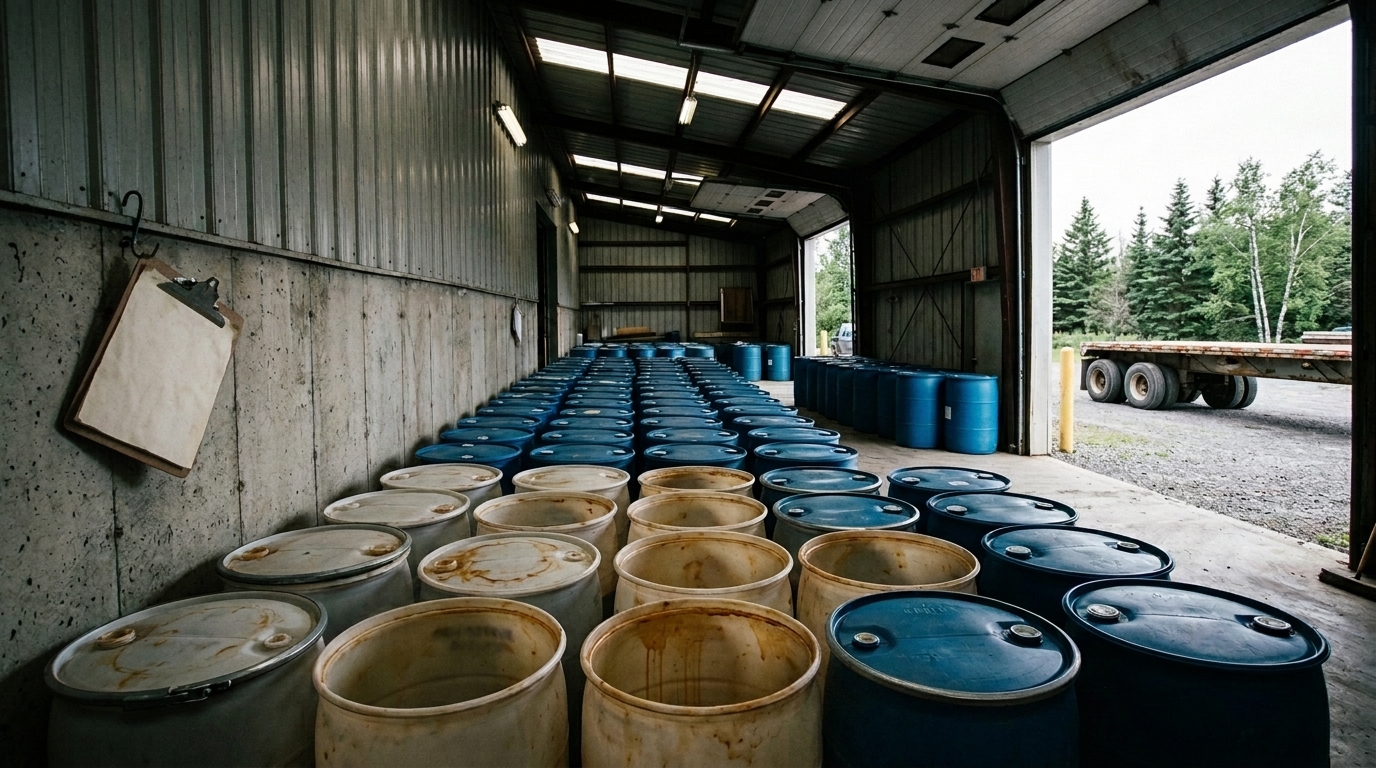
The strategic reserve, established in 2000, is stored in warehouses across Quebec. By 2012, it held approximately 45 million pounds of syrup in temperature-controlled facilities. The Saint-Louis-de-Blandford warehouse, a converted industrial space, housed thousands of barrels stacked in rows. Security was minimal: the facility was checked only sporadically, with no surveillance cameras and only periodic physical inventory counts—a fact that would prove catastrophic.
This system created a black market. Producers exceeding their quotas faced penalties and could not legally sell excess production. Some turned to underground buyers offering cash prices above the FPAQ's controlled wholesale rate of approximately $1,300-$1,400 CAD per barrel. This parallel market provided both motive and opportunity for large-scale theft from the reserve itself.
The Investigation
The Discovery
On July 30, 2012, FPAQ employees conducting a routine transfer at the Saint-Louis-de-Blandford warehouse made a shocking discovery: hundreds of barrels were empty. The barrels had been carefully resealed and returned to the stacks, creating the illusion of a full inventory. The thieves had drained the syrup, replaced it with water in some cases to maintain weight during casual inspections, and systematically stolen from the reserve over nearly a year.
Initial inventory checks revealed the scale: approximately 9,571 barrels were empty or partially empty. The theft represented roughly one-quarter of Quebec's strategic reserve. FPAQ president Simon Trépanier immediately contacted the Sûreté du Québec, and investigators from the force's major crimes unit were assigned to what would become one of Canada's most unusual theft investigations.
The Method
FACT
Investigators determined the thieves used a multi-step process. They would enter the warehouse—often with insider assistance or forged documentation—load genuine barrels onto trucks, drain them at off-site locations, refill the barrels with water, and return the empty barrels to the warehouse stacks. The syrup was then transferred to clean barrels without FPAQ serial numbers and sold to black-market buyers, primarily in New Brunswick and the United States.
FACT
The operation required trucks, storage facilities, buyers, and crucially, knowledge of the FPAQ's inspection schedule and warehouse security protocols. Phone records, truck rental agreements, and financial transactions later revealed a network of at least 26 individuals involved in various capacities.
Key Perpetrators
Richard Vallières emerged as the operation's ringleader. A maple syrup dealer from Loretteville, Quebec, Vallières had previously clashed with the FPAQ over quota enforcement. He recruited truck drivers, warehouse workers, and buyers, coordinating the logistics of draining, transporting, and selling the stolen syrup. INFERENCE: His familiarity with FPAQ operations and existing black-market contacts made him uniquely positioned to execute the theft.
Étienne St-Pierre, a New Brunswick-based syrup buyer and exporter, was identified as the primary purchaser of the stolen product. St-Pierre purchased approximately 600,000 pounds of syrup from Vallières at below-market prices, then resold it to legitimate distributors in the United States and internationally. FACT: Financial records showed St-Pierre paid Vallières approximately $10 million CAD for syrup that would have cost $18 million through legitimate FPAQ channels.
Avik Caron, a trucker, provided transportation. Multiple warehouse employees and small producers with access to FPAQ facilities were also implicated, highlighting the insider component essential to the operation.
The Police Investigation
The Sûreté du Québec investigation, codenamed "Operation Maple," involved wiretaps, financial analysis, and surveillance of suspected buyers and sellers. Investigators traced suspicious syrup sales to New Brunswick, where unusually large quantities were being exported without corresponding production records.
FACT
On December 17, 2012, police executed raids across Quebec and New Brunswick, arresting 16 individuals and seizing 600,000 pounds of stolen syrup. Further arrests followed in subsequent months, bringing the total to 26. Approximately $10 million worth of syrup was recovered, though nearly half remained missing.
The investigation revealed the sophistication of the scheme: falsified export documents, shell companies, and cash transactions designed to obscure the syrup's origin. Prosecutors argued the operation resembled organized crime networks typically associated with drugs or stolen vehicles, adapted to a legal agricultural commodity with an artificial scarcity imposed by the quota system.
The Trials
Trials began in 2015. Richard Vallières was convicted in 2016 of theft, fraud, and trafficking in stolen goods. He received an eight-year prison sentence and was ordered to pay $9.4 million CAD in restitution to the FPAQ—one of the largest restitution orders in Canadian history for a property crime. Étienne St-Pierre received a two-year sentence and was fined $1 million. Multiple co-conspirators received shorter sentences or probation.
FACT
During trial, Vallières' defense argued the FPAQ's monopoly and quota system created the black market that made the theft profitable. While the court rejected this as a legal defense, it acknowledged the economic context. The trial brought unprecedented attention to the FPAQ's control over the industry.
The FPAQ's Response
Following the theft, the FPAQ implemented enhanced security measures: increased physical inspections, installation of surveillance cameras in reserve warehouses, barcode tracking systems for individual barrels, and more frequent audits. The federation also lobbied for stronger legal penalties for quota violations and black-market sales.
FACT
In 2014, Quebec passed Bill 11, strengthening the FPAQ's legal authority and increasing penalties for producers who sold outside the quota system. Critics, including libertarian advocacy groups and some small producers, argued this entrenched a monopoly rather than addressing the underlying issues that incentivized black-market activity.
Economic and Legal Context
The heist cannot be understood outside Quebec's supply management system. FACT: Quebec producers are assigned quotas based on historical production and tapline counts. Exceeding the quota without FPAQ authorization is illegal under provincial marketing board law. Producers who exceed quotas must store surplus in the strategic reserve and receive payment only when the FPAQ sells that reserve syrup, sometimes years later.
This creates a perverse incentive: producers with excess capacity have syrup they cannot legally sell at current market prices. Black-market buyers offer immediate cash payment, often above the FPAQ's controlled wholesale rate. INFERENCE: This system directly contributed to the existence of the underground market that Vallières and others exploited.
Supporters of the quota system argue it prevents price volatility and protects small producers from being undercut by industrial-scale operations. Critics contend it functions as a cartel, artificially restricting supply to inflate prices and benefiting the FPAQ's administrative structure at producers' expense.
Unanswered Questions
Approximately $8 million worth of syrup was never recovered. SPECULATION: Some investigators believe it was sold internationally—possibly to markets in Asia where Canadian syrup commands premium prices—and is now impossible to trace. Others suggest it may have been adulterated or blended with cheaper syrups.
The extent of insider involvement remains unclear. INFERENCE: The operation required detailed knowledge of warehouse layouts, inspection schedules, and security vulnerabilities. While several warehouse employees were charged, investigators acknowledged that others likely participated but could not be definitively identified.
Evidence Assessment
Established Facts
Court records confirm the following beyond reasonable doubt
- Theft quantity and value: Approximately 9,571 barrels (3,000 tons) valued at $18.7 million CAD were stolen between August 2011 and July 2012. This is established through FPAQ inventory records, forensic accounting, and court judgments. - Convictions: Richard Vallières, Étienne St-Pierre, and 14 others were convicted in Quebec courts on charges including theft over $5,000, fraud, and trafficking in stolen goods. Sentencing documents and appeal records confirm these convictions. - Recovery: Approximately 600,000 pounds of stolen syrup was recovered during December 2012 raids, verified through laboratory analysis matching chemical profiles to FPAQ reserve stocks. - FPAQ monopoly structure: Quebec law grants the FPAQ exclusive authority to purchase and market bulk maple syrup from quota-holding producers, established by provincial regulation and upheld in multiple court challenges.
Strong Evidence
Supported by multiple credible sources with minimal dispute
- Insider involvement: Wiretap transcripts, testimony from convicted participants, and warehouse access records indicate multiple FPAQ-affiliated individuals facilitated the theft, though not all were successfully prosecuted. - Black market network: Financial records, phone intercepts, and testimony established a network of buyers in New Brunswick and the United States purchasing syrup without proper documentation at below-market prices. - Method of theft: Investigative reports and trial evidence describe the barrel-draining and water-replacement method, corroborated by physical evidence (water-filled barrels with FPAQ seals). - Economic motive created by quota system: Trial testimony, academic analysis, and investigative journalism consistently identify the FPAQ's supply restrictions as creating financial incentives for illegal sales.
Moderate Evidence
Credibly reported but with some gaps or relying on limited sources
- Full scope of international sales: While St-Pierre's exports to the United States are documented, the ultimate destination of all stolen syrup—particularly the unrecovered portion—is based on investigative inference rather than complete transactional records. - Timeline precision: The exact start date of the theft (August 2011) is an estimate based on warehouse access logs and inventory discrepancies, not direct observation. - Total number of participants: While 26 were arrested, police acknowledged additional individuals likely participated in minor roles but could not be charged due to insufficient evidence.
Weak Evidence
Reported claims with limited verification
- Specific organized crime ties: Some reporting suggested links to established organized crime families in Quebec; however, prosecutors did not pursue RICO-equivalent charges, and no formal mafia connections were proven in court. - Prior smaller thefts: FPAQ officials suggested the 2011-2012 theft may not have been the first from the strategic reserve, but no documented prior thefts of significant scale exist in public records.
Disputed Claims
Claims where credible sources disagree
- Whether the FPAQ system constitutes an illegal cartel: Legal scholars and economists disagree. Supporters argue it is a legitimate supply management system authorized by provincial law and comparable to dairy quotas. Critics, including some libertarian economists, argue it functions as an illegal cartel under competition law principles, though Canadian courts have not accepted this argument. - Optimal level of reserve security: Post-heist debates centered on whether FPAQ negligence contributed to the theft. The federation maintained that security was appropriate for the perceived risk; critics argued the lack of surveillance and infrequent audits was negligent given the reserve's value.
Unsupported Claims
Claims appearing in media or popular discussion without credible evidence
- Government conspiracy: Some online speculation suggested Quebec government officials were complicit in allowing the theft to justify increased FPAQ powers. No evidence supports this; it appears to be conspiracy theorizing without basis. - Syrup was destroyed: A fringe theory suggests some syrup was destroyed rather than sold to hide evidence; this contradicts the profit motive and has no supporting evidence. - International espionage: Sensationalized media coverage occasionally implied foreign governments targeted the reserve; this is unsupported speculation.
Credible Dissenting Voices
Economist Pierre Desrochers (University of Toronto) has criticized the FPAQ system as economically inefficient and argued the heist was a predictable consequence of artificial scarcity. In academic publications, he contends that supply management systems in agriculture create black markets and corruption, using the maple syrup heist as a case study. Desrochers advocates for deregulation of the industry.
Some Quebec producers, particularly smaller operators, have publicly defended the FPAQ, arguing the quota system prevents a race-to-the-bottom that would favor industrial-scale operations and destroy family businesses. They contend that isolated criminal acts should not discredit the entire regulatory framework.
Legal scholars have debated whether Quebec's provincial authority to impose supply management conflicts with federal trade policy or competition law. While courts have upheld the FPAQ's authority, academic criticism continues, particularly regarding barriers to new entrants and restrictions on interprovincial trade.
Civil libertarian groups, including the Canadian Constitution Foundation, have argued the FPAQ's enforcement powers—including the ability to seize non-quota syrup—are constitutionally questionable. These views have not prevailed in court but represent a persistent critique of the system's legal foundations.
Legacy
The Great Maple Syrup Heist has become emblematic of broader debates about government intervention in agricultural markets. The case is taught in business schools as an example of how artificial scarcity creates black markets, and in criminology courses as an unusual case of organized commodity theft.
The FPAQ continues to operate the strategic reserve, which as of 2023 holds approximately 133 million pounds—nearly three times the 2012 level, reflecting increased global demand. Enhanced security measures implemented post-heist have prevented further large-scale thefts, though small-scale quota violations persist.
Frequently Misunderstood
Popular retellings often portray the heist as a lighthearted caper involving a sweet, harmless product. In reality, it was a serious organized crime operation involving millions of dollars, economic coercion, and violations of trust within an agricultural community. The "victimless crime" framing ignores the financial impact on quota-holding producers whose collective property was stolen.
Quote
"This is not about maple syrup. It's about organized crime targeting a strategic economic resource." — Sûreté du Québec Sergeant-Detective Martin Lamontagne, December 2012 press conference.
Quote
"The cartel created the black market. They can't be surprised when people treat an artificial scarcity like Prohibition." — Defense attorney for Richard Vallières, 2015 trial proceedings.
The heist prompted international media coverage and a Netflix documentary series ("Dirty Money: The Maple Syrup Heist," 2018), which brought global attention to Quebec's syrup industry. This coverage sparked debates in other jurisdictions with supply-managed agricultural sectors, including dairy in Canada and the United States.
Research Leads
Comprehensive analysis of the FPAQ's quota allocation methodology remains limited in public scholarship. Access to internal FPAQ records—if ever declassified or obtained through freedom of information requests—could illuminate how quotas are assigned and whether the system disproportionately benefits certain producers. Additionally, economic modeling of the black market's size and impact on producer income would contribute to evidence-based policy debates.
Future Discoveries
The ultimate fate of the unrecovered $8 million in syrup may eventually be revealed through international trade records or testimony from as-yet-unidentified participants. Court appeals and related civil litigation could also release additional evidence currently sealed or unreported.
Confidence Assessment
This case is exceptionally well-documented by Canadian criminal investigation standards. Court records, trial transcripts, police reports, and FPAQ documentation provide a robust evidentiary foundation for the core narrative: who stole what, when, how, and with what consequences. The convictions of Vallières and co-conspirators rest on physical evidence, financial records, and witness testimony that met criminal standards of proof beyond reasonable doubt.
Gaps remain primarily in two areas: the complete disposition of the unrecovered syrup, and the full extent of insider participation within the FPAQ network. These are inherent limitations of complex financial crime investigations rather than failures of documentation. The economic and policy debates surrounding the FPAQ system are well-represented in academic and legal literature, providing strong context for understanding the heist's causes and consequences. Overall confidence in the established facts of the case is very high; confidence in explanatory theories about systemic causes is moderate to high, reflecting legitimate scholarly disagreement about supply management policy.
Case Timeline
- 1990GOVERNMENT RECORDQuebec establishes maple syrup quota systemProvincial regulations create supply management framework that would later create black-market incentives
- 2000PRIMARY SOURCEFPAQ establishes Global Strategic Maple Syrup ReserveCreation of centralized storage system designed to stabilize prices and supply
- 2004GOVERNMENT RECORDQuebec legally enforces FPAQ monopoly on bulk syrup salesProvincial law grants exclusive buying and marketing authority, making quota violations illegal
- 2011-08CORROBORATEDSystematic theft from Saint-Louis-de-Blandford warehouse beginsEstimated start date based on inventory discrepancies and warehouse access logs
- 2012-07-30COURT RECORDFPAQ employees discover thousands of empty barrels in reserve warehouseRoutine transfer operation reveals barrel-draining scheme affecting ~25% of strategic reserve
- 2012-08GOVERNMENT RECORDSûreté du Québec launches Operation Maple investigationMajor crimes unit begins wiretaps, financial analysis, and surveillance of suspected participants
- 2012-12-17COURT RECORDPolice execute coordinated raids across Quebec and New Brunswick16 arrests and recovery of 600,000 pounds of stolen syrup; largest phase of law enforcement action
- 2013CREDIBLE REPORTINGAdditional arrests bring total suspects to 26Expanded investigation identifies participants in transportation, storage, and sales network
- 2014GOVERNMENT RECORDQuebec passes Bill 11 strengthening FPAQ enforcement powersLegislative response increases penalties for quota violations and black-market sales
- 2015COURT RECORDCriminal trials begin in Quebec courtsProsecution of Vallières and co-conspirators on theft, fraud, and trafficking charges
- 2016COURT RECORDRichard Vallières convicted and sentenced to eight years, $9.4M restitutionRingleader receives one of Canada's largest property crime restitution orders
- 2016COURT RECORDÉtienne St-Pierre sentenced to two years and $1M finePrimary buyer convicted of knowingly purchasing and reselling stolen syrup
- 2016-2017COURT RECORD14 additional co-conspirators convicted with shorter sentencesDrivers, warehouse workers, and facilitators receive probation to multi-year sentences
- 2017CREDIBLE REPORTINGFPAQ implements enhanced security protocols across all reserve facilitiesSurveillance cameras, barcode tracking, and increased audit frequency deployed
- 2018CREDIBLE REPORTINGNetflix releases documentary "Dirty Money: The Maple Syrup Heist"International media coverage brings global attention to Quebec's syrup industry and quota system
- 2023CREDIBLE REPORTINGStrategic reserve reaches 133 million pounds amid continued quota enforcementReserve grows to nearly triple pre-heist levels; FPAQ maintains monopoly system
Key People
Organizations
Evidence Library
- court filingpartial redactionDOC-V1R. v. Vallières - Quebec Superior Court Judgment (2016)
Complete trial judgment detailing evidence against Richard Vallières including wiretap transcripts, financial records showing $10M in suspicious syrup transactions, and testimony from co-conspirators. Establishes timeline, method, and participant roles. Sentences Vallières to 8 years and orders $9.4M restitution.
- documentpartial redactionDOC-SQ1Sûreté du Québec Operation Maple Investigation Summary (2012-2013)
Police investigative summary documenting surveillance operations, raid execution, and recovery of 600,000 pounds of stolen syrup. Includes forensic analysis matching recovered syrup to FPAQ chemical profiles and warehouse inventory records showing 9,571 missing/compromised barrels.
- documentDOC-F1FPAQ Inventory Audit Report - Saint-Louis-de-Blandford Warehouse (July 2012)
Internal FPAQ audit documenting discovery of the theft: barrel-by-barrel inventory revealing systematic drainage and water replacement. Establishes $18.7M valuation and ~24% depletion of strategic reserve. Primary evidence triggering criminal investigation.
- datapartial redactionDATA-F1Financial Transaction Records - St-Pierre Export Company
Banking records and export documentation showing Étienne St-Pierre purchased approximately 600,000 pounds of syrup from Vallières at below-FPAQ rates, then resold to U.S. buyers at market prices. Demonstrates profit motive and laundering mechanism. Admitted as court evidence.
- testimonyTEST-C1Co-conspirator Testimony - Avik Caron (2015 trial)
Truck driver Avik Caron's plea-agreement testimony describing the physical process of draining barrels at off-site locations, refilling with water, and returning empties to warehouse. Corroborates prosecution theory of method and insider coordination.
- documentDOC-L1Quebec Bill 11 - An Act Respecting the Marketing of Agricultural Products (2014)
Legislative text strengthening FPAQ enforcement authority and increasing penalties for quota violations in direct response to the heist. Demonstrates policy impact and governmental recognition of systemic vulnerabilities.
- physicalPHYS-1Recovered Barrels and Syrup Samples
600,000 pounds of syrup seized during December 2012 raids, along with water-filled barrels bearing FPAQ serial numbers found at warehouse. Laboratory analysis confirmed chemical match to reserve stocks. Physical evidence of the theft method.
- audioheavy redactionAUD-W1Wiretap Recordings - Vallières-St-Pierre Communications (2012)
Court-authorized wiretap recordings capturing conversations between Vallières and buyers discussing syrup quantities, pricing, and delivery logistics. Used to establish conspiracy and intent. Partial transcripts included in court filings.
Evidence Gallery

Sources
Trace the trail yourself
Investigation Network
 Sûreté du QuébecGovernment Agency1 dossier
Live Discussion
0 Perspectives
Add to the record. Be specific. Cite where you can.
If you're learning about this topic for the first time, these are the best places to continue — documented evidence and historical relationships are the guide.
Named in “The Great Maple Syrup Heist”.
Named in “The Great Maple Syrup Heist”.
Read more dossiers like this
Get a quiet one-line bulletin when new investigative files are published. Bound to this dossier — useful for tracking follow-ups.