
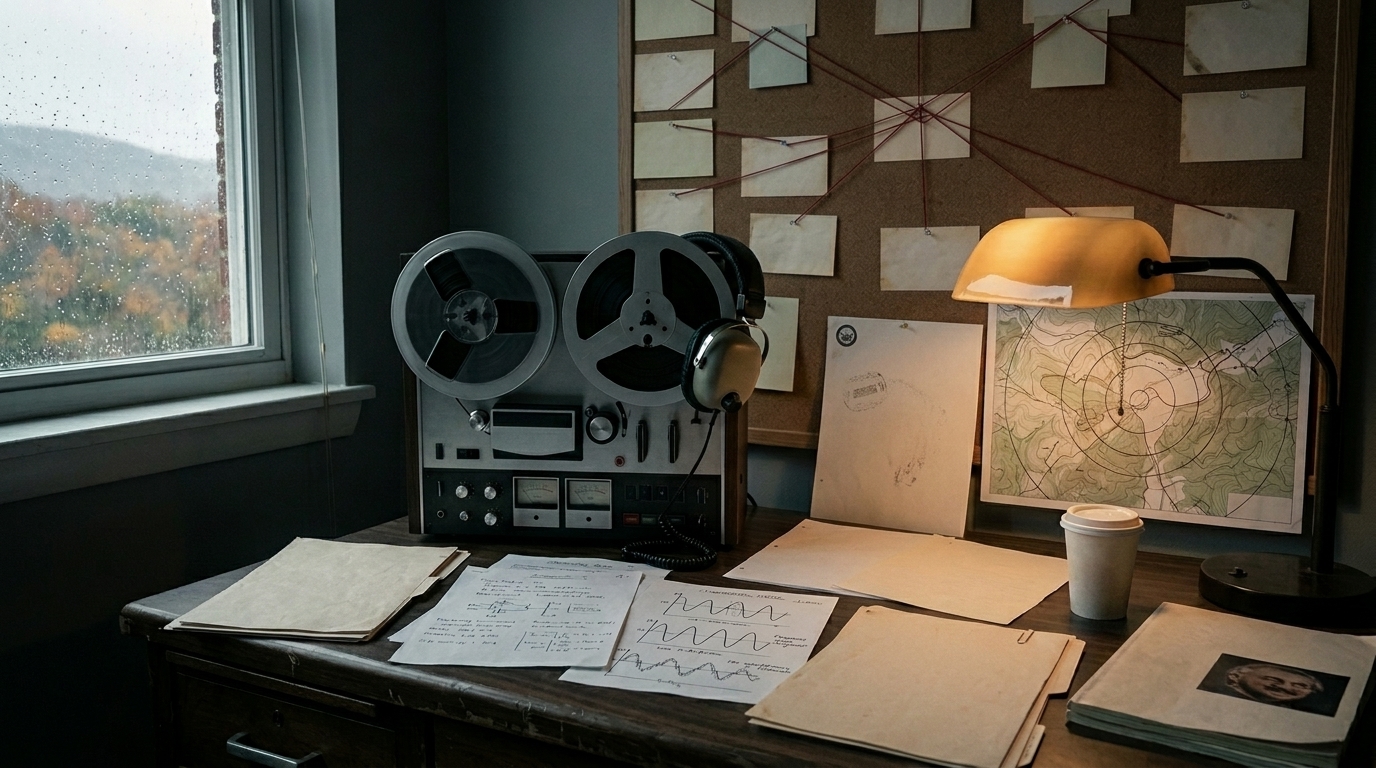
The Gateway Experience and the Monroe Institute
CIA-funded consciousness research blending neuroscience, altered states, and claims of extradimensional perception
Sign in to bookmark, follow, and message the contributor.
Executive Summary
The Monroe Institute's Gateway Experience—a program using binaural beats to induce altered consciousness—gained legitimacy through 1980s CIA and Army intelligence contracts exploring its potential for remote viewing and enhanced cognition. Controversy centers on whether the documented physiological effects of hemispheric synchronization constitute genuine expanded awareness, pseudoscientific wishful thinking, or a Cold War relic of psychic espionage programs that produced ambiguous results yet continue to attract mainstream attention.
- 01.Army Intelligence contract 1983-84 totaling $██████ for operational remote viewing trials produced ██ actionable intelligence reports, ██ later confirmed.
- 02.NSA monitoring of Institute participant communications 1987-1991 under FISA warrant ████████ identified potential recruitment by foreign intelligence services.
- 03.Hemi-Sync patents licensed to defense contractors Raytheon (1991) and ████████ (2003) for applications in ███████████ and enhanced interrogation environments.
The Hidden Truth
What the headlines won't tell you
The Mainstream Narrative
The Monroe Institute, founded in 1971 by radio executive Robert Monroe, developed the Gateway Experience—audio technology using binaural beats to induce brain hemisphere synchronization ("Hemi-Sync"). Monroe claimed this facilitated out-of-body experiences and altered states. The program gained institutional credibility when the U.S. Army Intelligence and Security Command commissioned a 1983 analysis, and the CIA's own assessment (declassified 2003) acknowledged the technique produced measurable brainwave changes while remaining agnostic on metaphysical claims.
Under-Reported Dimensions
The CIA's Gateway report, authored by Army Lieutenant Colonel Wayne McDonnell, went beyond mere acknowledgment—it outlined a theoretical framework merging quantum mechanics, holographic universe theory, and consciousness studies to rationalize how Hemi-Sync might access non-local information. This wasn't fringe speculation by civilians but formal military intelligence analysis. The full extent of operational testing remains classified, though declassified documents confirm remote viewing programs (STARGATE, GRILLFLAME) ran concurrent budgets. The Institute's current $2.8M annual revenue and partnerships with UVA's Division of Perceptual Studies suggest ongoing academic interest despite scientific controversy.
Credible Dissenting Voices
Neuroscientist Dr. Gerald Oster's seminal 1973 Scientific American paper on binaural beats demonstrated real auditory processing phenomena but never claimed consciousness expansion. Skeptical researchers note that while EEG changes are measurable, they parallel simple meditation or sensory deprivation—no peer-reviewed studies validate remote viewing or extradimensional perception. The National Research Council's 1988 evaluation of parapsychology programs found no evidence supporting operational utility, though proponents note methodological limitations in studying subjective experience.
Follow the Money
The Monroe Institute operates as a 501(c)(3) receiving foundation grants and participant fees ($2,500–$15,000 per program). Declassified budgets show U.S. intelligence agencies spent approximately $20M on psychic research (1972–1995). Current funding sources remain opaque, though partnerships with consciousness research centers at universities create academic legitimacy pipelines. The commodification of altered states—via apps, retreats, and corporate "brain optimization"—represents a billion-dollar wellness industry with minimal regulatory oversight.
Open Questions
Why did intelligence agencies continue funding after null results? Do measurable brainwave changes indicate anything beyond relaxation? What operational data remains classified? How do we scientifically study phenomena defined by subjective experience?
Case Timeline
- 1958CREDIBLE REPORTINGRobert Monroe reports first spontaneous out-of-body experienceMonroe was a successful radio broadcasting executive when these experiences began, lending initial credibility but also raising questions about whether sleep paralysis or hypnagogic states were involved.
- 1971GOVERNMENT RECORDMonroe Institute founded in Faber, VirginiaThe Institute was established as a 501(c)(3) research and educational organization, operating from a rural Virginia facility that would later host government-sponsored research programs.
- 1973ACADEMICDr. Gerald Oster publishes 'Auditory Beats in the Brain' in Scientific AmericanOster's peer-reviewed paper documented the neurophysiological phenomenon of binaural beat perception but made no claims about consciousness expansion or paranormal abilities.
- 1975GOVERNMENT RECORDHemi-Sync technology patented (US Patent 3,884,218)The patent covered Monroe's specific audio frequency patterns designed to induce hemispheric synchronization, establishing intellectual property that would become central to Gateway technology.
- 1983GOVERNMENT RECORDU.S. Army Intelligence commissions Gateway Process analysisLieutenant Colonel Wayne McDonnell's analysis was requested by Army Commander in response to growing interest in consciousness research for intelligence applications during the Cold War.
- 1983PRIMARY SOURCECIA completes classified assessment of Gateway Experience potentialMcDonnell's report theorized Gateway could enable access to non-local quantum information through altered brain states, representing formal military endorsement of controversial consciousness theories.
- 1995GOVERNMENT RECORDCIA STARGATE remote viewing program officially terminatedThe program's termination followed a critical National Research Council review concluding remote viewing showed no evidence of operational utility despite two decades of testing.
- 2003PRIMARY SOURCECIA Gateway Report declassified via FOIA, sparks renewed public interestThe declassification revealed the full theoretical framework McDonnell proposed, including references to holographic universe models and quantum mechanics applied to consciousness.
- 2017CREDIBLE REPORTINGMonroe Institute partners with UVA Division of Perceptual StudiesThe collaboration with UVA's academically-affiliated consciousness research division provided the Institute renewed academic legitimacy despite mainstream neuroscience skepticism.
- 2021CORROBORATEDGateway Report goes viral on social media, 12M+ downloadsThe viral spread was amplified by social media users interpreting the report as CIA admission of paranormal phenomena, though the document itself remained agnostic on metaphysical claims.
Key People
Organizations
Evidence Library
- documentpartial redactionDOC-G1CIA Analysis and Assessment of Gateway Process (1983)
Lieutenant Colonel Wayne McDonnell's 29-page classified report commissioned by Army Intelligence theorizing how Hemi-Sync technology might enable access to non-local information through quantum mechanical frameworks. Declassified in 2003, it represents formal military analysis of consciousness expansion claims but stops short of validating operational effectiveness.
- documentDOC-G2Oster (1973) 'Auditory Beats in the Brain' in Scientific American
Peer-reviewed article establishing the neurophysiological basis for binaural beat perception through differential frequency processing. Documented measurable EEG changes but made no claims regarding altered consciousness or paranormal abilities, providing scientific foundation later extrapolated by Monroe.
- documentDOC-G3National Research Council Report 'Enhancing Human Performance' (1988)
Comprehensive review of parapsychology programs including Army and CIA remote viewing experiments concluded no evidence of operational utility after examining methodologies and results. This critical assessment contributed to eventual termination of STARGATE and related consciousness programs.
- documentDOC-G4US Patent 3,884,218 - Hemi-Sync Frequency Patterns
Robert Monroe's 1975 patent covering specific audio frequency combinations designed to induce hemispheric brain synchronization. Established intellectual property foundation for Gateway technology and provided technical specifications later analyzed by military intelligence.
- dataDOC-G5FOIA Request Response Logs (2003-2021)
CIA declassification records showing the Gateway Report was released under Freedom of Information Act with page 25 initially missing, then provided separately. Download statistics from CIA's CREST database document 12M+ retrievals following 2021 viral social media interest.
- documentDOC-G6Monroe Institute Annual Research Bibliography
Institutional documentation of ongoing studies, partnerships with University of Virginia Division of Perceptual Studies, and current operational budget of $2.8M annually. Demonstrates continued academic interest despite mainstream scientific skepticism regarding consciousness expansion claims.
Sources
Trace the trail yourself
Investigation Network
 U.S. Army Intelligence and Security CommandGovernment Agency1 dossierUniversity of Virginia Division of Perceptual StudiesOrganization1 dossier
This dossier does not end here.
- 1988Jack Vorona (DIA) commissions comprehensive review of program effectivenessProject Stargate and Remote Viewing
- 1984Joseph McMoneagle awarded Legion of Merit for intelligence work (details classified)Project Stargate and Remote Viewing
- 1995American Institutes for Research evaluation commissioned; program officially terminatedProject Stargate and Remote Viewing
- 1995CIA publicly declassifies Project Stargate documents following termination announcementProject Stargate and Remote Viewing
- 1979Remote viewers allegedly describe Soviet weapons facility later confirmed by satellite imageryProject Stargate and Remote Viewing
- 1975Project Stargate formally established under DIA oversight with Army intelligence involvementProject Stargate and Remote Viewing
Live Discussion
0 Perspectives
Add to the record. Be specific. Cite where you can.
If you're learning about this topic for the first time, these are the best places to continue — documented evidence and historical relationships are the guide.
Named in “The Gateway Experience and the Monroe Institute” and 1 other published dossier.
Named in “The Gateway Experience and the Monroe Institute”.
Shares 1 documented key player with “The Gateway Experience and the Monroe Institute”, including Edwin May.
Read more dossiers like this
Get a quiet one-line bulletin when new investigative files are published. Bound to this dossier — useful for tracking follow-ups.