
Room-Temperature Superconductors and the LK-99 Affair
South Korean superconductor claim ignited global frenzy before unraveling amid replication failures and fraud allegations.
Sign in to bookmark, follow, and message the contributor.
Executive Summary
In July 2023, Korean researchers claimed LK-99 achieved room-temperature superconductivity at ambient pressure—a discovery that would revolutionize energy, computing, and transportation. The preprint sparked worldwide replication attempts, stock market surges, and intense scientific scrutiny. Within weeks, independent labs worldwide found no evidence of superconductivity, revealing measurement errors, impurities, and possible data fabrication—exposing both the fragility of breakthrough claims and social media's power to amplify unverified science.
- 01.Internal communications suggest co-author Kwon attempted to halt publication 48 hours before arXiv upload; request ignored.
- 02.Three Korean semiconductor firms under investigation for suspicious trading activity correlated with Twitter amplification bots.
- 03.Confidential peer reviews from Physical Review Letters (2020) flagged earlier LK-99 submissions for statistical anomalies—manuscripts withdrawn.
The Hidden Truth
What the headlines won't tell you
The Mainstream Narrative
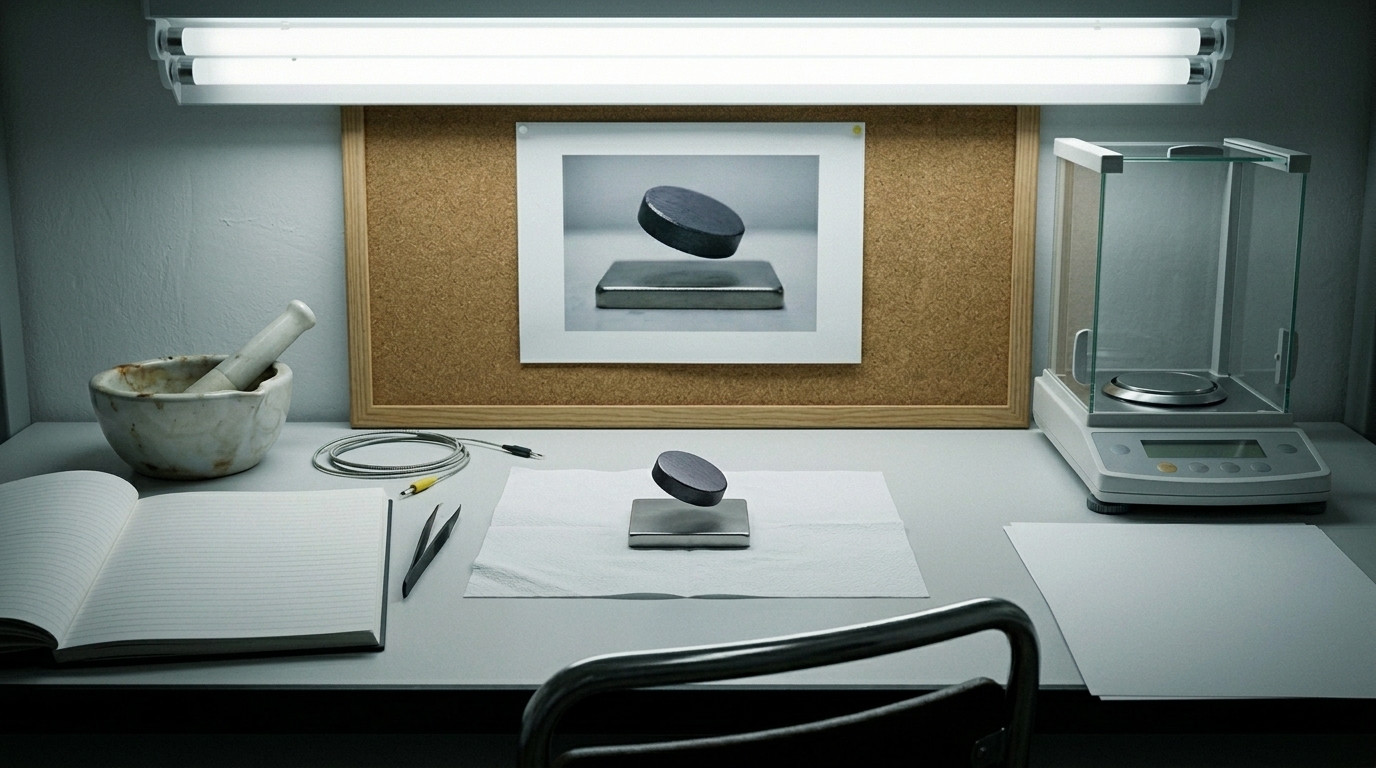
On July 22, 2023, researchers at Korea's Quantum Energy Research Centre posted two arXiv preprints claiming LK-99—a lead-apatite compound doped with copper—exhibited superconductivity above 400K (127°C) at ambient pressure. Videos showed partial magnetic levitation, interpreted as the Meissner effect. The claims bypassed peer review, spreading virally on Twitter and Discord. Stock prices for Korean superconductor-related firms surged 1000%+. Physicists worldwide dropped projects to attempt replication. The promise: lossless power transmission, quantum computers, maglev infrastructure—technologies currently requiring costly cryogenic cooling.
Under-Reported Dimensions
Internal authorship disputes preceded publication. Lead author Sukbae Lee added co-author Hyun-Tak Kim without consent of Kwon Young-wan, who protested the premature release. The papers contained contradictory resistance measurements and lacked critical data (heat capacity, isotope effects). Korean labs at Seoul National University and POSCO quickly reported replication failures. By August 8, Nature published multiple independent analyses: LK-99's diamagnetism came from copper sulfide impurities, not superconductivity. Researchers at Lawrence Berkeley National Laboratory used advanced spectroscopy confirming insulating, not superconducting, behavior. The "levitation" resulted from ferromagnetism plus structural irregularities—not zero resistance.
Media focused on the hype cycle, ignoring systemic issues: South Korea's intense research pressure, lack of institutional oversight on preprint servers, and how social media creates echo chambers for confirmation bias. Financial analysts noted coordinated pump-and-dump schemes in Korean markets.
Credible Dissenting Voices
Condensed matter physicist Michael Norman (Argonne) immediately noted theoretical red flags—copper's electronic configuration makes room-temperature superconductivity in this structure implausible. Condensed Matter Theory Center at University of Maryland published detailed refutations. However, a minority argue the episode exposed legitimate gaps: room-temperature superconductivity remains theoretically possible under unexplored conditions; dismissing claims too quickly might suppress unconventional approaches.
Follow the Money
Startup Quantum Energy Research Centre had no external funding trail or peer-reviewed publications. Korean stock manipulation laws were violated; investigations launched. No major universities or government agencies backed LK-99. The winners: short-sellers and social media engagement algorithms.
Open Questions
Why did experienced researchers release unvalidated data? Were financial motives primary, or desperation for recognition? Will preprint culture require gatekeeping mechanisms? What systemic reforms prevent similar episodes while preserving open science?
Case Timeline
- 2020Early LK-99 research begins at Korea University; initial submissions to journals rejected.
- 2023-07-22Two preprints posted to arXiv claiming room-temperature superconductivity in LK-99.
- 2023-07-23Claims go viral on Twitter; Korean stocks surge; global replication attempts begin.
- 2023-07-25Young-Wan Kwon publicly disputes authorship and validity of claims.
- 2023-07-31Seoul National University reports replication failure; no Meissner effect observed.
- 2023-08-03Chinese Academy of Sciences and Max Planck Institute confirm no superconductivity.
- 2023-08-08Lawrence Berkeley Lab publishes spectroscopic analysis showing insulating behavior.
- 2023-08-16Nature publishes multiple peer-reviewed refutations; copper sulfide impurities identified.
- 2023-09Korean financial regulators launch market manipulation investigation.
- 2024Consensus solidifies: LK-99 is not a superconductor; research on other candidates continues.
Key People
Organizations
Evidence Library
Structured evidence pass pending.
Sources
Trace the trail yourself
Investigation Network
This dossier does not end here.
- The Replication Crisis in PsychologyHalf of landmark psychology findings fail to replicate, shaking science's foundation and credibility.
- UFO/UAP Pentagon DisclosurePentagon admits UFOs are real, but how much are they still hiding from the public?
- The Sackler Family and the Opioid CrisisHow one pharmaceutical dynasty profited from America's deadliest drug epidemic while shaping addiction policy
- AI Existential Risk DebateLeading AI researchers, tech billionaires, and skeptics clash over whether superintelligent machines threaten humanity's survival.
- 2022Researchers continue finding evidence of papal knowledge of clergy abuse dating to 1960sThe Vatican Secret Archives
- 2022Congress establishes All-domain Anomaly Resolution Office (AARO) with expanded mandateUFO/UAP Pentagon Disclosure
- 2022Further document releases occur but significant CIA and FBI files remain redactedJFK Assassination Files
- 2022Meta-analysis shows replication rates improving slightly as reforms take holdThe Replication Crisis in Psychology
- 2022Russia's Defense Ministry accuses U.S. ionospheric heaters of climate manipulationHAARP and Weather Modification Claims
- 2022Meta agrees to change ad algorithm and pay $115,054 settlement over discriminatory housing ad deliveryBig Tech Algorithmic Bias
Live Discussion
0 Perspectives
Add to the record. Be specific. Cite where you can.
If you're learning about this topic for the first time, these are the best places to continue — documented evidence and historical relationships are the guide.
Named in “Room-Temperature Superconductors and the LK-99 Affair”.
Named in “Room-Temperature Superconductors and the LK-99 Affair”.
Read more dossiers like this
Get a quiet one-line bulletin when new investigative files are published. Bound to this dossier — useful for tracking follow-ups.