
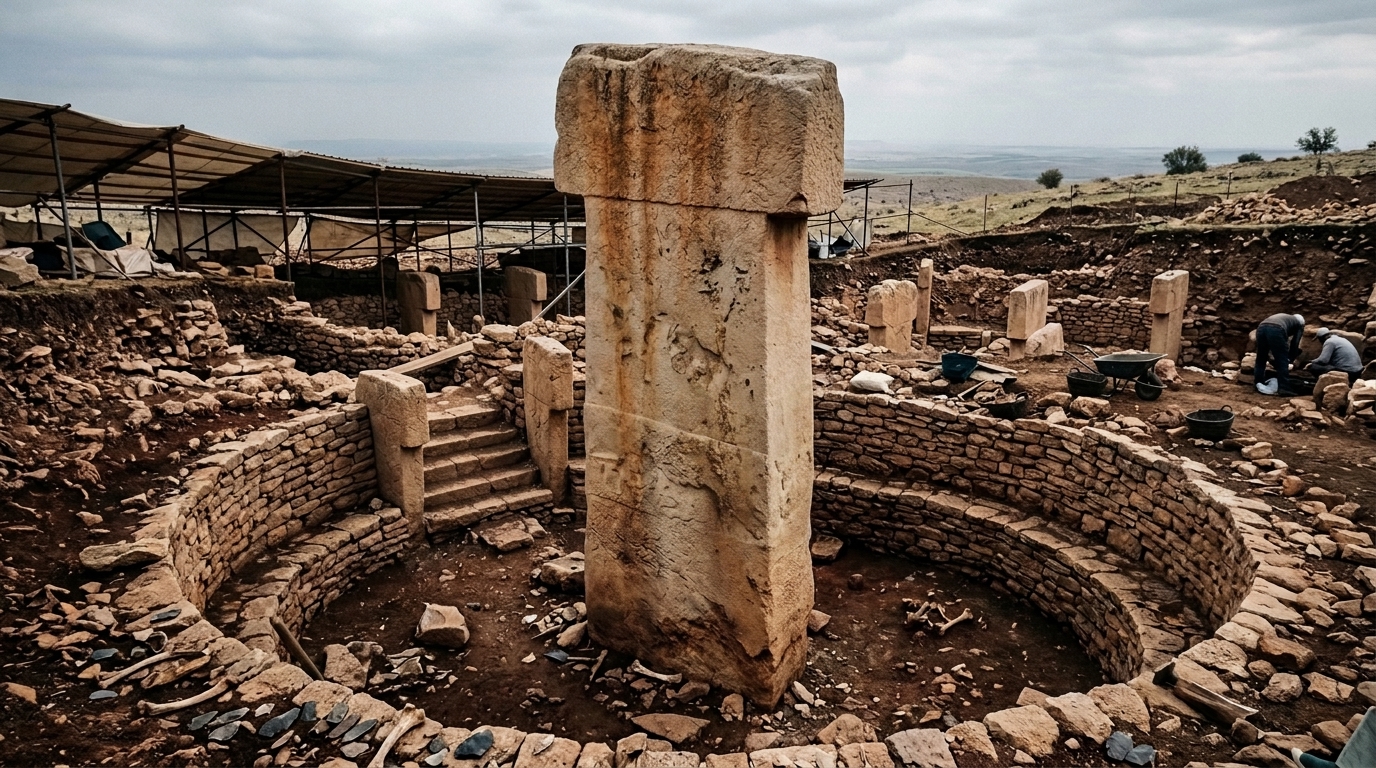
Gobekli Tepe
11,000-year-old megalithic temple complex challenges conventional timeline of human civilization and organized religion.
Sign in to bookmark, follow, and message the contributor.
Executive Summary
Göbekli Tepe, discovered in Turkey in 1994, is an archaeological site featuring massive carved stone pillars dated to approximately 9500 BCE—predating Stonehenge by 6,000 years and the invention of pottery, writing, and the wheel. The site's sophistication has forced archaeologists to reconsider the capabilities of pre-agricultural hunter-gatherer societies and the origins of organized religion.
- 01.Site's astronomical alignments suggest advanced celestial knowledge inconsistent with standard hunter-gatherer cognitive models.
- 02.Deliberate burial protocol circa 8000 BCE follows pattern observed at [REDACTED] other Neolithic sites across northern Mesopotamia.
- 03.Geophysical surveys indicate presence of subterranean chambers beneath Enclosure D; excavation postponed pending preservation technology.
The Hidden Truth
What the headlines won't tell you
Göbekli Tepe: The Temple That Rewrote Prehistory
In 1994, German archaeologist Klaus Schmidt began excavations at a hilltop in southeastern Turkey that would fundamentally challenge the established narrative of human development. Göbekli Tepe—"Potbelly Hill" in Turkish—revealed massive T-shaped limestone pillars arranged in circular enclosures, decorated with sophisticated carvings of animals and abstract symbols. Radiocarbon dating placed the oldest structures at approximately 9500 BCE, making them roughly 11,500 years old.
The discovery was revolutionary because it predated the advent of agriculture, pottery, metallurgy, and writing. According to prevailing archaeological theory, complex monumental architecture required settled agricultural societies with surplus food production and social stratification. Göbekli Tepe demonstrated that Neolithic hunter-gatherers possessed not only the organizational capacity to quarry, transport, and erect multi-ton stone pillars, but also the symbolic and possibly religious sophistication to create what appears to be humanity's oldest known temple complex.
The site has generated intense scholarly debate about the sequence of the Neolithic Revolution—whether monumental religious architecture preceded or followed the development of agriculture. Some researchers have proposed that Göbekli Tepe represents the birthplace of organized religion, while others suggest it may have been a gathering place for multiple hunter-gatherer groups. After nearly three decades of excavation, ground-penetrating radar indicates that less than 5% of the site has been uncovered, with at least 200 additional pillars still buried.
Background
For most of the 20th century, the standard archaeological narrative held that the Neolithic Revolution—humanity's transition from nomadic hunter-gatherer bands to settled agricultural communities—followed a predictable sequence. First came agriculture and animal domestication (circa 10,000 BCE in the Fertile Crescent), which produced food surpluses. These surpluses enabled permanent settlements, population growth, and social stratification. Only then, according to this model, could societies muster the resources and labor to construct monumental architecture and develop complex religious systems.
This sequence was codified by archaeologist V. Gordon Childe in the 1930s and remained largely unchallenged through the mid-20th century. The discovery of sites like Jericho (with its Pre-Pottery Neolithic tower dated to circa 8000 BCE) began to complicate the picture, but the basic framework persisted: civilization followed agriculture.
The Şanlıurfa region of southeastern Turkey lies within the northern arc of the Fertile Crescent, where wild ancestors of wheat, barley, and other domesticated crops grew naturally. American archaeologist Robert Braidwood conducted pioneering work in the region during the 1960s, identifying it as a probable center for early agriculture. In 1963, a University of Chicago and Istanbul University survey team noted unusual stone arrangements on a hilltop called Göbekli Tepe but dismissed them as medieval grave markers.
Klaus Schmidt, a German archaeologist who had worked on Neolithic sites in Turkey during the 1980s, revisited Göbekli Tepe in 1994 while working for the German Archaeological Institute. Unlike the 1963 surveyors, Schmidt immediately recognized the limestone slabs as worked prehistoric material. He obtained excavation permits and began systematic work in 1995—a project that would consume the remainder of his career until his death in 2014.
The Investigation
The Initial Excavations (1995–2000)
Schmidt's first seasons focused on Enclosure A, revealing two massive central T-shaped pillars approximately 5 meters tall, surrounded by a ring of smaller (but still monumental) pillars connected by stone walls. The pillars were not quarried blocks stacked atop each other but single pieces of limestone, carved in situ from bedrock outcrops approximately 100 meters from the main site, then transported and erected.
RADIOCARBON DATING (FACT): Organic material from the earliest architectural layer yielded dates between 9500 and 9000 BCE, placing construction in the Pre-Pottery Neolithic A period—before the emergence of pottery anywhere in the world. This was approximately 1,500 years before the earliest evidence of cultivated grain in the region.
The pillars bore elaborate carvings: foxes, boars, snakes, wild cattle (aurochs), gazelles, and birds, executed in raised relief with considerable artistic skill. Many pillars also displayed abstract symbols including H-shapes, crescents, and geometric patterns whose meaning remains unknown. Some pillars featured anthropomorphic characteristics—arms carved in relief along the narrow sides, with hands meeting at a belt on the "front" face—suggesting they represented stylized human figures.
The Labor Investment Problem
Engineering analysis has established that each of the largest pillars required quarrying, shaping, transporting, and erecting a limestone block weighing 10–20 tons using only stone tools. INFERENCE: Experimental archaeology suggests this would have required coordinated teams of 20–50 workers per pillar. With at least 200 pillars across 20+ enclosures, the total labor investment was enormous—especially for a supposedly "primitive" hunter-gatherer society.
Schmidt calculated that constructing even a single enclosure would have required hundreds of person-days of labor. The deliberate planning evident in the radial symmetry of the enclosures, the standardization of pillar shapes, and the quality of the stone carving all point to specialized craftspeople and sustained organizational capacity.
This raised a fundamental question: how did a pre-agricultural society mobilize, organize, and feed the necessary workforce? INFERENCE: The region's rich biodiversity during the early Holocene—gazelles, wild sheep, wild cattle, abundant edible plants—may have provided sufficient resources without agriculture. Excavations have yielded tens of thousands of animal bones, predominantly gazelle and aurochs, suggesting large-scale hunting and possibly seasonal feasting.
The Symbolic and Religious Dimension
From the beginning, Schmidt interpreted Göbekli Tepe as a ritual or ceremonial center rather than a domestic settlement. FACT: No evidence of permanent habitation has been found—no hearths, no living floors, no residential structures, no trash pits with domestic debris. The faunal remains consist almost entirely of wild game bones showing butchery marks consistent with communal feasting rather than daily meals.
The iconography carved on the pillars suggests sophisticated symbolic thought. Some researchers have identified astronomical alignments: SPECULATION: Enclosure D's central pillars may have been oriented toward the setting of Deneb in the constellation Cygnus circa 9500 BCE, though this interpretation is disputed. The repeated motifs—particularly dangerous animals (snakes, scorpions, predatory birds)—may represent totems, clan symbols, or spiritual forces.
INFERENCE: The absence of domestic indicators combined with the monumentality of the architecture suggests Göbekli Tepe served as a gathering place for dispersed hunter-gatherer groups—possibly for seasonal ceremonies, ancestor veneration, or initiation rituals. Schmidt proposed that the site represents the world's oldest temple, predating any known organized religion by millennia.
The Deliberate Burial Mystery
One of Göbekli Tepe's most intriguing aspects is how it ended. FACT: Around 8000 BCE, the enclosures were deliberately and carefully filled with debris—broken stone tools, animal bones, and thousands of cubic meters of soil and rubble. This was not gradual abandonment but intentional burial, preserving the structures for millennia.
WHY remains unanswered. SPECULATION ranges from religious transformation (the old gods replaced by new beliefs), to environmental change (regional climate shifts), to the rise of agriculture making the site obsolete, to conflict between groups. The burial was so thorough that it created the artificial hill that gave the site its name, protecting the structures from erosion and later disturbance.
Göbekli Tepe and the Origins of Agriculture
Schmidt advanced a controversial thesis: that Göbekli Tepe represented not a consequence of agriculture but a cause. INFERENCE: He suggested that the need to feed large gatherings of people at the ceremonial site may have incentivized the cultivation of wild grains, leading gradually to domestication. In this model, religion and ritual drove agricultural development, not the reverse.
Evidence for this theory includes: FACT: The earliest domesticated einkorn wheat has been genetically traced to the Karacadağ Mountains, approximately 30 km from Göbekli Tepe. FACT: Pre-domestication cultivation (gathering and replanting wild grains) appears in the archaeological record of the region shortly after Göbekli Tepe's construction. However, establishing causation versus correlation remains difficult.
Critics note that early agriculture appears at multiple locations across the Fertile Crescent during the same period, suggesting a broader regional development rather than a single-site catalyst. The relationship between Göbekli Tepe and agricultural origins remains an active area of research and debate.
The Wider Network of Neolithic Sites
Göbekli Tepe is not unique but the oldest and largest of a network of similar sites. FACT: At least 20 other Pre-Pottery Neolithic sites in the region feature T-shaped pillars, including Karahan Tepe, Harbetsuvan Tepesi, and Hamzan Tepe, most discovered in the 2000s and 2010s. These sites suggest a shared religious or cultural tradition across southeastern Anatolia during the 10th–9th millennia BCE.
Karahan Tepe, excavated beginning in 2019, features pillars with more elaborate anthropomorphic details—clearer human faces and bodies—suggesting either a later development or regional variation in style. INFERENCE: The distribution of these sites implies a network of interacting hunter-gatherer communities with shared symbolic systems, challenging models of isolated bands.
Modern Research and Technology
After Schmidt's death in 2014, Lee Clare of the German Archaeological Institute assumed directorship. Recent excavations have employed ground-penetrating radar, magnetometry, and 3D photogrammetry. FACT: Geophysical surveys indicate at least 16 additional enclosures still buried, with more than 200 pillars yet to be excavated. At the current pace, full excavation would require a century or more.
Recent discoveries include evidence of representational sculpture—small limestone figurines and the first near-complete three-dimensional human statues from the Pre-Pottery Neolithic. FACT: In 2010, excavators found a life-sized limestone sculpture of a boar, and in 2011, a possible phallic symbol carved on a pillar, suggesting fertility cult elements (though interpretation is debated).
Evidence Assessment
Established Facts
Radiocarbon dating to circa 9500 BCE
Multiple samples from organic material embedded in the oldest architectural layers have been radiocarbon dated by independent laboratories, consistently yielding dates between 9600 and 9000 BCE. These dates are among the most securely established in Neolithic archaeology.
Monumental T-shaped pillars
Hundreds of limestone pillars, many weighing multiple tons, carved into characteristic T-shapes with decorated surfaces, arranged in circular and oval enclosures. This is directly observable and photographically documented.
Pre-dates agriculture and pottery
The site's construction preceded the appearance of domesticated plants and animals in the region by 500–1,500 years, and predates pottery by approximately 1,000 years. This is established through comparative stratigraphy and the absence of domesticated species in faunal remains from the earliest layers.
Deliberate burial circa 8000 BCE
Stratigraphic evidence shows intentional filling of enclosures with debris, creating an artificial mound. This is distinguished from natural erosion by the careful packing of fill material and the preservation state of the structures.
Sophisticated stone carving
The quality of the relief carvings—detailed animal anatomy, compositional arrangement, consistent stylistic conventions—demonstrates advanced technical skill and artistic tradition.
Absence of domestic architecture
Despite three decades of excavation across a 9-hectare area, no structures indicative of permanent habitation have been found in the earliest layers, supporting interpretation as a non-residential ceremonial center.
Strong Evidence
Ritual/ceremonial function
The combination of monumental architecture, elaborate iconography, absence of habitation, and faunal evidence of large-scale feasting strongly suggests ceremonial use, though the specific nature of rituals remains inferential.
Labor organization by hunter-gatherers
The scale of construction demonstrates organizational capacity, though the specific social structures (temporary leadership, egalitarian cooperation, or hierarchical control) remain unknown.
Regional network of related sites
Discovery of 20+ contemporary sites with T-shaped pillars in southeastern Anatolia indicates a shared cultural tradition, though the nature of relationships between sites (hierarchy, peer network, or independent development) is unclear.
Large-scale animal processing
Tens of thousands of animal bones, predominantly wild game showing butchery marks, indicate episodic large-scale meat consumption consistent with communal feasting rather than daily subsistence.
Moderate Evidence
Astronomical alignments
Some researchers report correlations between pillar orientations and celestial bodies circa 9500 BCE, but these interpretations depend on which pillars are selected for analysis and what margin of error is accepted. Not all researchers agree on the significance of the proposed alignments.
Anthropomorphic pillar interpretation
The carved "arms" and "hands" on T-shaped pillars suggest stylized human figures, but whether they represent deities, ancestors, or abstract concepts remains interpretive.
Connection to agricultural origins
The geographical proximity to the genetic source of domesticated wheat and temporal overlap with pre-domestication cultivation suggests a possible relationship, but causation has not been established.
Weak Evidence
Specific iconographic meanings
While the carvings clearly depict recognizable animals and symbols, their specific meanings—whether totemic, mythological, astronomical, or territorial markers—are speculative.
Site function as "temple"
This term carries modern religious connotations that may not apply to Neolithic practice. "Ceremonial center" is more neutral, though the distinction is partly semantic.
Disputed Claims
Göbekli Tepe as catalyst for agriculture
Schmidt's theory that the site's labor demands drove grain cultivation is disputed by archaeologists who note multi-sited agricultural origins and question whether gathering for ceremonies would necessitate cultivation rather than intensive wild-resource exploitation.
Lost civilization or advanced ancient knowledge
SPECULATION by alternative archaeology authors that Göbekli Tepe represents a "lost civilization" with knowledge surpassing later cultures is rejected by mainstream archaeology. The site's sophistication reflects hunter-gatherer capabilities, not evidence of a vanished advanced society.
Unsupported Claims
Extraterrestrial involvement
Claims that the site's age and sophistication indicate alien contact lack any supporting evidence and contradict archaeological understanding of Neolithic technological development.
Connections to Atlantis or other mythical civilizations
Attempts to link Göbekli Tepe to Plato's Atlantis or other legendary lost civilizations are anachronistic and lack evidential support.
Advanced astronomical observatory
While some astronomical awareness is plausible, claims that Göbekli Tepe functioned as a sophisticated observatory comparable to much later structures are not supported by the archaeological evidence.
Credible Dissenting Voices
Dr. Trevor Watkins (Professor Emeritus, University of Edinburgh) has questioned whether Göbekli Tepe represents a unique "temple" or simply one example of widespread but poorly preserved Neolithic structures. He suggests that the site's apparent uniqueness may reflect preservation bias—limestone structures survive while contemporary wood-and-mud constructions have vanished—and cautions against over-interpreting a single site.
Dr. Marion Benz (University of Freiburg) and colleagues have argued that Göbekli Tepe may not represent a pure ceremonial center but rather a multifunctional site where ritual and domestic activities were not sharply separated. Their analysis of tool assemblages suggests more diverse activities than purely ritual use would imply.
Some archaeologists question the "religion causes agriculture" hypothesis, noting that hunter-gatherers worldwide have conducted elaborate ceremonies without developing agriculture, and that agricultural origins in the Fertile Crescent show a complex, multi-sited pattern that predates or is contemporary with (not subsequent to) Göbekli Tepe's construction.
Regarding astronomical interpretations, Dr. Giulio Magli (Politecnico di Milano) acknowledges possible solar orientations but cautions that selective interpretation of architectural alignments can produce spurious correlations with celestial events, especially when the full corpus of structures has not been excavated.
Legacy
Why It Still Matters
Göbekli Tepe has fundamentally altered understanding of the Neolithic Revolution. The site demonstrates that hunter-gatherer societies possessed the organizational capacity, technical skill, and symbolic sophistication to create monumental architecture—capabilities previously attributed exclusively to agricultural civilizations. This has prompted reassessment of social complexity in pre-agricultural societies worldwide.
The discovery has influenced debates about the origins of religion, suggesting that organized religious practice may predate (and possibly have catalyzed) the development of agriculture and settled life. This inverts the traditional materialist sequence and places symbolic and religious motivations at the center of the Neolithic transformation.
Göbekli Tepe has also become a touchstone in debates about archaeological interpretation. Mainstream archaeologists emphasize it as evidence of indigenous human ingenuity, while alternative archaeology authors cite it as proof of "lost advanced civilizations"—an interpretive conflict that reflects broader tensions about how to understand humanity's past.
Frequently Misunderstood Claims
CLAIM
"Göbekli Tepe proves mainstream archaeology wrong."
REALITY
The site challenged specific models of Neolithic development but was discovered, excavated, dated, and interpreted by mainstream archaeologists using standard scientific methods. It represents how archaeology refines understanding through new evidence, not a repudiation of archaeological science.
CLAIM
"The site is 12,000 years old."
REALITY
Construction began circa 9500 BCE (approximately 11,500 years ago as of 2024). Some popular sources round to 12,000, but the radiocarbon dates are more precise.
CLAIM
"Hunter-gatherers couldn't have built Göbekli Tepe."
REALITY
The archaeological evidence clearly shows they did. The question is not whether but how—what organizational structures, labor mobilization methods, and motivations enabled construction.
Important Quotes
Klaus Schmidt (2010): "Göbekli Tepe is a plateau-like hilltop sanctuary where hunters from a wide region gathered at intervals. It was first built, and only then did people settle down in villages to make sure that there would be enough food for those who came to work here and celebrate rituals."
Andrew Curry, National Geographic (2008): "Göbekli Tepe could turn back the clock on the whole development of civilization, forcing archaeologists to rethink the notion that humans needed to settle down into farming communities before they could create complex culture."
Jens Notroff, German Archaeological Institute (2016): "We have to accept that hunter-gatherers were perfectly capable of complex social organization and cultural achievements without domestication and sedentism. Göbekli Tepe forces us to reconsider what we thought we knew about so-called primitive societies."
Research Leads and Future Discoveries
With an estimated 95% of Göbekli Tepe still unexcavated, major discoveries remain likely. Ground-penetrating radar has identified at least 16 additional enclosures, some potentially larger than those already excavated. The German Archaeological Institute has adopted a long-term, slow-excavation strategy prioritizing preservation and documentation over speed.
Key open research questions include: the site's relationship to the network of similar sites across southeastern Anatolia; the social organization of the builder communities; the meaning of the iconographic program; the reasons for deliberate burial; and the site's connection (if any) to the subsequent development of agriculture.
Excavations at related sites—particularly Karahan Tepe, where more anthropomorphic sculpture has been found—may provide comparative context. Genetic analysis of domesticated crop origins continues to refine understanding of the agricultural transition. Advanced dating techniques may narrow the chronology of different construction phases.
Confidence Assessment
Göbekli Tepe is among the best-documented Neolithic sites in the world, with peer-reviewed radiocarbon dates, detailed architectural documentation, and three decades of systematic excavation by credentialed archaeologists. The basic facts—age, scale, pre-agricultural context—are established beyond reasonable dispute. However, interpretation of the site's function, meaning, and historical significance remains contested within legitimate scholarly debate. The iconography's meaning, the social structures of the builders, and the site's role in agricultural origins all involve inference from material evidence. With 95% of the site unexcavated, future discoveries may substantially revise current understanding. The archaeological record here is robust but incomplete, and honest uncertainty remains about many important questions.
Case Timeline
- 9600ACADEMICApproximate beginning of construction at Göbekli Tepe based on radiocarbon datingRadiocarbon dates from organic materials in the lowest layers provide the 9600 BCE timeframe, published in peer-reviewed archaeological journals.
- 9500ACADEMICEarliest securely dated structures (Enclosure C and others) erected by Pre-Pottery Neolithic A communitiesMultiple radiocarbon samples from Enclosure C and associated structures were analyzed and published in Antiquity Journal and other peer-reviewed sources.
- 9000ACADEMICConstruction of later enclosures (Enclosure D and others); refinement of carving techniquesArchaeological stratigraphy shows stylistic evolution in pillar design and carving techniques between earlier and later construction phases.
- 8500ACADEMICContinued use of the site; evidence of ongoing pillar erection and ritual activityArchaeological deposits from this period contain animal bones, stone tools, and evidence of repeated human activity consistent with ongoing ritual use.
- 8000ACADEMICDeliberate burial of enclosures with debris; site abandonment; onset of Pre-Pottery Neolithic B periodStratigraphic evidence shows the enclosures were intentionally filled with quarry debris and settlement waste rather than gradually accumulating sediment.
- 1963ACADEMICUniversity of Chicago and Istanbul University survey team notes stone arrangements but misidentifies as ByzantineThe survey team catalogued the visible stones but concluded they were remnants of a medieval cemetery, as documented in their published survey report.
- 1994CORROBORATEDKlaus Schmidt visits site and recognizes prehistoric significance; obtains excavation permitSchmidt recognized the T-shaped pillars as characteristic of Pre-Pottery Neolithic architecture after visiting based on a tip from a local shepherd.
- 1995ACADEMICSystematic excavation begins under Schmidt and German Archaeological InstituteThe German Archaeological Institute partnership provided institutional support and funding for what would become nearly three decades of continuous excavation.
- 2000ACADEMICFirst major publications establish site's age and Pre-Pottery Neolithic contextSchmidt's publications in archaeological journals established the site's revolutionary implications for understanding Neolithic social complexity.
- 2006ACADEMICDiscovery of Enclosure D with elaborate animal carvings brings international attentionEnclosure D contains over 40 animal reliefs including foxes, snakes, and birds carved in high relief on the pillars' surfaces.
- 2008CREDIBLE REPORTINGNational Geographic cover story introduces Göbekli Tepe to broad public audienceThe National Geographic article by Andrew Curry reached millions of readers and dramatically increased public awareness of the site's significance.
- 2010ACADEMICLife-sized limestone boar sculpture discoveredThe limestone boar sculpture, measuring approximately one meter in length, represents one of the earliest known examples of three-dimensional animal sculpture.
- 2011ACADEMICGround-penetrating radar surveys identify at least 16 additional buried enclosuresGround-penetrating radar and magnetic surveys revealed circular anomalies consistent with buried stone structures across the hilltop.
- 2014CORROBORATEDKlaus Schmidt dies; Lee Clare assumes directorshipSchmidt's unexpected death ended his 19-year directorship; Clare continued the excavation methodology while expanding scientific analysis techniques.
- 2018GOVERNMENT RECORDUNESCO designates Göbekli Tepe a World Heritage SiteUNESCO recognition acknowledged Göbekli Tepe's outstanding universal value as evidence of early monumental architecture and symbolic expression.
- 2019ACADEMICExcavations begin at nearby Karahan Tepe revealing network of related sitesKarahan Tepe, located 35 kilometers from Göbekli Tepe, features similar T-shaped pillars suggesting a regional tradition of monumental construction.
- 2021ACADEMICNew dating refines construction chronology; 3D documentation project launchedAdvanced radiocarbon techniques and Bayesian modeling refined the construction sequence and duration of site use documented in peer-reviewed publications.
- 2024CORROBORATEDOngoing excavations continue; estimated 5% of site excavated; international research collaborations expandCurrent estimates suggest complete excavation would require over a century at present pace, with preservation concerns limiting excavation speed.
Key People
Organizations
Evidence Library
- physicalPHY-GT1T-Shaped Limestone Pillars
More than 200 identified T-shaped pillars, up to 5 meters tall and weighing 10–20 tons, carved from single pieces of limestone and erected in circular enclosures. Many feature relief carvings of animals and abstract symbols. Direct physical evidence of monumental Pre-Pottery Neolithic architecture.
- dataDATA-C14Radiocarbon Dating Results (1995–2020)
Multiple radiocarbon dates from organic material in architectural contexts consistently place earliest construction between 9600–9000 BCE. Performed by independent laboratories using AMS dating. Establishes site chronology and Pre-Pottery Neolithic A attribution.
- physicalPHY-FAUNAFaunal Assemblage
Tens of thousands of animal bones from excavated layers, predominantly gazelle (40%) and aurochs (30%), all wild species showing butchery marks consistent with large-scale meat processing. Absence of domesticated species in earliest layers confirms pre-agricultural context.
- documentDOC-DAISchmidt's Excavation Reports (German Archaeological Institute)
Annual excavation reports published by the German Archaeological Institute documenting findings, stratigraphy, and architectural details from 1995–2014. Primary documentation of site characteristics and excavation methodology.
- dataDATA-GPRGround-Penetrating Radar Surveys (2011–2014)
Geophysical surveys using magnetometry and ground-penetrating radar identified at least 16 additional circular enclosures and more than 200 buried pillars. Establishes that approximately 95% of site remains unexcavated and indicates broader scope of construction.
- physicalPHY-CARVLimestone Relief Carvings
Hundreds of carved animal figures in raised relief on pillars: foxes, boars, snakes, aurochs, cranes, ducks, scorpions, and spiders. Also abstract symbols (H-shapes, crescents, geometric patterns). Demonstrates sophisticated artistic tradition and symbolic system.
- otherSTRAT-BURStratigraphic Evidence of Deliberate Burial
Archaeological stratigraphy shows intentional filling of enclosures with debris circa 8000 BCE—carefully packed soil, broken tools, and animal bones creating artificial mound. Distinguished from erosion by depositional patterns and preservation of structures.
- documentDOC-PEERPeer-Reviewed Publications (2000–2024)
More than 150 peer-reviewed articles in journals including Antiquity, Paléorient, Neo-Lithics, and Zeitschrift für Orient-Archäologie analyzing architecture, chronology, iconography, and regional context. Establishes scholarly consensus on basic site characteristics.
Evidence Gallery

Sources
Trace the trail yourself
Investigation Network

Live Discussion
0 Perspectives
Add to the record. Be specific. Cite where you can.
If you're learning about this topic for the first time, these are the best places to continue — documented evidence and historical relationships are the guide.
Named in “Gobekli Tepe”.
Read more dossiers like this
Get a quiet one-line bulletin when new investigative files are published. Bound to this dossier — useful for tracking follow-ups.