
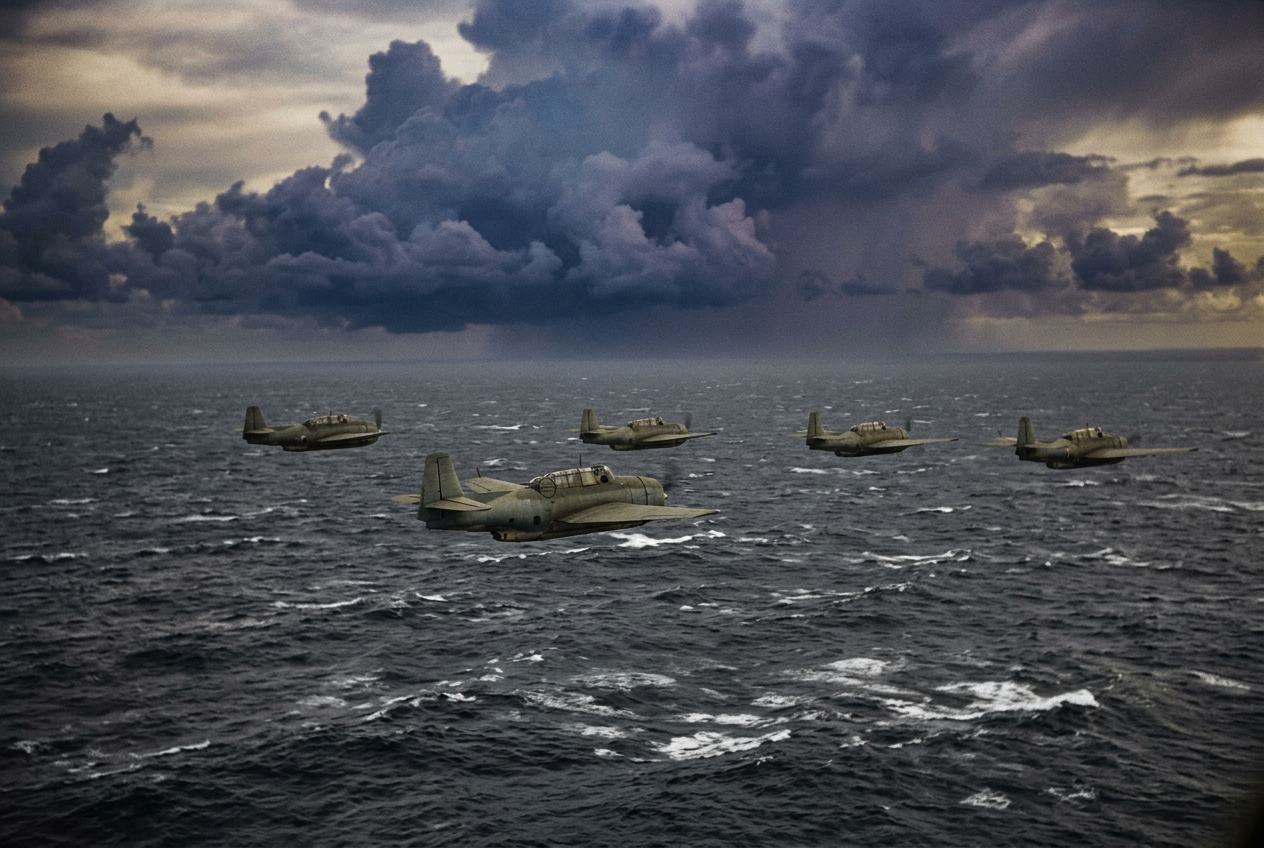
Flight 19: The Lost Squadron and the Birth of the Bermuda Triangle Myth
Five Navy bombers vanished off Florida in 1945. Radio transcripts point to disorientation and rough seas—but missing wreckage fueled decades of supernatural speculation.
Sign in to bookmark, follow, and message the contributor.
Executive Summary
Five Navy bombers vanished off Florida in 1945. Radio transcripts point to disorientation and rough seas—but missing wreckage fueled decades of supernatural speculation. On December 5, 1945, five TBM Avenger torpedo bombers—Flight 19—departed Naval Air Station Fort Lauderdale on a routine navigation drill. Fourteen men aboard: flight leader Lt. Charles C. Taylor and thirteen student aviators. The mission: fly east, practice bombing, return. Within hours, all five vanished. That evening, a PBM Mariner search plane with thirteen crew disappeared during the search. Total lost: 27 men. Despite one of the Navy's most extensive searches, no wreckage from Flight 19 was ever confirmed. The incident might have remained a footnote in military records—until the 1960s, when it became the centerpiece of Bermuda Triangle lore, transforming probable navigation error into one of aviation's most famous mysteries.
The Hidden Truth
What the headlines won't tell you
Radio transcripts document the deterioration: Taylor reports compass trouble around 15:40–16:00, expresses position uncertainty, debates direction with other pilots, and leads the flight on a heading consistent with flying farther out to sea. Weather reports confirm deteriorating conditions and rough seas—hazardous for night ditching and explaining the absence of survivors or debris. The Navy Board of Inquiry, despite ruling cause initially 'unknown' (later amended under family pressure), had full communications access and concluded navigation error compounded by adverse weather. The PBM loss is well-documented: these aircraft were nicknamed 'flying gas tanks,' and the SS Gaines Mills provided eyewitness evidence of an explosion consistent with fuel system failure. The mystery case rests on absence: no wreckage, no bodies, no debris, despite extensive searches. Taylor was experienced—over 2,500 flight hours—raising questions about how he became so lost in training waters. Some radio operators claimed transmissions after the official last contact (19:04), suggesting longer flight time. Multiple salvage operations claim Flight 19 discoveries; none confirmed by the Navy. The Board's initial 'causes or reasons unknown' finding is sometimes cited as official bafflement. However: radio transcripts show an explicable sequence, 1945 ocean search technology was limited, Taylor was new to this area (recently transferred from Florida Keys), and 'unknown' reflected bureaucratic caution, not supernatural acknowledgment. Where exactly did Flight 19 crash? Nearly 80 years without confirmed wreckage is puzzling, though not unprecedented for 1940s ocean losses. Why did Taylor become disoriented—actual compass failure or landmark misidentification in poor visibility? Were there radio transmissions after 19:04, and what did they contain? Why did the Board initially rule cause 'unknown' before amendments? How much did 1960s–70s Bermuda Triangle popularization distort understanding of what was likely a tragic but explicable accident?
Case Timeline
- 1945-12-05Flight 19 departs NAS Fort Lauderdale at 14:10 EST with 5 TBM Avengers and 14 crew for routine training mission
- 1945-12-05Approximately 15:40-16:00, Lt. Taylor reports compasses malfunctioning, believes he is over Florida Keys (likely actually over Bahamas)
- 1945-12-05Flight 19 instructed to fly west toward Florida; Taylor concerned about flying west into Gulf of Mexico
- 1945-12-05Last definitive radio contact approximately 19:04; transmissions indicate deteriorating weather, low fuel
- 1945-12-05PBM Mariner Training 49 dispatches from NAS Banana River to search; disappears approximately 19:27
- 1945-12-05SS Gaines Mills reports seeing explosion and observing widespread oil slick at 19:50, position consistent with PBM flight path
- 1945-12-06Massive search operation begins involving Navy and Coast Guard aircraft and vessels
- 1945-12-10Search operations conclude without finding wreckage of Flight 19
- 1946Navy Board of Inquiry initially attributes loss to 'causes or reasons unknown'
- 1946After appeal by Taylor's mother, findings amended to blame 'physical causes' rather than pilot error, but evidence points to navigation mistakes
- 1964Vincent Gaddis publishes 'The Deadly Bermuda Triangle' in Argosy magazine, popularizing the mystery and linking Flight 19 to pattern of disappearances
- 1974Charles Berlitz publishes 'The Bermuda Triangle,' bestselling book that amplifies Flight 19 mystery and makes incident internationally famous
Key Players
Editorial pass pending.
Evidence Library
Structured evidence pass pending.
Sources
Trace the trail yourself
Editorial pass pending.
Live Discussion
0 Perspectives
Add to the record. Be specific. Cite where you can.
If you're learning about this topic for the first time, these are the best places to continue — documented evidence and historical relationships are the guide.
Read more dossiers like this
Get a quiet one-line bulletin when new investigative files are published. Bound to this dossier — useful for tracking follow-ups.